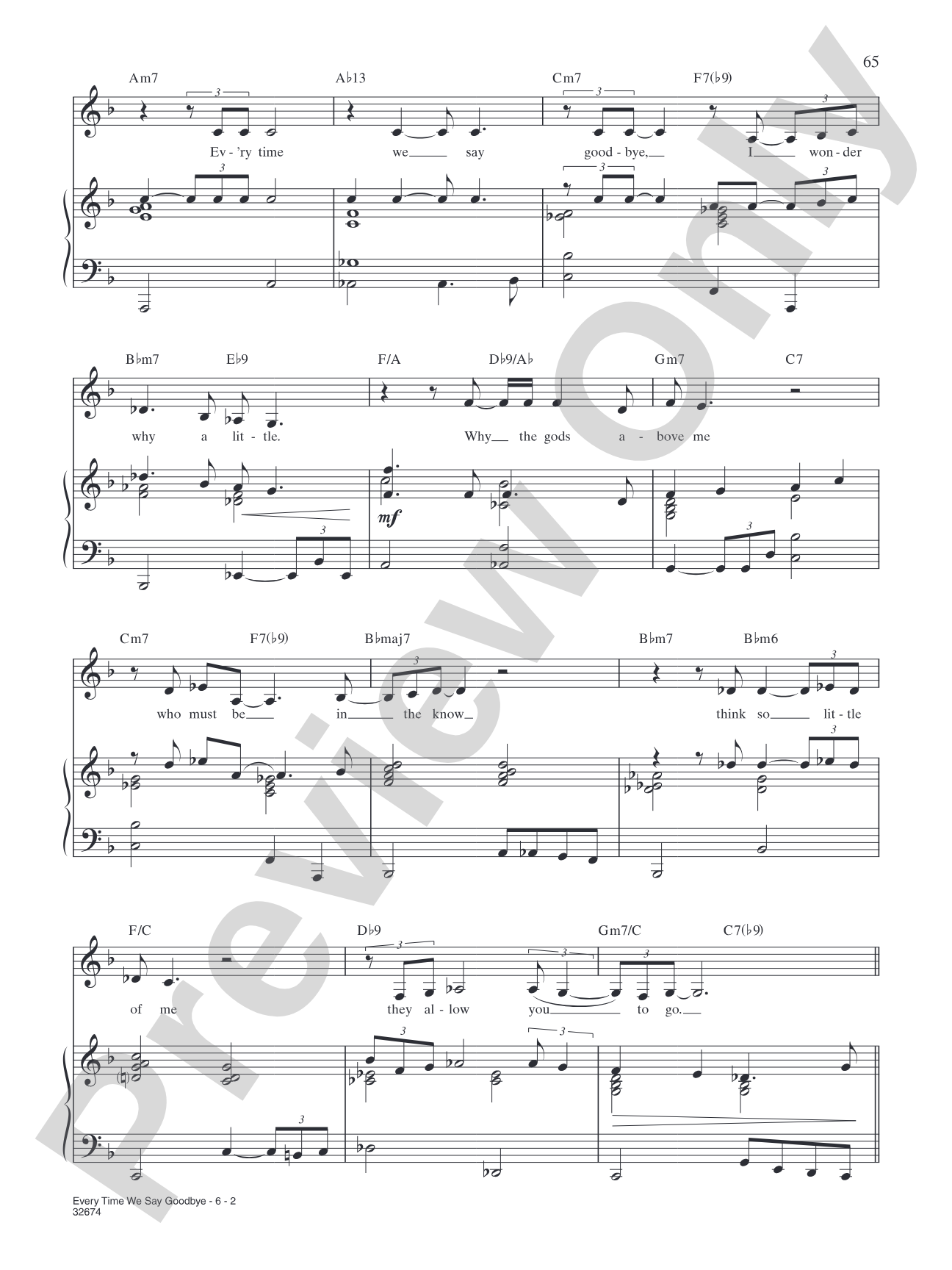
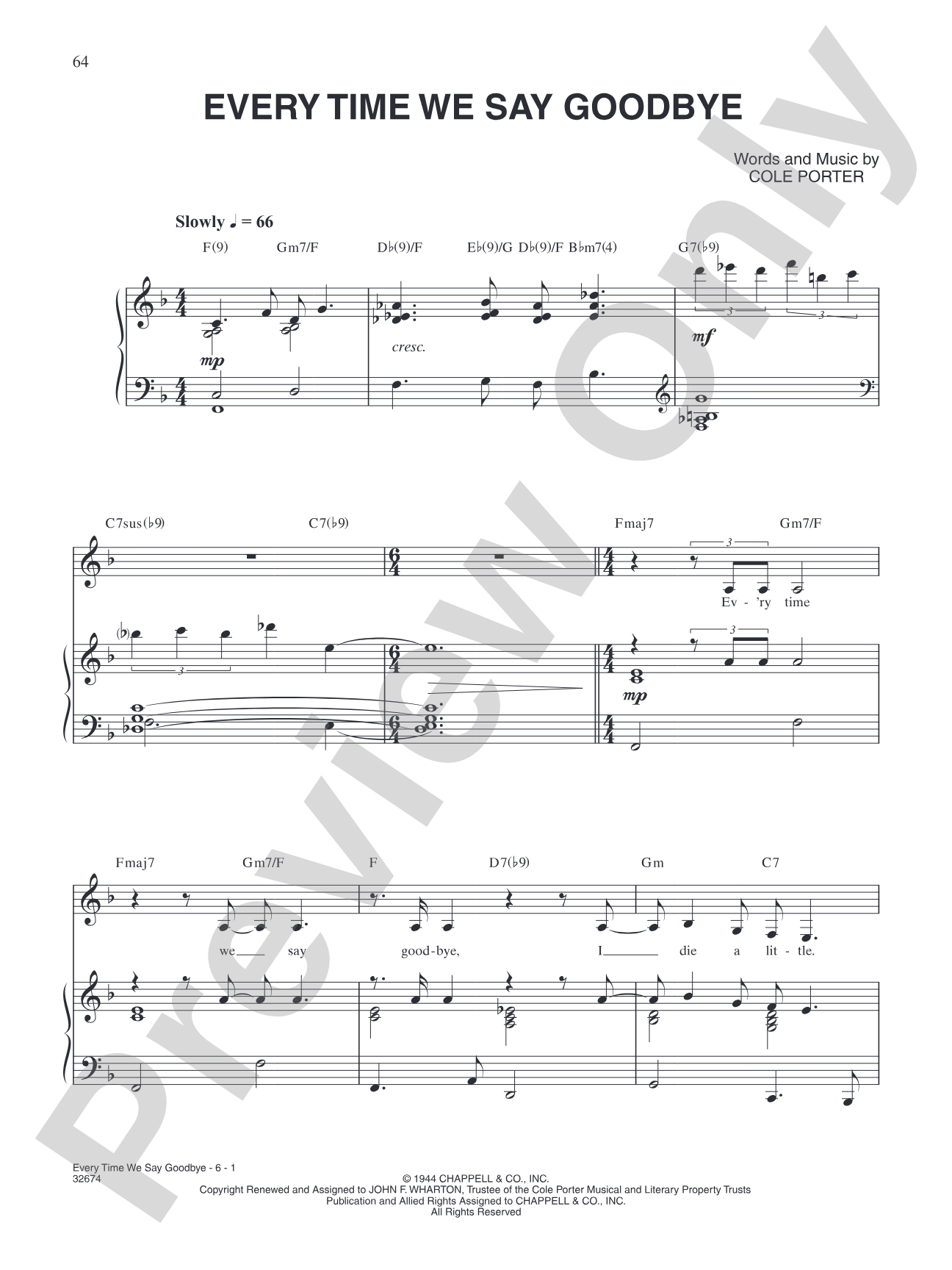
Ev'ry Time We Say Goodbye Sheet Music Preview

Ev'ry Time We Say Goodbye: Piano/Vocal/Chords

Diana Krall

Item: 00-PS-0010824

Digital Download
$5.99

One moment…

Description
The titles inside the Quiet Nights songbook are unnerving in their intimacy from the soul-stilling rendition of "You're My Thrill" to the inspirational version of "Where or When." The twelfth album released by Diana Krall pushes her familiar breathy contralto vocals into the realm of sweet surrender with a Brazilian-influenced flare. Titles: The Boy from Ipanema * Este Seu Olhar * Every Time We Say * Goodbye * Guess I'll Hang My Tears Out to Dry * How Can You Mend a Broken Heart * I've Grown Accustomed to His Face * Quiet Nights * So Nice * Too Marvelous for Words * Walk on By * Where or When * You're My Thrill.

Ev'ry Time We Say Goodbye: Piano/Vocal/Chords isn't in MakeMusic Cloud just yet...but it could be. Let us know you'd like to see it, and you'll help shape what comes next. In the meantime, start a free trial and dive into thousands of interactive titles your students can play along with today.

Sample Audio
No sample audio found.
Sample Video
Additional Details
Publisher: Alfred Music
Page Count: 76
SKU: 00-PS-0010824

More about this title

About the Composer: Cole Porter

Cole Porter (1891-1964) stands as one of American musical theater's most sophisticated composers and lyricists. His catalog spans decades of Broadway and film scores, from "Anything Goes" to "Kiss Me, Kate," marked by witty, urbane lyrics and melodies that balance accessibility with harmonic complexity. Porter's influence extends far beyond his era; his songs remain central to the jazz and pop vocal repertoire, recorded countless times across genres and styles.

Why we love this

This collection captures Porter's elegant approach to melody and harmony in a setting that reveals how these standards continue to sustain singers and pianists. The piano/vocal/chord format makes the writing immediately useful for studio work, recitals, or ensemble arrangements, while the songs themselves demonstrate why Porter's catalog endures across generations of vocalists.

What to expect

These songs inhabit a space of bittersweet reflection and sophisticated restraint. Porter's melodies move with conversational ease while his harmonies deepen the emotional landscape, creating room for intimate vocal delivery and sensitive accompaniment that honors both the lyrical content and the musical elegance underlying each phrase.

Who it's for

Vocalists developing their jazz and standards repertoire, pianists building their collaborative and solo performance skills, and music students studying American songwriting craft. The digital format and comprehensive chord notation make it accessible for singers working with accompanists in studio, recital, or rehearsal settings.

How to get the most out of it

  • Pay attention to Porter's harmonic sophistication; these songs reward clear voicing in the piano part, especially during moments where the harmony shifts beneath a held vocal line.
  • Balance the breathy, intimate vocal quality with precise rhythmic clarity in the accompaniment; the conversational ease of these standards can obscure the need for solid timekeeping.
  • Explore the Brazilian-influenced textures in pieces like "Quiet Nights" and "The Boy from Ipanema," allowing the rhythmic character to inform both the piano's touch and the vocalist's phrasing.
  • Use chord symbols to inform improvisation and reharmonization during interludes; Porter's standards invite creative interpretation while maintaining the song's essential character.

How to use it

Feature individual songs in jazz or cabaret-style recitals where the intimate scope and harmonic richness can be fully realized. The collection works equally well for singers preparing audition material or for pianists seeking substantial solo and collaborative repertoire that demonstrates both technical facility and musical maturity.

Skills your students will build

  • Reading and interpreting jazz chord symbols and harmonic extensions
  • Balancing accompaniment texture with solo vocal lines
  • Understanding Porter's melodic and harmonic language as foundation for jazz and standards interpretation
  • Sight-reading fluency in piano/vocal score format
  • Collaborative listening and ensemble balance between voice and piano

You May Also Like