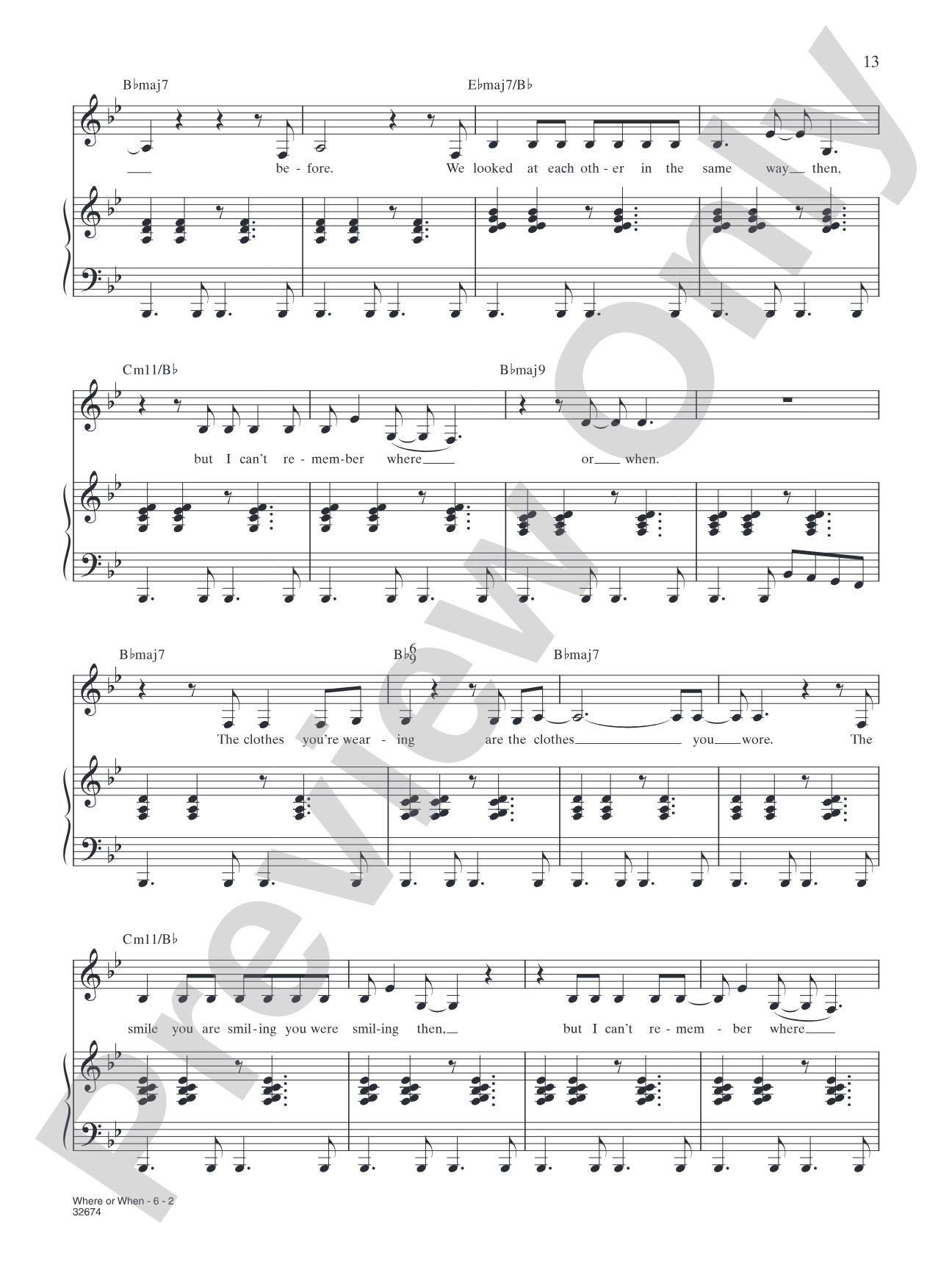
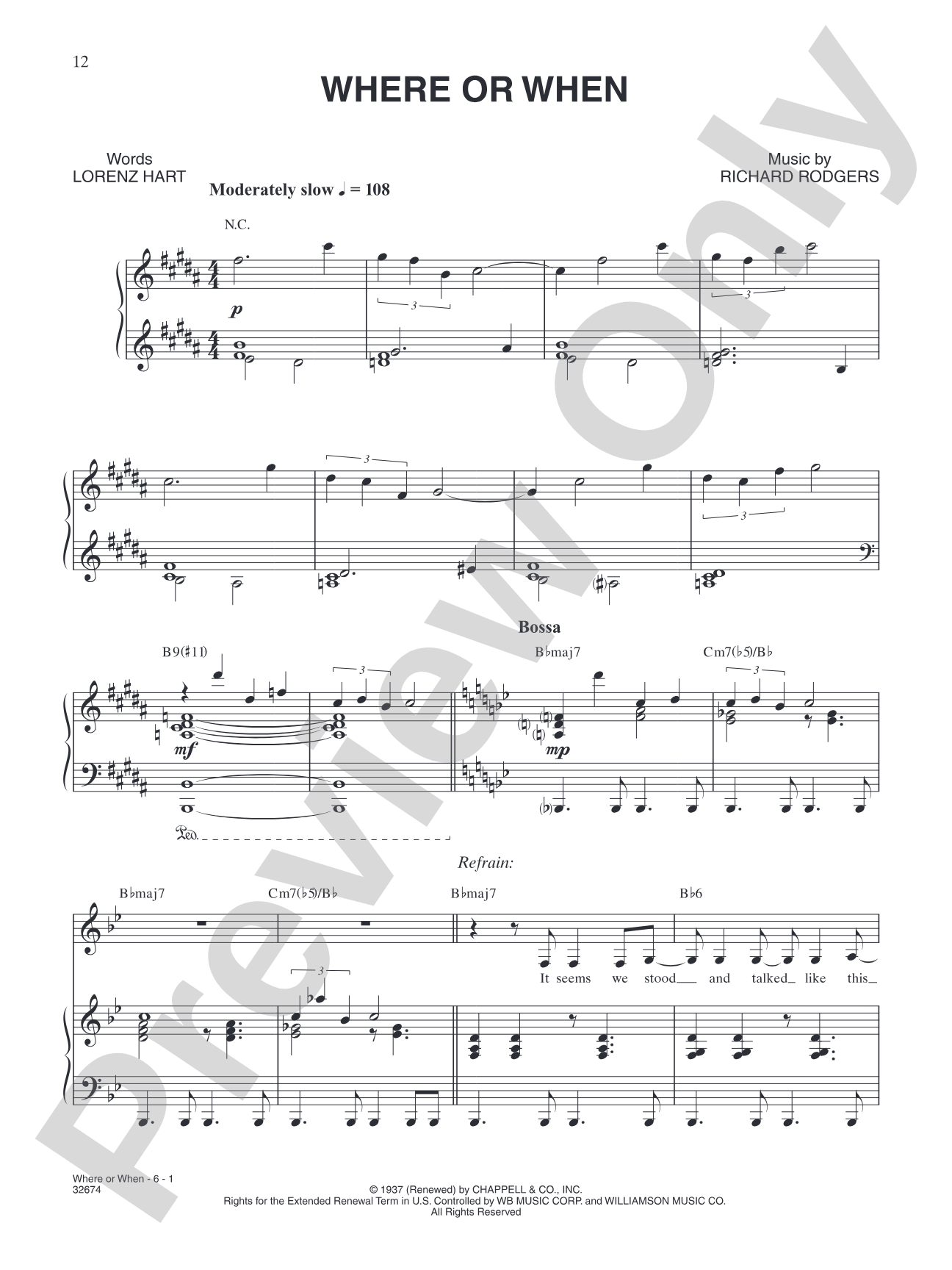
Where or When (from "Babes In Arms") Sheet Music Preview

Where or When (from "Babes In Arms"): Piano/Vocal/Chords

Diana Krall

Item: 00-PS-0010836

Digital Download
$5.99

One moment…

Description
The titles inside the Quiet Nights songbook are unnerving in their intimacy from the soul-stilling rendition of "You're My Thrill" to the inspirational version of "Where or When." The twelfth album released by Diana Krall pushes her familiar breathy contralto vocals into the realm of sweet surrender with a Brazilian-influenced flare. Titles: The Boy from Ipanema * Este Seu Olhar * Every Time We Say * Goodbye * Guess I'll Hang My Tears Out to Dry * How Can You Mend a Broken Heart * I've Grown Accustomed to His Face * Quiet Nights * So Nice * Too Marvelous for Words * Walk on By * Where or When * You're My Thrill.

Where or When (from "Babes In Arms"): Piano/Vocal/Chords isn't in MakeMusic Cloud just yet...but it could be. Let us know you'd like to see it, and you'll help shape what comes next. In the meantime, start a free trial and dive into thousands of interactive titles your students can play along with today.

Sample Audio
No sample audio found.
Sample Video
Additional Details
Publisher: Alfred Music
Page Count: 76
SKU: 00-PS-0010836

More about this title

About the Composer: Richards Rodgers

Richard Rodgers (1902-1979) shaped American musical theater through his collaboration with lyricist Lorenz Hart and later Oscar Hammerstein II. His melodic gift produced some of the most enduring standards in the Great American Songbook, including works from "Babes in Arms," "The King and I," and "The Sound of Music." Rodgers' ability to write singable, memorable melodies with sophisticated harmonic underpinnings made his songs ideal for both theatrical performance and jazz interpretation.

For music educators, Rodgers' catalog offers an essential resource for teaching jazz phrasing, harmonic analysis, and the relationship between melody and accompaniment. His standards continue to challenge and inspire singers across genres, from classical vocalists exploring jazz interpretation to contemporary jazz musicians discovering new depths in familiar material.

Why we love this

This arrangement captures the vulnerability that made Diana Krall's "Quiet Nights" album resonate so deeply. The piano voicings and chord charts provide enough specificity to guide interpretation while leaving room for a singer's own emotional arc through this introspective standard.

What to expect

Tender and introspective, "Where or When" unfolds like a memory surfacing unexpectedly. The melody lingers in familiar territory while the harmonies shift underneath, creating subtle emotional complexity that draws listeners into intimate reflection.

Who it's for

Singers preparing jazz standards for recital or audition, whether in classical voice studios exploring cross-genre repertoire or in jazz vocal ensembles. Pianists accompanying jazz singers will find clear guidance in the chord charts and voicings.

How to get the most out of it

  • Approach the rubato conversationally; let the lyrical phrases breathe rather than locking strictly to the piano rhythm. This matches the intimate quality of Krall's recording.
  • Observe the chord extensions and alterations carefully—they create the sophisticated harmonic landscape that distinguishes this arrangement from simpler lead sheet versions.
  • Balance the vocal line so it floats above the accompaniment without overwhelming it. The song's power lies in restraint, not volume.
  • Use the piano voicings as a roadmap for phrasing; the harmonic movement often suggests where to shape and release phrases.

How to use it

Include this arrangement in a program exploring jazz standards within a classical recital context, or feature it as part of a jazz vocalist showcase. It pairs well with other standards from the "Quiet Nights" collection for a thematic evening of introspective, Brazilian-influenced interpretations.

Skills your students will build

  • Interpreting jazz chord symbols and extended harmonies
  • Singing with restrained dynamics and conversational phrasing
  • Collaborating between vocalist and accompanist to balance transparency with expression
  • Understanding how harmonic sophistication supports emotional storytelling in vocal music

You May Also Like