
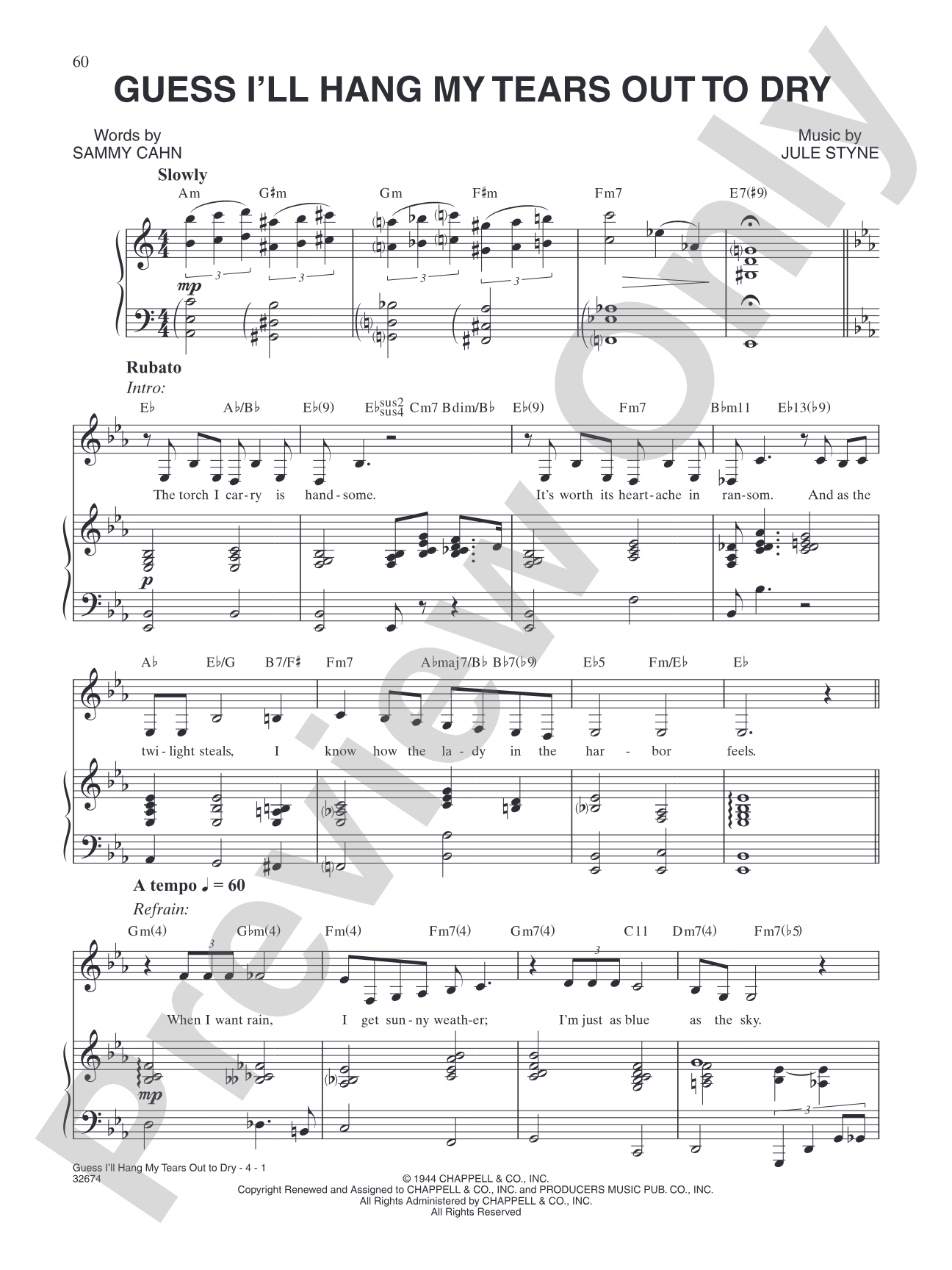

Guess I'll Hang My Tears Out to Dry: Piano/Vocal/Chords
Diana Krall
Item: 00-PS-0010832
$4.99
One moment…
Description
The titles inside the Quiet Nights songbook are unnerving in their intimacy from the soul-stilling rendition of "You're My Thrill" to the inspirational version of "Where or When." The twelfth album released by Diana Krall pushes her familiar breathy contralto vocals into the realm of sweet surrender with a Brazilian-influenced flare. Titles: The Boy from Ipanema * Este Seu Olhar * Every Time We Say * Goodbye * Guess I'll Hang My Tears Out to Dry * How Can You Mend a Broken Heart * I've Grown Accustomed to His Face * Quiet Nights * So Nice * Too Marvelous for Words * Walk on By * Where or When * You're My Thrill.


Guess I'll Hang My Tears Out to Dry: Piano/Vocal/Chords isn't in MakeMusic Cloud just yet...but it could be. Let us know you'd like to see it, and you'll help shape what comes next. In the meantime, start a free trial and dive into thousands of interactive titles your students can play along with today.
Request This Title
Tell us you want it.
Start Your Free Trial
Explore everything that's ready to play right now.
Sample Audio
No sample audio found.
Sample Video
No sample videos found.
Additional Details
Publisher:
Alfred Music
Page Count:
76
SKU:
00-PS-0010832
More about this title
About the Composer: July Styne
Jule Styne (1905-1994) was a prolific composer whose career spanned Broadway, film, and popular song. Born in London and raised in Chicago, Styne became one of the most recorded composers of the mid-twentieth century, collaborating with lyricists including Sammy Cahn, Stephen Sondheim, and Adolph Green. His melodies are marked by singability and emotional directness, qualities that made his work a staple of jazz interpretation and vocal performance.
Styne's gift for writing memorable, expressive lines suited to the human voice made him essential to the Great American Songbook. Singers from Ella Fitzgerald to modern interpreters like Diana Krall have returned repeatedly to his catalog, finding in pieces like "Guess I'll Hang My Tears Out to Dry" the kind of harmonic sophistication and emotional clarity that rewards both intimate performance and careful study.
Why we love this
This is a curated selection from Diana Krall's Quiet Nights album, capturing some of the most lyrical and harmonically rich material Styne composed for singers. The arrangements preserve the sultry, introspective quality of her interpretations while remaining accessible for classroom or studio work. Pianists and vocalists will appreciate how these pieces demand control, phrasing sensitivity, and an understanding of jazz harmony without overwhelming technical requirements.
What to expect
These songs breathe with the kind of unhurried elegance associated with late-night jazz clubs and intimate performance spaces. The harmonic language is warm and occasionally bittersweet, inviting performers to explore the emotional nuance beneath what might first appear as straightforward melody.
Who it's for
Pianists who work with vocalists in studio, recital, or classroom settings will find these arrangements essential. The lead sheet format serves singers preparing solo repertoire as well as jazz educators introducing standards and harmonic analysis to intermediate and advanced students.
How to get the most out of it
- Balance the vocal line against the piano voicings rather than playing beneath the melody; these songs reward a conversational relationship between voice and accompaniment.
- Pay attention to the chord symbols and explore substitutions and reharmonizations once you've mastered the lead sheet changes.
- Shape phrases around lyrical content, allowing the text to inform rubato and dynamic shaping rather than playing metronomically.
- Listen to Krall's recorded interpretations for phrasing and breath placement ideas, then develop your own approach based on your instrument and range.
How to use it
Include selections from this collection in a jazz standards recital, or use individual pieces to teach harmonic analysis and voice-leading to pianists and theory students. The accessible difficulty level makes these suitable for studio performance exams or informal concert settings where emotional connection matters more than technical pyrotechnics.
Skills your students will build
- Reading and interpreting chord symbols and jazz voicings
- Balancing ensemble voicing with the lead melody
- Lyric-driven phrasing and expressive control
- Harmonic analysis of standards and jazz composition
- Accompanying singers with appropriate dynamic and textural support