
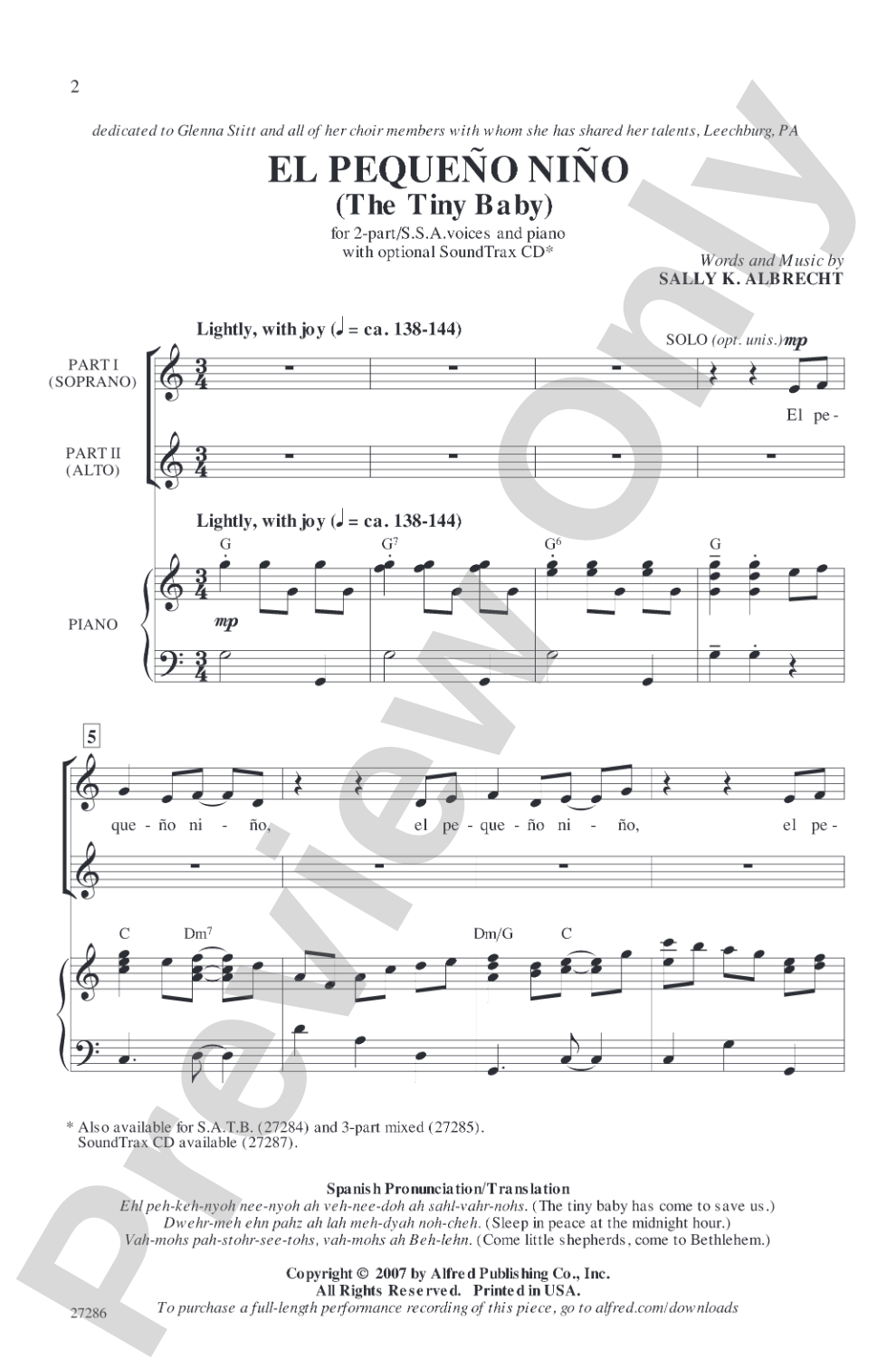
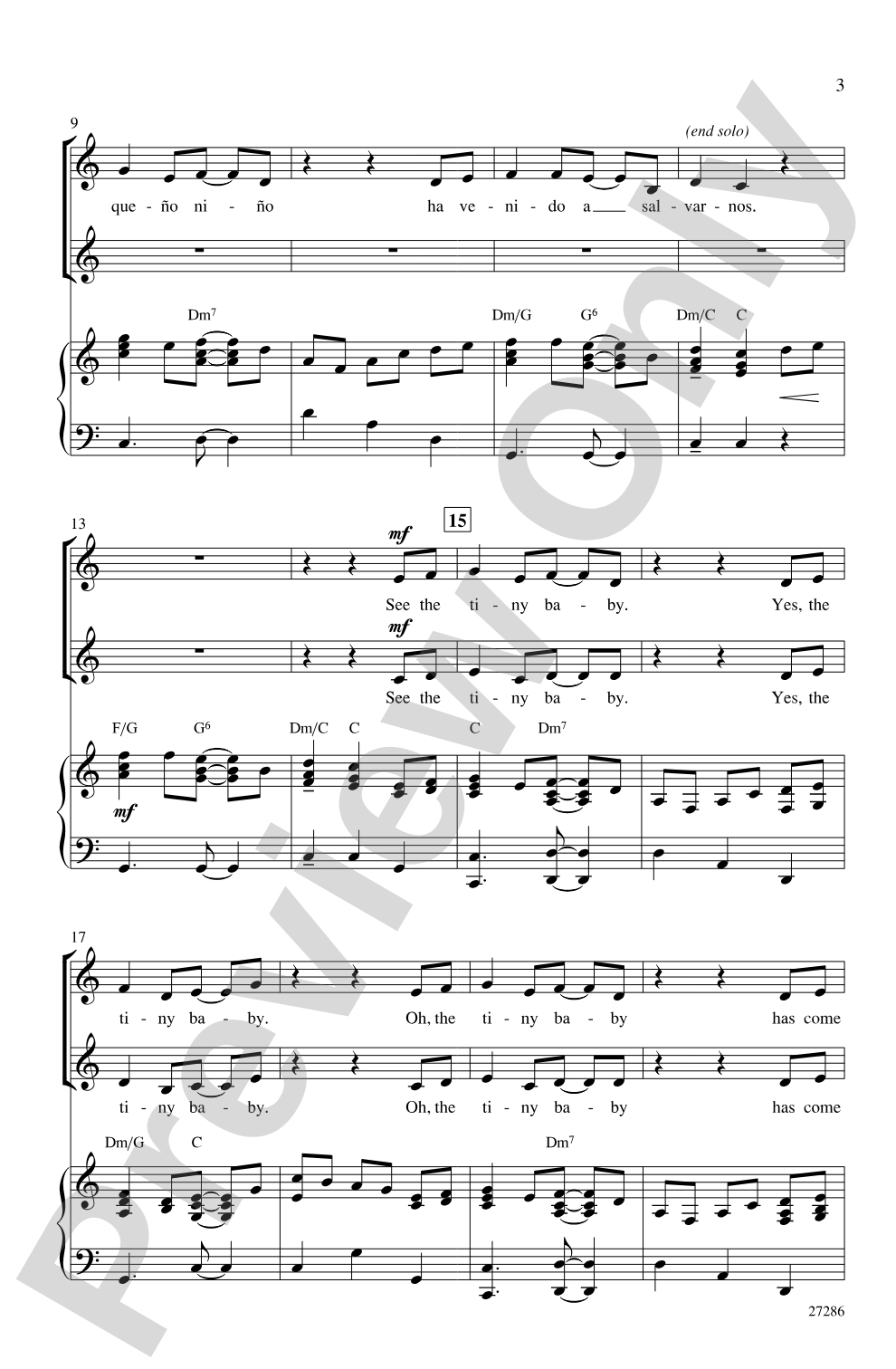
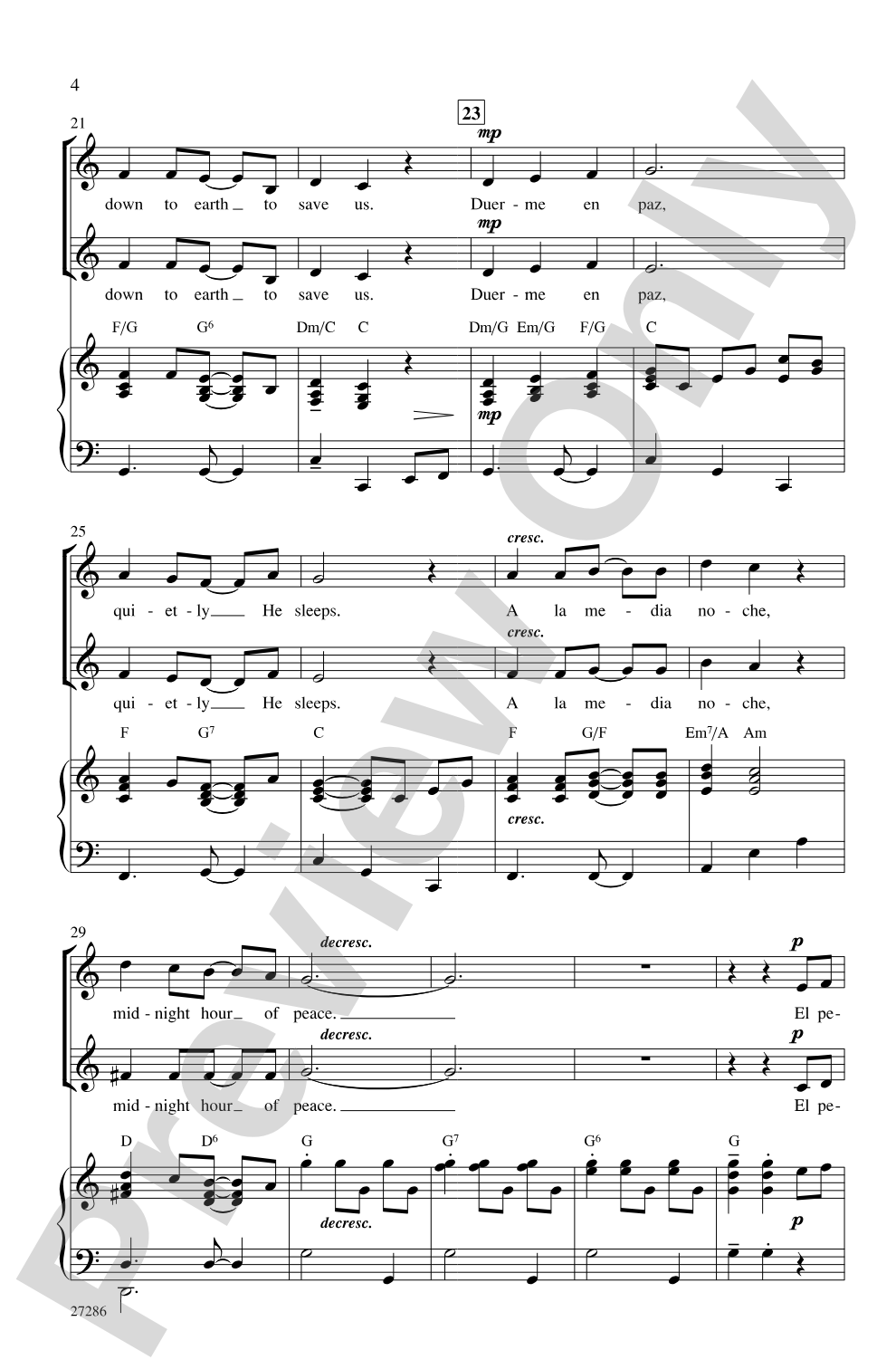

El Pequeño Nino (The Tiny Baby): 2-Part / SSA Choral Octavo
(The Tiny Baby)
Words and music by Sally K. Albrecht
Item: 00-PO-0000361
$1.75
Minimum order quantity: 20 copies
Pickup currently not available
Related Items
El Pequeño Nino: SoundTrax Digital Audio Download |
$22.95
|
View | |
El Pequeño Nino (The Tiny Baby): SATB Choral Octavo |
$1.75
|
View | |
El Pequeño Nino (The Tiny Baby): 3-Part Mixed Choral Octavo |
$1.75
|
View | |
El Pequeño Nino: SATB Choral Octavo |
$1.75
|
View | |
El Pequeño Nino: 3-Part Mixed Choral Octavo |
$1.75
|
View | |
El Pequeño Nino: 2-Part / SSA Choral Octavo |
$1.75
|
View | |
El Pequeño Nino: Choral Octavo SoundTrax CD |
$22.95
|
View |
Description
This charming and delicate Christmas number includes some Spanish phrases, and includes a pronunciation guide and translation in the publication. The perfect cross-cultural piece for your holiday concerts. Easy, straightforward choral writing for all ages with a simple piano accompaniment.


El Pequeño Nino (The Tiny Baby): 2-Part / SSA Choral Octavo isn't in MakeMusic Cloud just yet...but it could be. Let us know you'd like to see it, and you'll help shape what comes next. In the meantime, start a free trial and dive into thousands of interactive titles your students can play along with today.
Request This Title
Tell us you want it.
Start Your Free Trial
Explore everything that's ready to play right now.
Sample Audio
1
Audio File
--:--
0:00
0:00
Sample Video
No sample videos found.
Additional Details
Series:
Alfred Choral Designs
Publisher:
Alfred Music
Page Count:
12
SKU:
00-PO-0000361
More about this title
About the Composer: Sally K. Albrecht

Sally K. Albrecht has shaped American choral music for over four decades as a composer, conductor, and clinician with particular expertise in choral movement. Since 1987, she has received annual recognition through the ASCAP Special Music Award, and her catalog now includes more than 600 choral publications alongside 75 songbooks and musicals. She spent thirty-three years leading school choral, vocal, and elementary music publications at major educational publishers, culminating in her tenure as Director of School Choral, Vocal, and Elementary Publications at Alfred Music.
Albrecht has conducted festival honor choirs across the United States at prestigious venues including Lincoln Center, Carnegie Hall, and The Kennedy Center. Her academic background spans music and drama: she earned a B.A. from Rollins College (Florida), an M.A. in Drama from the University of Miami, and an M.M. in Accompanying, also from Miami. She has taught at Oakland University (Michigan), Jersey City State College (New Jersey), and Meredith College (North Carolina). In 2021, she received the Distinguished Alumna Award from both her graduate and undergraduate institutions, and she currently serves on the Board of Trustees at Rollins College.
Why we love this
Albrecht writes with genuine warmth and accessibility, never sacrificing musicality for simplicity. The inclusion of a pronunciation guide and English translation removes barriers to authentic performance, letting directors and singers engage meaningfully with the Spanish text without requiring prior language study. Holiday programming often skews toward familiar carols; this piece brings genuine cultural substance and freshness to your Christmas concert.
What to expect
Tender and intimate, this piece captures the gentle wonder of the nativity through its simple melodic grace and warm harmonic support. The Spanish text lends authenticity and warmth, while the accessible vocal writing ensures every singer can participate fully in creating a moment of genuine reverence.
Who it's for
Elementary through high school choirs, particularly programs seeking accessible holiday literature that honors cultural traditions beyond the Western European canon. Directors managing mixed age ensembles or limited rehearsal time will appreciate the straightforward harmonic language and modest page count.
How to get the most out of it
- Spend rehearsal time on the Spanish pronunciation before drilling harmony, so singers understand the text they're singing rather than treating it as pure phonetics.
- Shape the gentle contours of the melody to avoid a singsong quality, especially in the simpler sections; young singers need guidance on phrasing even in straightforward writing.
- Balance the two or three parts so the treble voice carries without drowning out the supporting voices, keeping the piece's delicate character intact.
How to use it
Anchor a multicultural or sacred section of your holiday concert, pairing it with music from other traditions to reflect your community's diversity. Its modest demands make it ideal for programs that blend advanced repertoire with more accessible pieces, or as an effective opening number that settles an audience before weightier selections.
Skills your students will build
- Singing in Spanish with accurate pronunciation and idiomatic phrasing
- Reading two or three independent vocal lines with clear harmonic function
- Maintaining a sustained legit tone in simpler, prayer-like writing
- Interpreting text in a second language to deepen musical expression