
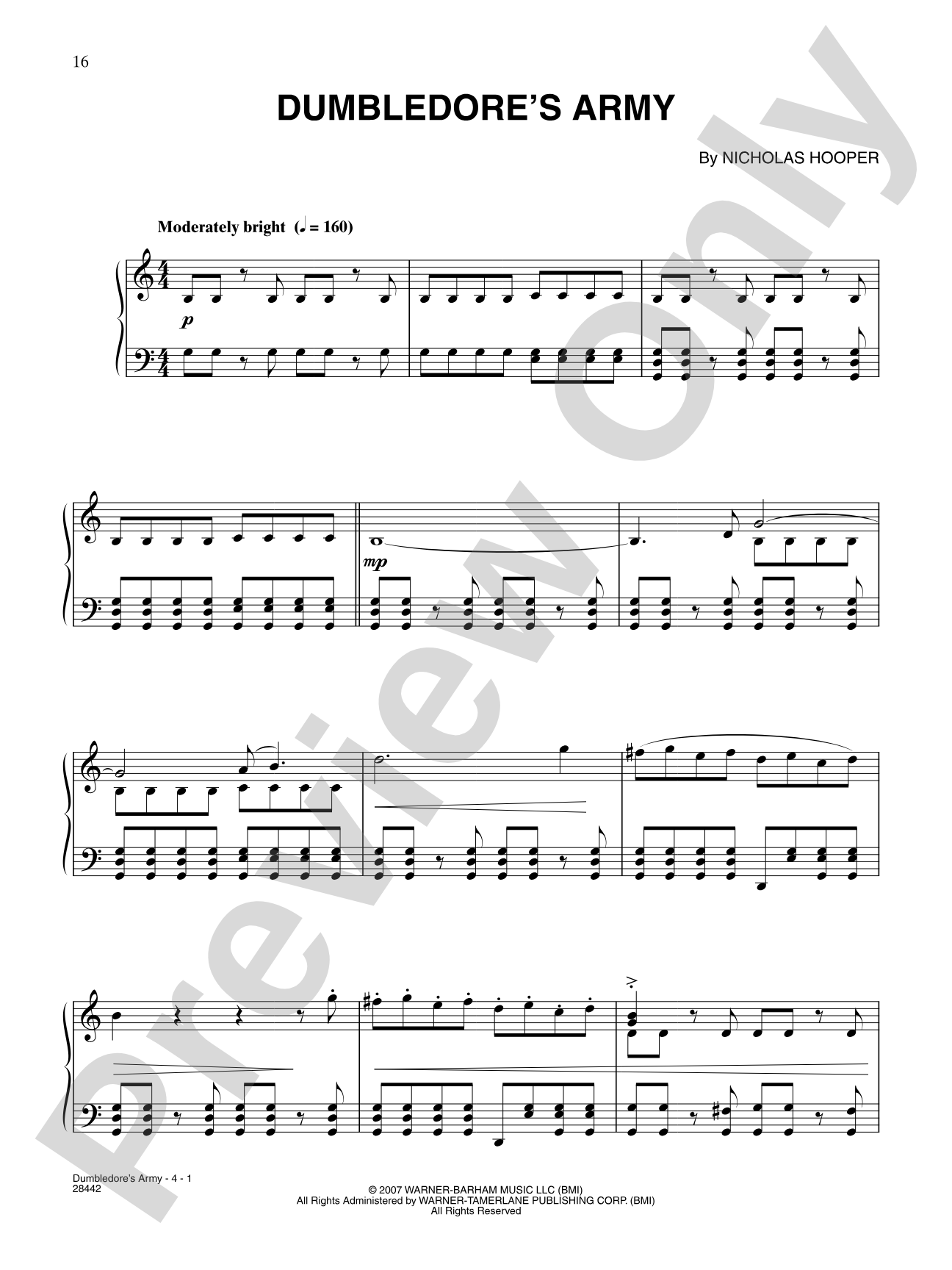

Dumbledore's Army (From "Harry Potter and the Order of the Phoenix"): Piano
Music by Nicholas Hooper with bonus selection by John Williams
Level: Late Intermediate
Item: 00-PSP-000409
$4.99
Pickup currently not available
Related Items
Fireworks (From "Harry Potter and the Order of the Phoenix"): Piano |
$4.99
|
View | |
Flight of the Order of the Phoenix (From "Harry Potter and the Order of the Phoenix"): Piano |
$4.99
|
View | |
Loved Ones and Leaving (From "Harry Potter and the Order of the Phoenix"): Piano |
$4.99
|
View | |
Professor Umbridge (From "Harry Potter and the Order of the Phoenix"): Piano |
$4.99
|
View | |
The Ministry of Magic (From "Harry Potter and the Order of the Phoenix"): Piano |
$4.99
|
View | |
The Room of Requirement (From "Harry Potter and the Order of the Phoenix"): Piano |
$5.99
|
View | |
Harry Potter and the Order of the Phoenix™, Selections from: Piano Book |
$14.95
|
View |
Description
Watching the characters from J.K. Rowling's Harry Potter and the Order of the Phoenix™ come alive is made only more delightful by the extraordinary soundtrack that enhances Harry, Hermione, Ron's adventures.
Alfred presents this selection of music from the soundtrack to the major motion picture arranged for advanced solo piano. Titles are Dumbledore's Army * Fireworks * Flight of the Order of the Phoenix * Loved Ones & Leaving * The Ministry of Magic * Professor Umbridge * The Room of Requirement * (Bonus Selection) Hedwig's Theme.


Alfred presents this selection of music from the soundtrack to the major motion picture arranged for advanced solo piano. Titles are Dumbledore's Army * Fireworks * Flight of the Order of the Phoenix * Loved Ones & Leaving * The Ministry of Magic * Professor Umbridge * The Room of Requirement * (Bonus Selection) Hedwig's Theme.
Dumbledore's Army (From "Harry Potter and the Order of the Phoenix"): Piano isn't in MakeMusic Cloud just yet...but it could be. Let us know you'd like to see it, and you'll help shape what comes next. In the meantime, start a free trial and dive into thousands of interactive titles your students can play along with today.
Request This Title
Tell us you want it.
Start Your Free Trial
Explore everything that's ready to play right now.
Sample Audio
No sample audio found.
Sample Video
No sample videos found.
Additional Details
Publisher:
Alfred Music
Page Count:
40
SKU:
00-PSP-000409
More about this title
About the Composer: Nicholas Hooper
Nicholas Hooper composed the scores for the final four films in the Harry Potter series, beginning with Order of the Phoenix. His work brought a more mature orchestral sensibility to the franchise, moving away from John Williams' earlier themes while maintaining the magical world's musical identity. Hooper's film scores have earned him recognition for his ability to balance sweeping cinematic drama with intimate character moments.
Why we love this
This collection captures some of the most emotionally resonant moments from Order of the Phoenix in arrangements that demand serious pianistic control. Advanced students will find themselves navigating rich harmonic language, dynamic contrasts, and the kind of film music orchestration that translates beautifully to solo piano. The pieces offer a bridge between classical study and contemporary popular music that keeps practicing pianists genuinely invested.
What to expect
These pieces carry the weight of magic and conflict. Moments of heroism and determination contrast with quieter passages of reflection and loss. The music swells with orchestral grandeur translated for two hands, moving from the intimate and introspective to the triumphant and defiant.
Who it's for
Advanced high school pianists and adult students ready to work with sophisticated harmonic writing and film-based repertoire. Teachers looking to engage students with contemporary popular music that doesn't sacrifice musical depth or technical demand.
How to get the most out of it
- Balance the weight of chords against melodic clarity; these arrangements often layer important themes that need to emerge without overwhelming the harmonic foundation.
- Attend to tempo rubato in passages marked with emotional peaks, particularly in pieces like Loved Ones & Leaving, where the piano's expressive range matters more than strict metronomic precision.
- Use the dynamic range fully. Film music at this level relies on subtle gradations between pp and mf just as much as dramatic forte passages to create narrative arc.
- Track which hand carries the primary melodic line through thicker textures; the right hand isn't always the sole voice, and finding the voice you're telling helps shape phrasing across longer phrases.
How to use it
Program individual selections in student recitals to offer audiences a familiar musical world that still displays serious musical ambition. Use the full collection as a supplementary recital or as a thematic bridge between classical and film music concert programming. The bonus Hedwig's Theme provides a moment of levity and recognition that works well as an encore.
Skills your students will build
- Managing thick harmonic textures and voicing inversions for clarity
- Executing dynamic control in passages without rests
- Reading and performing film music idioms (harmonic progressions, orchestral textures adapted for piano)
- Sustaining emotional narrative across extended melodic phrases
- Pedal technique for blending complex harmonies while maintaining articulation