

Dream: SATB Choral Octavo
Words and music by Johnny Mercer / arr. Jay Althouse
Item: 00-PO-0002255
$2.10
Minimum order quantity: 20 copies
One moment…
Related Items
Dream: SoundTrax Digital Audio Download |
$27.99
|
View | |
Dream: SAB Choral Octavo |
$2.25
|
View | |
Dream: SSAA Choral Octavo |
$2.25
|
View | |
Dream: Choral SoundPax |
$25.00
|
View | |
Dream: SATB Choral Octavo |
$2.10
|
View | |
Dream: SAB Choral Octavo |
$2.25
|
View | |
Dream: SSAA Choral Octavo |
$2.25
|
View | |
Dream: Choral Octavo SoundTrax CD |
$27.99
|
View | |
Dream: Choral SoundPax |
$25.00
|
View |
Description
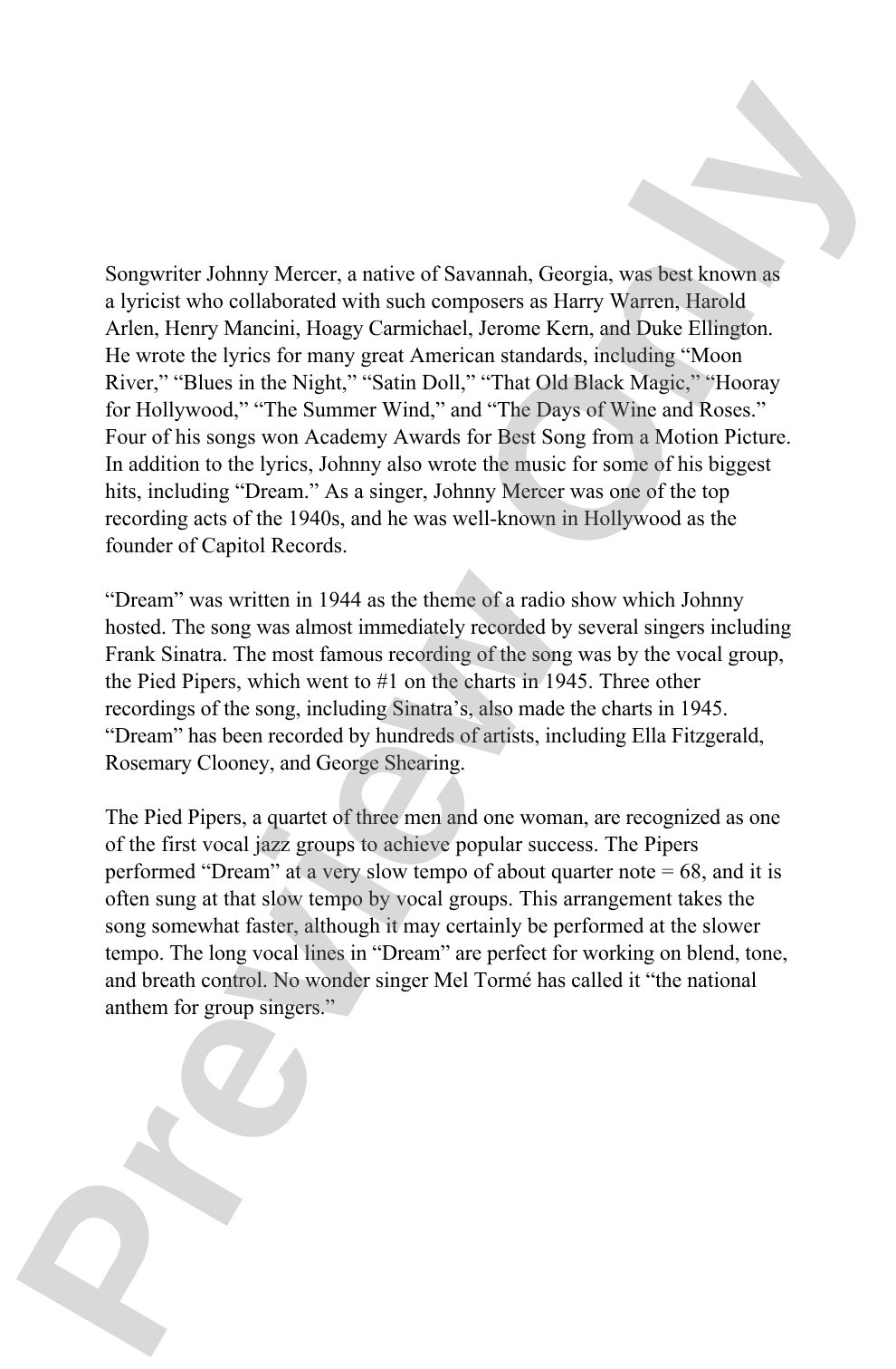
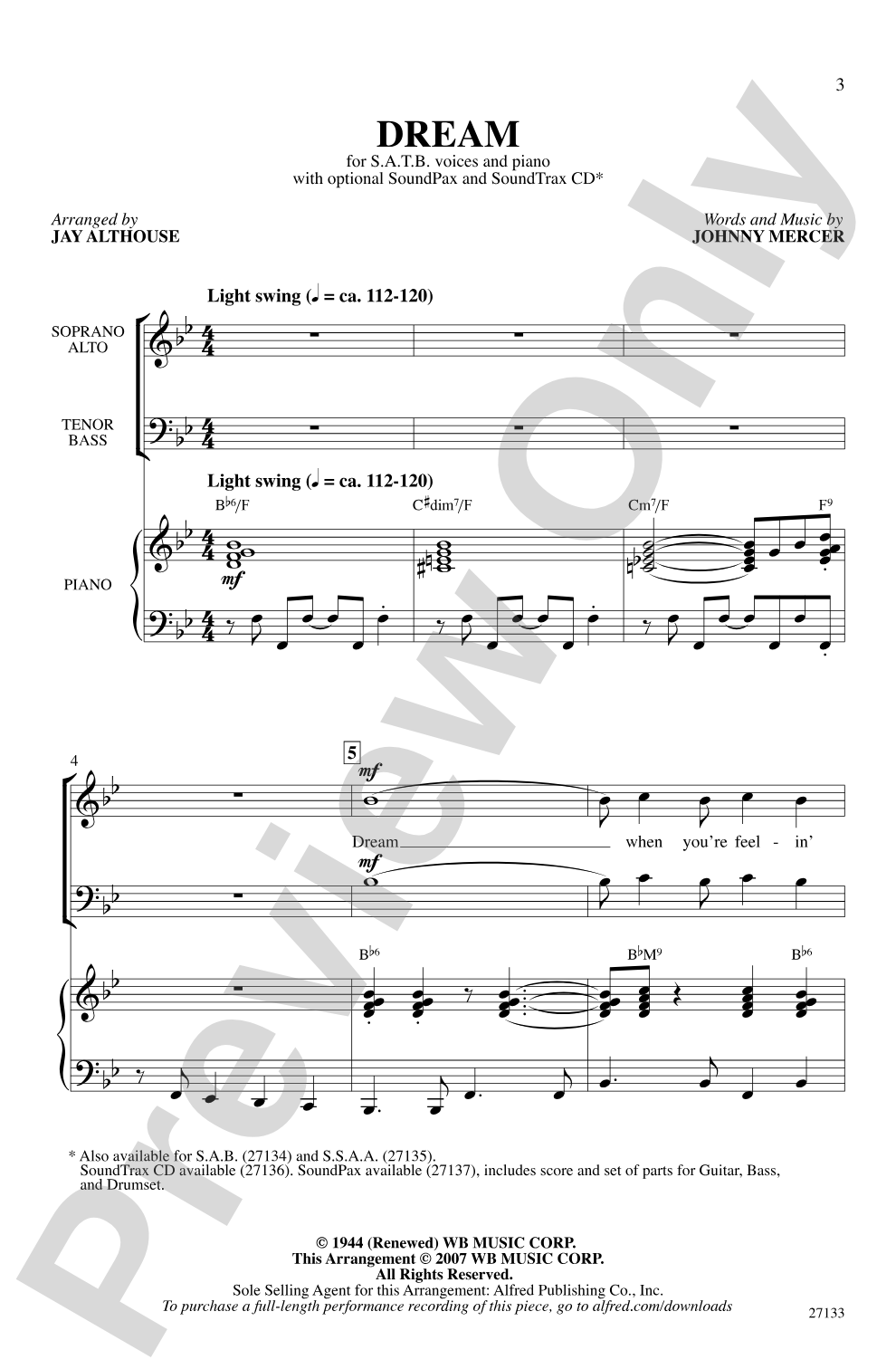
Singer Mel Tormé called "Dream" "the national anthem for group singers." It's been recorded by everyone from Frank Sinatra to George Shearing, and is the quintessential vocal group number. The vocal lines are easy, so it's a great piece to work on tone and blend...for any ensemble of any size. Easy piano accompaniment.


Dream: SATB Choral Octavo isn't in MakeMusic Cloud just yet...but it could be. Let us know you'd like to see it, and you'll help shape what comes next. In the meantime, start a free trial and dive into thousands of interactive titles your students can play along with today.
Request This Title
Tell us you want it.
Start Your Free Trial
Explore everything that's ready to play right now.
Sample Audio
1
Audio File
--:--
0:00
0:00
Sample Video
No sample videos found.
Additional Details
Series:
Alfred Pop Choral Series
Publisher:
Alfred Music
Page Count:
12
SKU:
00-PO-0002255
More about this title
About the Composer: Johnny Mercer
Johnny Mercer (1909-1976) was one of America's greatest lyricists, crafting words for hundreds of standards that define the Great American Songbook. His gift lay in conversational elegance: lyrics that sound like natural speech but contain perfect rhymes, witty internal rhymes, and emotional depth. He won four Academy Awards and collaborated with composers including Harold Arlen, Jerome Kern, and Henry Mancini, creating songs that remain central to jazz and popular music education.
Mercer's lyrics were built for singers. He understood vocal phrasing, singability, and how words land on melody. His work appears regularly in choral programs because his lines sit naturally in the voice, and his imagery rewards both performers and listeners who pay attention to text.
Why we love this
Jay Althouse's arrangement respects the song's economy while making it accessible to any choir size. The vocal lines sit beautifully in the middle of the staff, which means you can focus rehearsal time on the real work: creating unified vowels, shaping phrases as a unit, and discovering why Frank Sinatra and countless vocal groups have returned to this song across decades. It's a masterclass in how great songwriting needs almost nothing added to shine.
What to expect
Warm, conversational, and timelessly elegant. The song inhabits a space between intimate and grand, never requiring a large voice but rewarding one that's centered and connected. There's a wistfulness in the harmony and phrasing that invites singers to listen deeply to one another.
Who it's for
Any SATB choir looking for a song that teaches musicianship through beauty rather than technical display. This works equally well for high school mixed choirs, college ensembles, and community groups. The straightforward vocal lines make it ideal for singers focused on developing mature tone and blend rather than negotiating complex rhythms or ranges.
How to get the most out of it
- Shape the phrase across the bar line rather than landing hard on each chord change; let the accompaniment anchor the harmony while voices find the song's conversational arc
- Isolate the opening unison or octave section to lock blend before parts divide; this establishes the tone quality you'll need throughout
- Balance the inner voices (alto and tenor) so they support rather than compete with the soprano line; use this as your primary tuning and balance exercise
- Use the recorded accompaniment to internalize phrasing and rubato, then gradually shift to live piano to develop responsiveness to a conductor's interpretation
How to use it
Pair this with other Mercer or Great American Songbook standards to create a program that celebrates American lyric writing. It's also ideal as an opener or closer for a concert, since its emotional clarity and accessibility make it a natural bridge between your audience and your ensemble. It works well in a program about jazz influence on choral music.
Skills your students will build
- Unified vowel production and sustained tone quality across all four parts
- Phrase shaping and breathing as an ensemble unit
- Harmonic listening and balance awareness, especially for inner voices
- Interpretation of swing and jazz phrasing in a choral setting
- Text clarity and the connection between lyric meaning and vocal line