

Deo Gratias: 3-Part Mixed Choral Octavo
Words and music by Sally K. Albrecht and Jay Althouse
Item: 00-PO-0008028
$1.75
Minimum order quantity: 20 copies
Pickup currently not available
Description
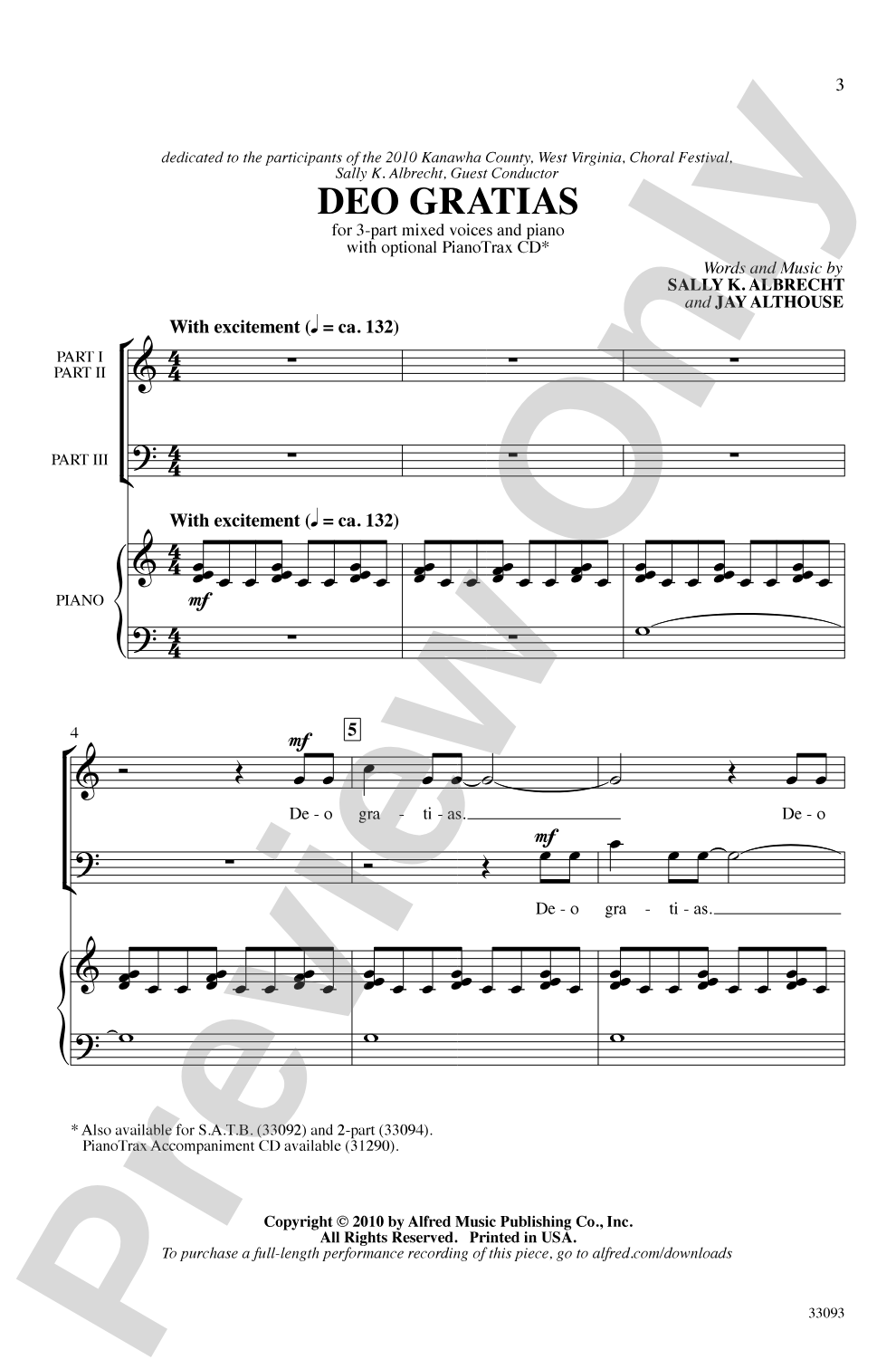
Opening and closing with a fanfare echo, this rhythmic setting of a Latin text will make your singers sound their best. An easy, yet effective choice for general or holiday use. Accompaniment available on PianoTrax 2 CD (00-31290).


Deo Gratias: 3-Part Mixed Choral Octavo isn't in MakeMusic Cloud just yet...but it could be. Let us know you'd like to see it, and you'll help shape what comes next. In the meantime, start a free trial and dive into thousands of interactive titles your students can play along with today.
Request This Title
Tell us you want it.
Start Your Free Trial
Explore everything that's ready to play right now.
Sample Audio
1
Audio File
--:--
0:00
0:00
Sample Video
No sample videos found.
Additional Details
Series:
Alfred Choral Designs
Publisher:
Alfred Music
Page Count:
12
SKU:
00-PO-0008028
More about this title
About the Composer: Sally K. Albrecht

Sally K. Albrecht has shaped choral music education for over three decades as a composer, conductor, and clinician with particular expertise in choral movement. Since 1987, she has received annual ASCAP Special Music Awards and maintains more than 600 published choral works alongside 75 songbooks and musicals. Her conducting has appeared at major venues including Lincoln Center, Carnegie Hall, and The Kennedy Center, where she has led honor choirs and festival ensembles across the nation.
Before her collaborative work with husband and composer Jay Althouse, Albrecht served as Director of School Choral, Vocal, and Elementary Publications at major educational publishers, including her final role at Alfred Music. She holds degrees from Rollins College (B.A. in Music and Theater, 1976), the University of Miami (M.A. in Drama, 1977; M.M. in Accompanying, 1979), and has taught at Oakland University, Jersey City State College, and Meredith College. In 2021, she received Distinguished Alumna Awards from both the University of Miami Frost School of Music and Rollins College, where she serves on the Board of Trustees.
Why we love this
The fanfare framing at beginning and end gives this piece theatrical lift without demanding advanced vocal technique. Albrecht and Althouse have crafted something that sits in that sweet spot where your singers feel like they're performing something substantial, yet the straightforward three-part writing lets everyone contribute meaningfully. The Latin text adds dignity to any program while remaining accessible enough for developing ensembles.
What to expect
Bright and purposeful. The rhythmic drive keeps energy moving while the Latin text lends a reverent quality that deepens once singers understand they're offering thanks and praise. The bookended fanfares make the piece feel ceremonial without becoming ponderous.
Who it's for
Any director seeking a short, polished piece for holiday concerts, general programs, or special services. The three-part mixed voicing works equally well for adult choirs or upper middle school ensembles with consistent attendance and basic part-reading skills.
How to get the most out of it
- Articulate the opening fanfare crisply to establish the piece's rhythmic energy. This moment sets expectations for the rest of the work, so commit fully even though the passage is brief.
- Balance the parts so the text remains clear throughout. With three voices sharing syllables, slight separation between parts prevents muddiness and lets the Latin come through.
- Use the recorded PianoTrax accompaniment strategically during early rehearsals to anchor pitch and tempo, then gradually reduce dependence so the singers develop confidence in holding their own lines.
- Bring the closing fanfare back to match the opening's character. This echo effect only lands when both moments feel intentional and energetic.
How to use it
Slot this as an opener or closer on any concert where you want to start strong or leave listeners with something memorable. It pairs particularly well on holiday or sacred programs, where its brevity and clear message complement longer choral works or allow room for other repertoire.
Skills your students will build
- Reading and executing rhythmic precision in three-part textures
- Sustaining clear diction in Latin text across distributed vocal lines
- Balancing three independent melodic lines to maintain transparency
- Responding to fanfare rhythms with articulate consonants and controlled breath support