
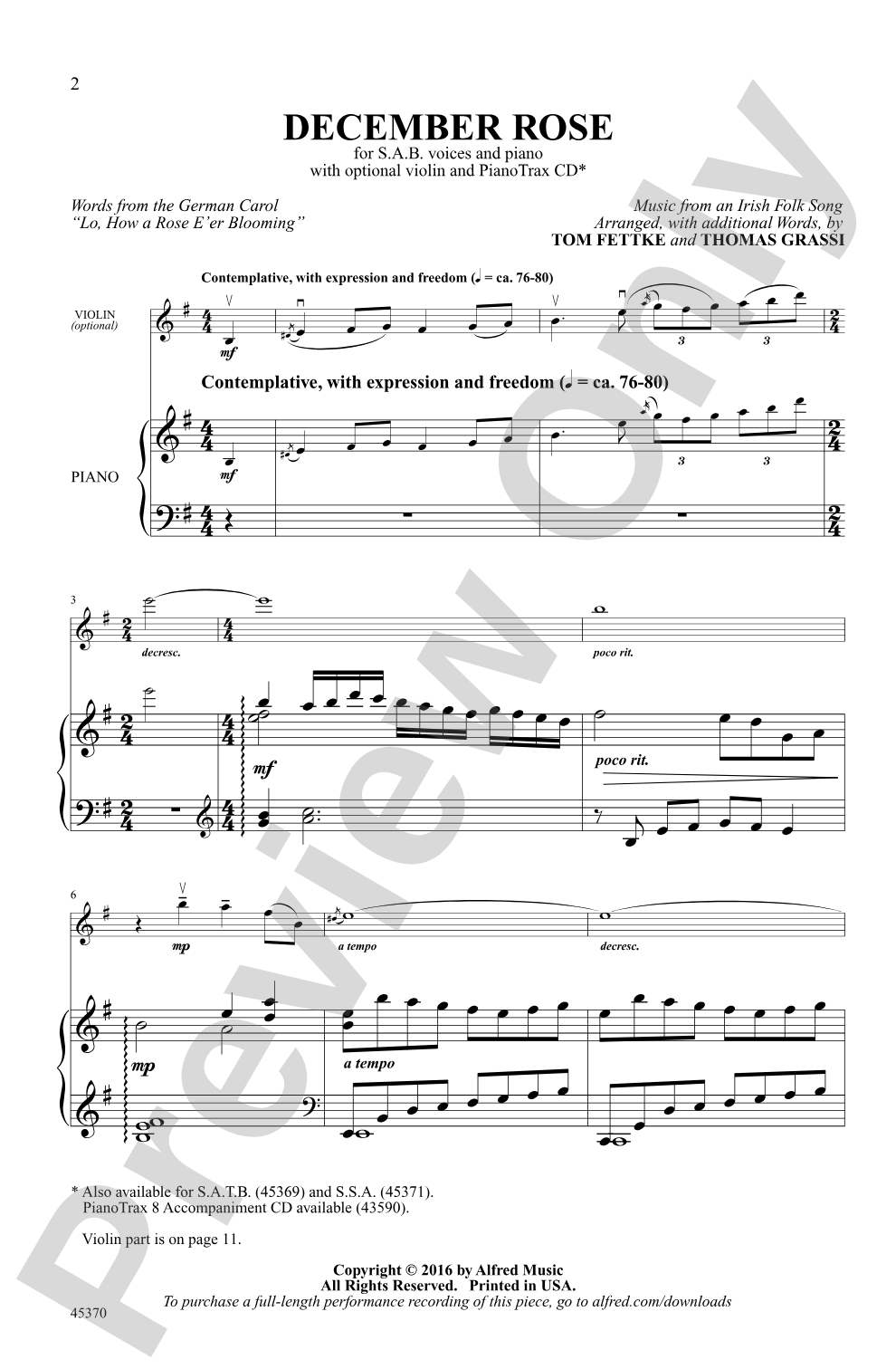
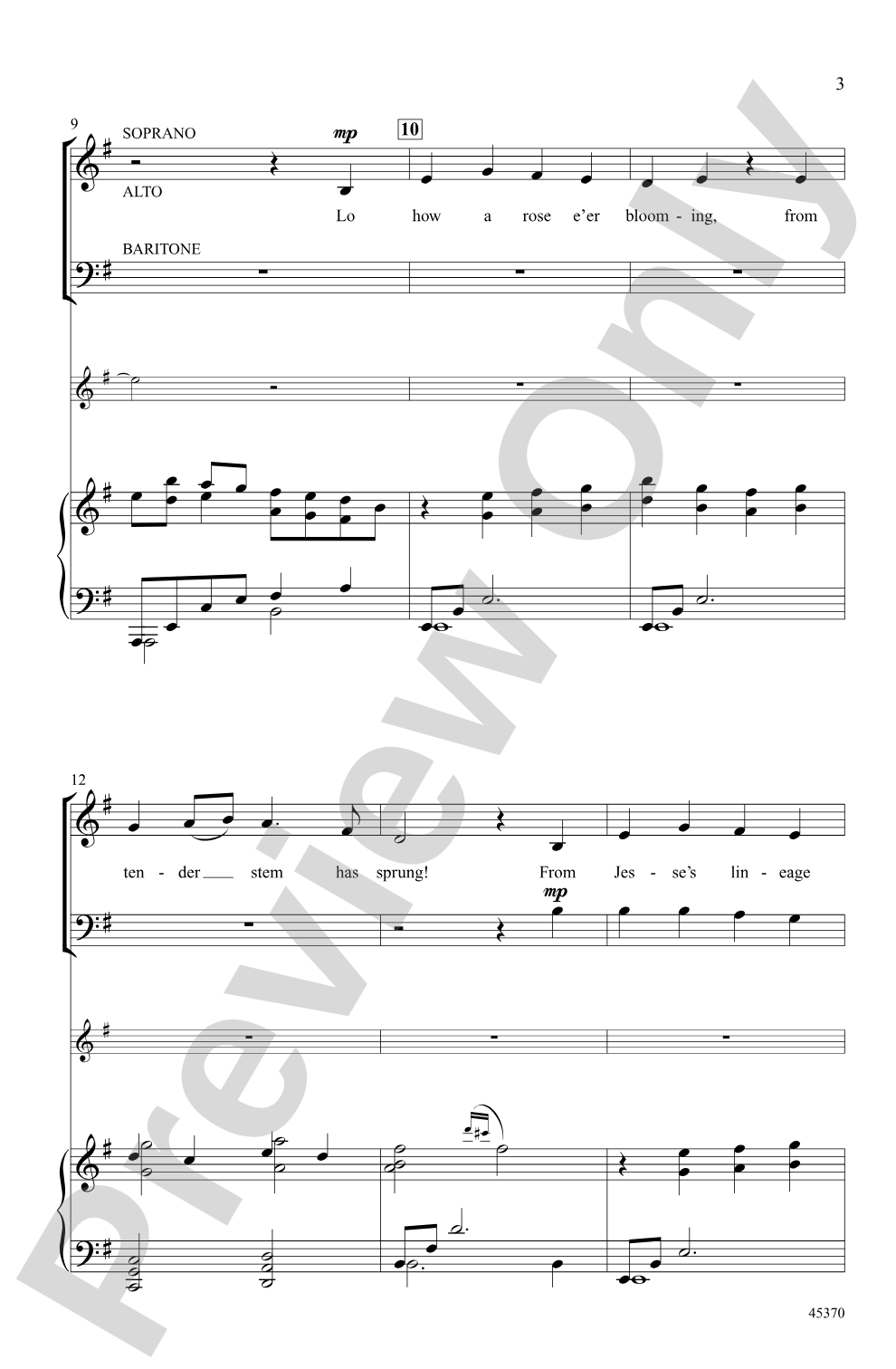

December Rose: SAB Choral Octavo
Words from the German Carol "Lo, How a Rose E'er Blooming," music from a Traditional Irish Carol / Arr., with additional Words, by Tom Fettke and Thomas Grassi
Item: 00-PO-0003621

$1.90
Minimum order quantity: 20 copies
Pickup currently not available
Description
The text from "Lo, How a Rose E'er Blooming" is set to a wistful Irish folk song in this one-of-a-kind Christmas treasure. An optional violin part brings a chill to a song full of warmth. Breathtaking!


Don't just read it, hear it, play along with it, and watch your students grow with it. In MakeMusic Cloud, December Rose: SAB Choral Octavo comes alive with professional accompaniment, adjustable tempo, and built-in practice tools that turn solo practice into real progress.
Open in the Player
Jump straight in and assign it today.
Start Your Free Trial
Open this title and explore the full library in minutes.
Sample Audio
1
Audio File
--:--
0:00
0:00
Sample Video
No sample videos found.
Additional Details
Series:
Alfred Choral Designs
Publisher:
Alfred Music
Page Count:
12
SKU:
00-PO-0003621
Instrumentation:
with Opt. Violin
More about this title
About the Arranger: Tom Fettke

Tom Fettke has shaped church and school music for more than five decades as a composer, arranger, and recording producer. His catalog runs to hundreds of published works, and his choral compositions have found their way into thousands of worship spaces and rehearsal rooms worldwide. The Majesty and Glory of Your Name remains one of his most frequently performed pieces, a testament to his gift for writing music that connects with singers and congregations alike.
Fettke's career spans classroom teaching in California's public schools, extensive work as a church musician and director across congregations of various sizes, and leadership roles in music curriculum development. He served as creator and senior editor of The Hymnal for Worship and Celebration, which has placed more than three million copies in church pews since 1986, and as senior editor of The Celebration Hymnal. His degrees from Oakland City College and California State University at Hayward, combined with a California Lifetime Music Credential, grounded his work in both practical pedagogy and artistic vision. He now resides in Nashville with his wife Jan.
Why we love this
Fettke and Grassi have taken a beloved hymn text and married it to a melody with genuine character, creating something that feels both familiar and fresh. The optional violin part is the real masterstroke here: it adds texture and intrigue without overwhelming the choir, and its inclusion signals that this piece invites artistic collaboration. For directors seeking a Christmas selection that avoids the obvious while remaining accessible to singers and audiences, this stands apart.
What to expect
Wistful and reflective, with an undercurrent of melancholy that feels right for a Christmas piece grounded in ancient text. The Irish melody carries warmth alongside quiet introspection, and when the optional violin enters, the song acquires an almost ethereal quality, as though listening to something half-remembered.
Who it's for
SAB choirs looking for a genuinely distinctive Christmas offering that works across high school, college, and community ensembles. This arrangement suits groups comfortable with hymn literature but eager to avoid standard carol repetition, as well as choirs with the musicianship to shape folk melody effectively.
How to get the most out of it
- Let the Irish melody shape your phrasing; resist the urge to sing this with the rhythmic evenness of a standard hymn. The folk character asks for a gentler, more conversational line.
- If you include the optional violin part, use rehearsals to ensure the instrument complements rather than competes. The violin should feel like a chill wind rather than a prominent voice.
- Pay attention to the text setting for "Lo, How a Rose E'er Blooming." Fettke's arrangement likely honors the words' devotional weight; sing with intention toward meaning, not merely notes.
How to use it
Program this as a bridge between traditional carol fare and newer choral writing; it honors the Christmas season without predictability. The contemplative mood makes it well-suited to a winter concert's second half, or as an opening number that sets a reflective tone for the entire program.
Skills your students will build
- Shaping melodic contour within the folk idiom
- Balancing three-part harmony with clear part independence
- Text expression and devotional singing
- Ensemble communication with optional instrumental partners