
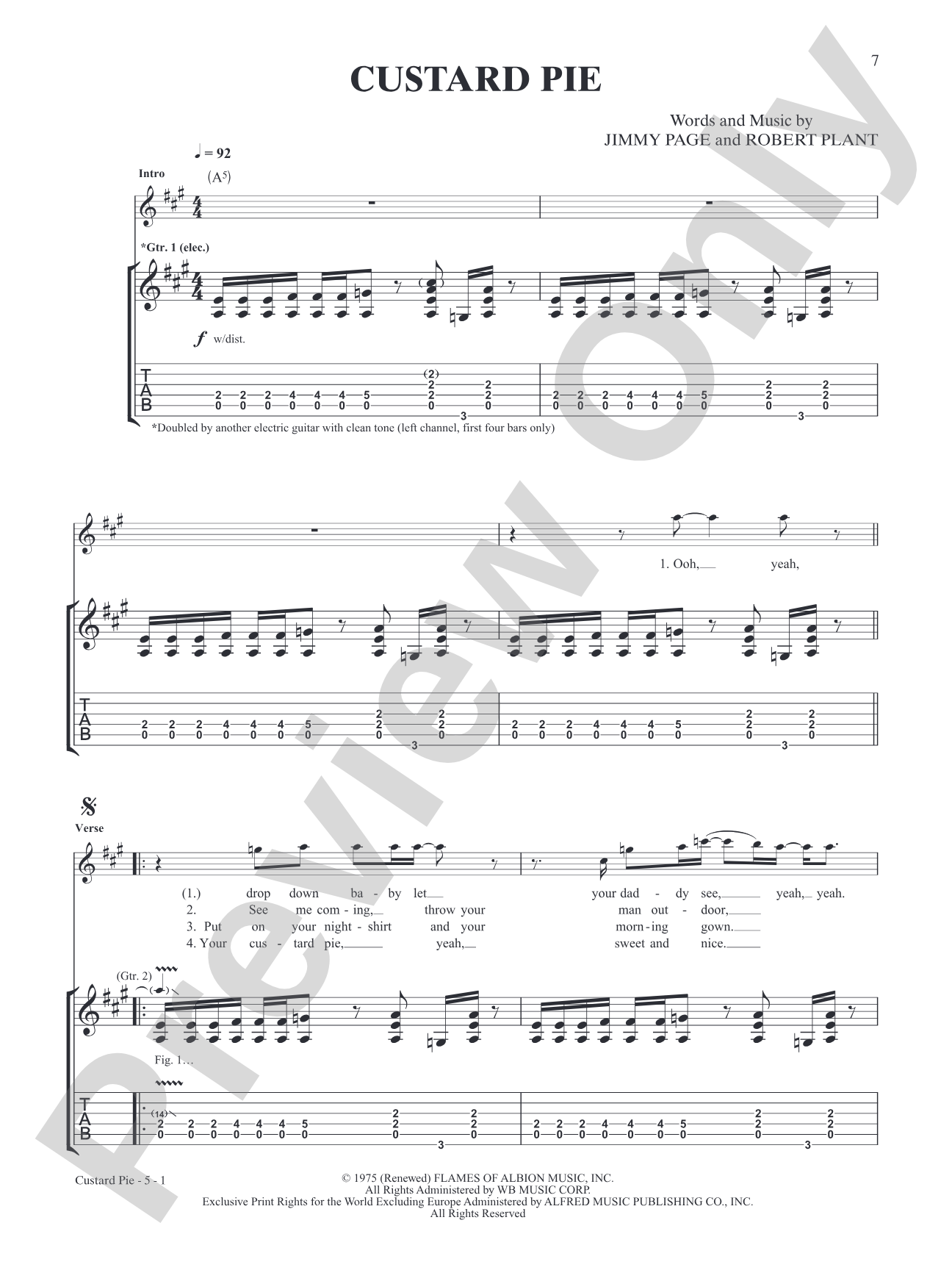

Custard Pie: Authentic Guitar TAB
Led Zeppelin
Item: 00-PS-0013719
$4.99
Pickup currently not available
Related Items
The Rover: Authentic Guitar TAB |
$9.99
|
View | |
In My Time of Dying: Authentic Guitar TAB |
$9.99
|
View | |
Houses of the Holy: Authentic Guitar TAB |
$5.99
|
View | |
Kashmir: Authentic Guitar TAB |
$9.99
|
View | |
Trampled Under Foot: Authentic Guitar TAB |
$9.99
|
View | |
In the Light: Authentic Guitar TAB |
$9.99
|
View | |
Night Flight: Authentic Guitar TAB |
$5.99
|
View | |
Bron-Yr-Aur: Authentic Guitar TAB |
$4.99
|
View | |
Down by the Seaside: Authentic Guitar TAB |
$9.99
|
View | |
Ten Years Gone: Authentic Guitar TAB |
$9.99
|
View | |
The Wanton Song: Authentic Guitar TAB |
$5.99
|
View | |
Black Country Woman: Authentic Guitar TAB |
$5.99
|
View | |
Sick Again: Authentic Guitar TAB |
$9.99
|
View | |
Boogie with Stu: Authentic Guitar TAB |
$5.99
|
View | |
Led Zeppelin: Physical Graffiti Platinum Album Edition: Drum Transcriptions Book |
$19.99
|
View | |
Led Zeppelin: Physical Graffiti Platinum Album Edition: Authentic Guitar TAB Book |
$24.99
|
View | |
Led Zeppelin: Physical Graffiti Platinum Album Edition: Authentic Bass TAB Book |
$19.99
|
View |
Description
Alfred Music, in association with Led Zeppelin, is proud to present this new Platinum Album Edition book. Drawn from more than 30 years of documentation, interviews, and recorded footage, these all-new transcriptions feature unprecedented accuracy and insight into the guitar style of Jimmy Page. With vintage Zeppelin photographs and a historical foreword by Guitar World magazine's editor-in-chief, Brad Tolinski, this book is a true collectible every fan must own. Titles: Custard Pie * The Rover * In My Time of Dying * Houses of the Holy * Trampled Under Foot * Kashmir * In the Light * Bron-Yr-Aur * Down by the Seaside * Ten Years Gone * Night Flight * The Wanton Song * Boogie with Stu * Black Country Woman * Sick Again.


Custard Pie: Authentic Guitar TAB isn't in MakeMusic Cloud just yet...but it could be. Let us know you'd like to see it, and you'll help shape what comes next. In the meantime, start a free trial and dive into thousands of interactive titles your students can play along with today.
Request This Title
Tell us you want it.
Start Your Free Trial
Explore everything that's ready to play right now.
Sample Audio
No sample audio found.
Sample Video
No sample videos found.
Additional Details
Series:
Alfred's Platinum Album Editions
Publisher:
Alfred Music
Page Count:
160
SKU:
00-PS-0013719
More about this title
About the Composer: Jimmy Page
Jimmy Page stands as one of the most influential and technically adventurous guitarists in rock history. His work with Led Zeppelin across the 1970s fundamentally changed what the electric guitar could express, blending blues vocabulary with experimental production, Eastern modal influences, and fingerstyle techniques that seemed impossibly advanced for the era.
Why we love this
These transcriptions offer guitarists direct access to Page's most iconic arrangements with unprecedented accuracy, drawn from three decades of study and documentation. The collection spans Led Zeppelin's entire catalog of studio classics, giving serious players the chance to decode techniques and harmonic choices that defined stadium rock guitar.
What to expect
These arrangements capture the swagger and experimental boldness of 1970s rock at its peak. From the sprawling minor-key meditation of "Kashmir" to the fingerstyle intricacy of "Bron-Yr-Aur," the collection moves between heavy riff-based power and intimate, intricate acoustic work.
Who it's for
Intermediate to advanced guitarists who want to master the specific techniques and arrangements that defined Led Zeppelin's studio sound. Guitar teachers and students preparing auditions or recitals can use these transcriptions to ground their study in documented, professional-level accuracy.
How to get the most out of it
- Study the fingering patterns carefully; Page's approach to chord voicings often favors shapes and positions that unlock unconventional tones rather than standard open or barre forms.
- Use the recorded versions as constant reference; many pieces employ layered or double-tracked guitar parts that the TAB notates in a single staff, so hearing the original clarifies texture and balance.
- Pay attention to the tuning notations for each piece; Page tuned his guitars differently across songs, and matching the tuning unlocks the exact timbre and resonance he captured in the studio.
- Work slowly through the fingerstyle passages to develop the independence and precision required; rushing these sections collapses the dynamics and articulation that make them distinctive.
How to use it
Feature these transcriptions in guitar recitals or ensemble programs that explore rock repertoire with serious musical intent. Advanced students tackling one or two pieces over several months can develop mastery of Page's style while building catalog knowledge of essential rock composition.
Skills your students will build
- Alternate tunings and their effects on timbre and chord voicing
- Fingerstyle technique for both classical and rhythmic contexts
- Double-tracked and layered guitar notation interpretation
- Open tuning harmony and non-standard harmonic movement
- Dynamic control across single-note passages and block chords
- Historical listening and transcription verification