
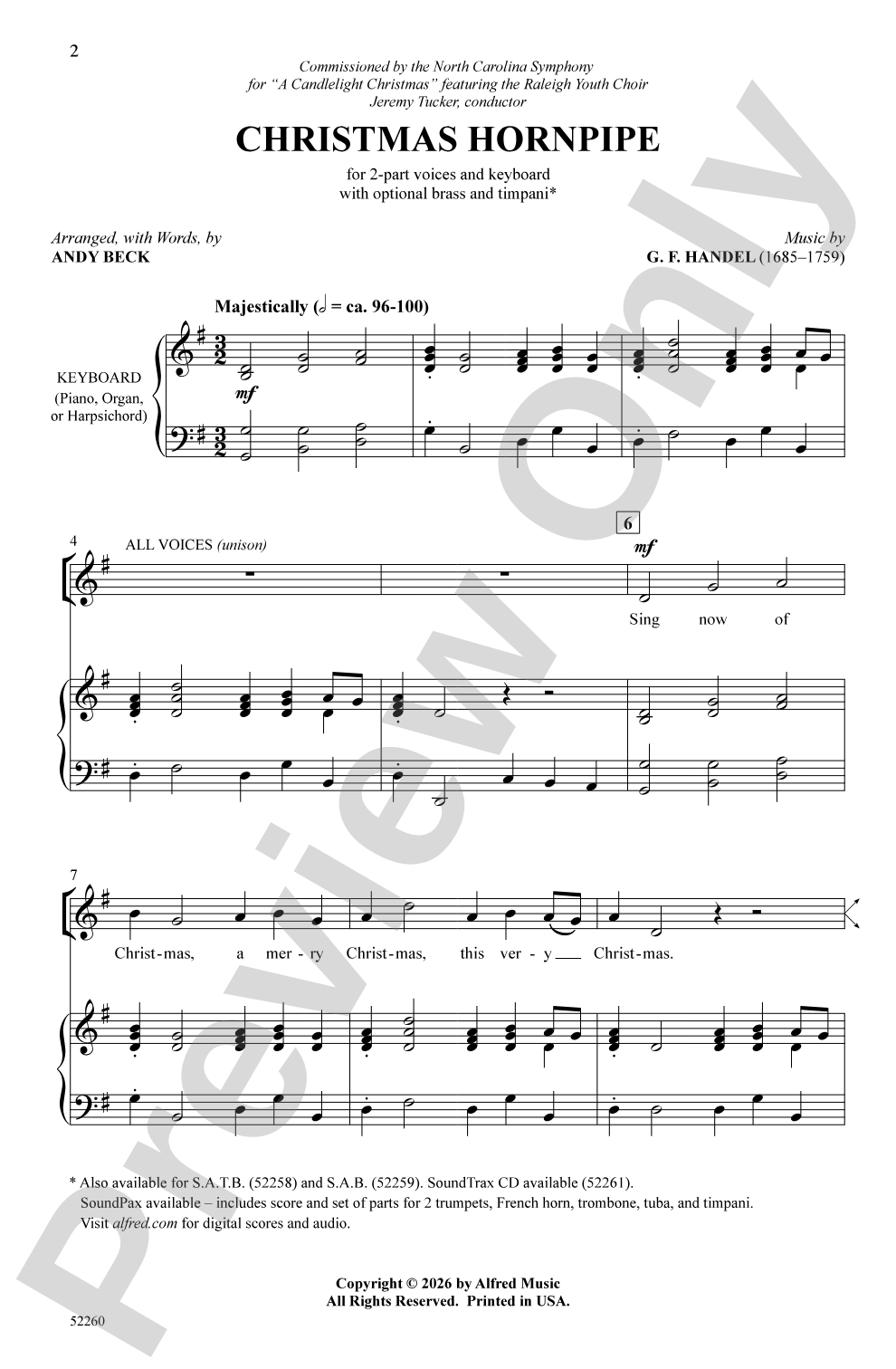
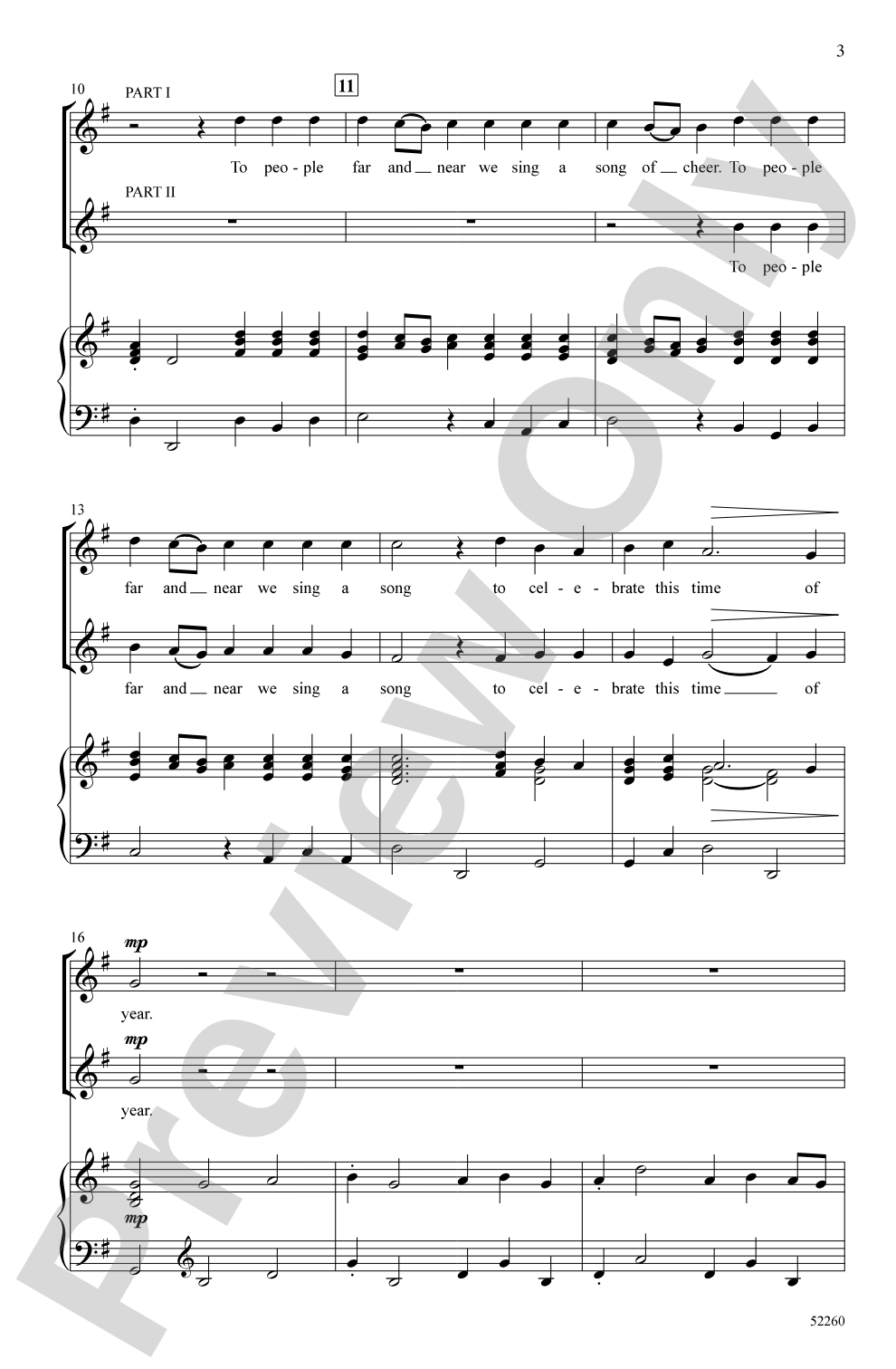

Christmas Hornpipe: 2-Part Choral Octavo
Music by G. F. Handel / arr., with words, by Andy Beck
Item: 00-PO-0007847
$2.50
Minimum order quantity: 20 copies
Pickup currently not available
Related Items
Christmas Hornpipe: SATB Choral Octavo |
$2.50
|
View | |
Christmas Hornpipe: SAB Choral Octavo |
$2.50
|
View | |
Christmas Hornpipe: Choral SoundPax Digital Download |
$30.00
|
View | |
Christmas Hornpipe: SATB Choral Octavo |
$2.50
|
View | |
Christmas Hornpipe: SAB Choral Octavo |
$2.50
|
View | |
Christmas Hornpipe: 2-Part Choral Octavo |
$2.50
|
View | |
Christmas Hornpipe: Choral Octavo SoundTrax CD |
$29.99
|
View |
Description
Handel's famous "Water Music" becomes a spirited holiday fanfare with the addition of a celebratory Christmas text. Buoyant vocal parts, traditional choral writing, and the jaunty hornpipe feel are a natural fit for the season and bring a touch of class to every performance. The flexible form invites you to sing just once through, or use the optional keyboard interlude as a Baroque-style transition before a joyful recapitulation. Elevate the majestic flair with festive brass and timpani (SoundPax sold separately).


Christmas Hornpipe: 2-Part Choral Octavo isn't in MakeMusic Cloud just yet...but it could be. Let us know you'd like to see it, and you'll help shape what comes next. In the meantime, start a free trial and dive into thousands of interactive titles your students can play along with today.
Request This Title
Tell us you want it.
Start Your Free Trial
Explore everything that's ready to play right now.
Sample Audio
1
Audio File
--:--
0:00
0:00
Sample Video
Additional Details
Series:
Alfred Choral Designs
Publisher:
Alfred Music
Page Count:
8
SKU:
00-PO-0007847
More about this title
About the Composer: Georg Friedrich Handel
Georg Friedrich Handel (1685, 1759) shaped the sound of Baroque Europe through his mastery of melody, harmonic language, and orchestration. Working across opera, oratorio, and instrumental music, he created works of such structural clarity and emotional directness that they remain accessible to performers and audiences centuries later. His instrumental pieces, particularly the Water Music and Music for the Royal Fireworks, showcase his gift for writing music that feels both dignified and genuinely joyful.
Why we love this
This arrangement channels the swagger of Baroque instrumental writing into a choral setting without sacrificing either the hornpipe's infectious bounce or the dignity of the source material. The optional keyboard interlude gives you real architectural choices in performance—you can reshape the piece for your moment and ensemble, which is exactly what directors need during the holiday rush.
What to expect
Bright, propulsive, and genuinely festive. The hornpipe rhythm gives the piece an almost dance-like quality that feels contemporary even though the harmonic language is unmistakably Baroque. There's a sense of celebration without sentimentality, and the text lands naturally over the melodic contours.
Who it's for
This works for mixed 2-part choirs and ensembles where you need solid melodic writing that still sounds sophisticated. It suits directors programming for holiday concerts who want something beyond the standard carol fare, plus groups looking for a bridge between classical music and seasonal programming.
How to get the most out of it
- Lock the rhythmic precision of the hornpipe. This feels buoyant only when the syncopations land with confidence; rehearse the offbeat figures separately until they sit solidly.
- Treat the text with the same attention you'd give to the melodic line. Clear diction on the Christmas words transforms the piece from a clever arrangement into a cohesive holiday statement.
- Shape the optional keyboard interlude as a genuine breath, not a speed bump. If you're using it, let the accompaniment establish a moment of reflection before the return.
- Consider the optional brass and timpani parts as enhancement, not necessity. Without them, the piece stands complete; with them, it gains festive weight.
How to use it
Slot this into a holiday concert as an opener or closer—it has enough classical weight to command respect but enough seasonal spirit to set a festive tone. It pairs well with traditional carols because the arrangement confirms that holiday music doesn't have to be simple, and it works equally well in a standalone holiday assembly or as part of a longer choral concert.
Skills your students will build
- Sustained 2-part voicing with clear independence between lines
- Rhythmic accuracy in syncopated figures characteristic of Baroque dance forms
- Clear articulation and diction of text at a flowing tempo
- Dynamic shaping across longer phrases to maintain forward momentum