

Chatter with the Angels: SAB Choral Octavo
Traditional Spiritual / arr. Greg Gilpin
Item: 00-PO-0001820
$1.85
Minimum order quantity: 20 copies
Pickup currently not available
Related Items
Chatter with the Angels: PianoTrax Digital Download |
$9.99
|
View | |
Chatter with the Angels: SATB Choral Octavo |
$1.85
|
View | |
Chatter with the Angels: 2-Part Choral Octavo |
$2.10
|
View | |
Chatter with the Angels: SATB Choral Octavo |
$1.85
|
View | |
Chatter with the Angels: SAB Choral Octavo |
$1.85
|
View | |
Chatter with the Angels: 2-Part Choral Octavo |
$2.10
|
View |
Description
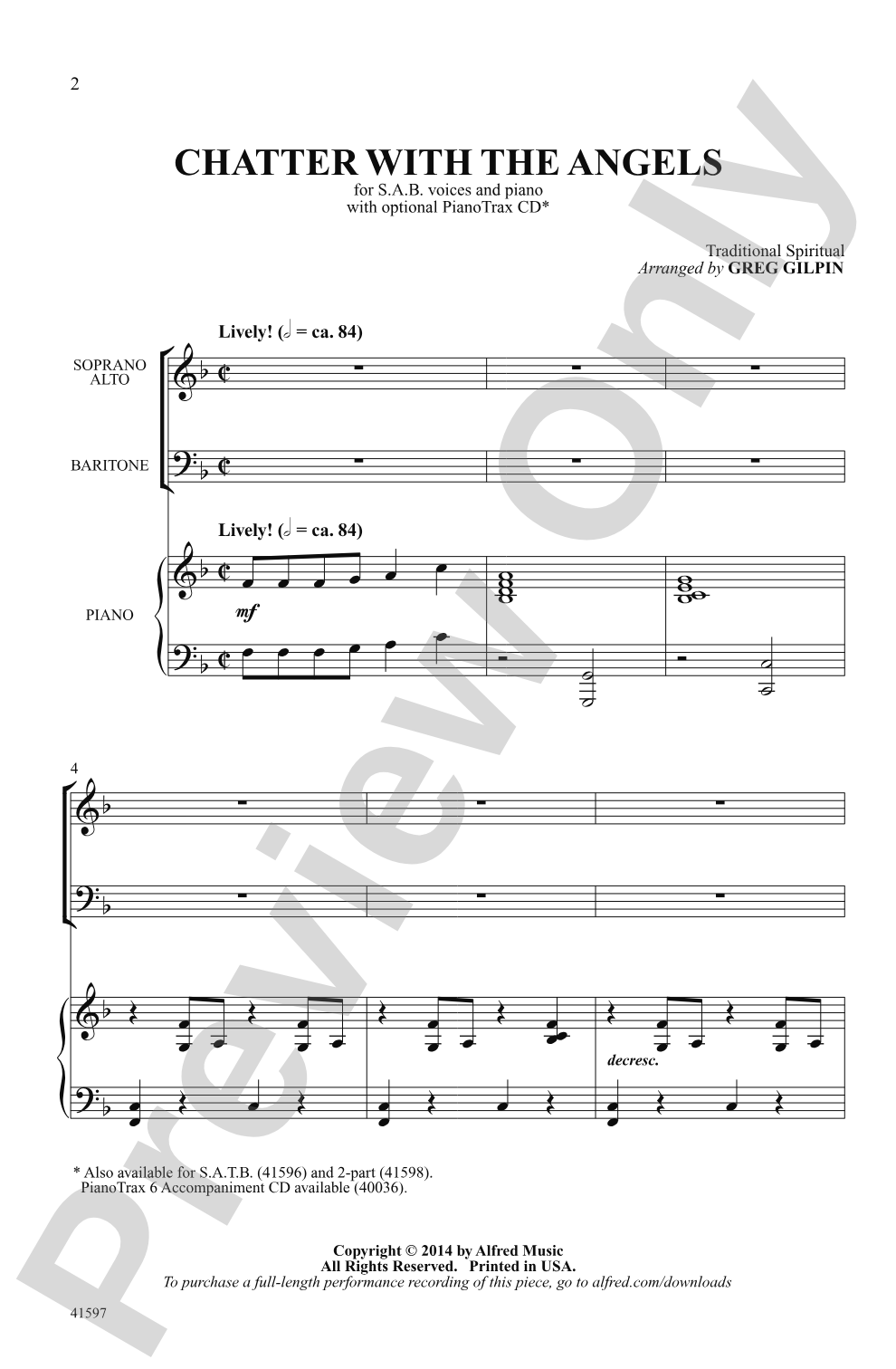
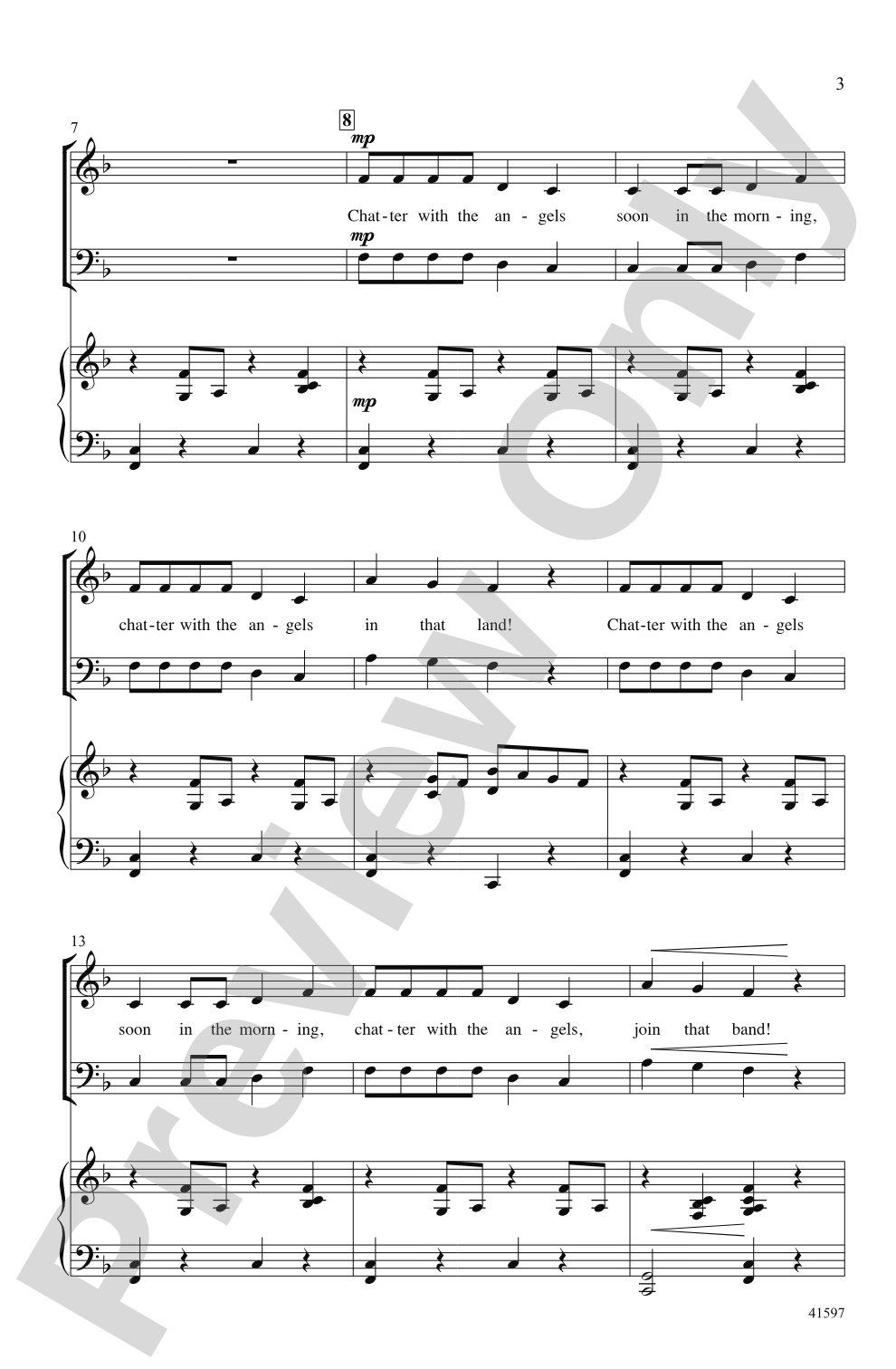
A bouncy piano accompaniment moves this cheerful arrangement along, as the playful melody is passed from voice to voice. Greg has great fun weaving "chatter"s through the choir and modulating to the big finish. Light spiritual repertoire for any group.


Chatter with the Angels: SAB Choral Octavo isn't in MakeMusic Cloud just yet...but it could be. Let us know you'd like to see it, and you'll help shape what comes next. In the meantime, start a free trial and dive into thousands of interactive titles your students can play along with today.
Request This Title
Tell us you want it.
Start Your Free Trial
Explore everything that's ready to play right now.
Sample Audio
1
Audio File
--:--
0:00
0:00
Sample Video
No sample videos found.
Additional Details
Series:
Alfred Choral Designs
Publisher:
Alfred Music
Page Count:
12
SKU:
00-PO-0001820
More about this title
About the Arranger: Greg Gilpin

Greg Gilpin has established himself as both a composer and arranger whose work is performed across major concert halls in North America and internationally, from Carnegie Hall and Lincoln Center to the Sydney Opera House and Royal Festival Hall in London. An ASCAP award-winning musician, he serves as Director of Educational Choral Publications for Shawnee Press and maintains an active career as a choral conductor, recording producer, and educator.
Beyond music, Gilpin has pursued additional professional certifications as a financial coach and organizing specialist, founding Maestro Organizing and appearing on network television. In 2021, he composed the score for the award-winning short film "Rosie's Rescue" and collaborated with opera singer Angela Brown on a new arrangement of "What Child is This?" for the Indianapolis Symphonic Choir. He holds membership in ACDA, NAfME, SAG-AFTRA, and Phi Mu Alpha Sinfonia.
Why we love this
Gilpin's gift for voice leading keeps all three parts engaged and genuinely interesting to sing. The "chatters" woven throughout create rhythmic vitality and humor without requiring vocal gymnastics, making this arrangement as joyful to perform as it is to hear. The modulation to the finish gives your singers a real climactic moment without overshooting the accessibility that makes this work for any choir.
What to expect
Playful energy and infectious joy define this spiritual. The bouncy piano accompaniment creates immediate momentum, while the passing melody feels conversational and warm, like voices genuinely engaging with one another. The finish lands with satisfying brightness.
Who it's for
This arrangement suits developing and intermediate choirs seeking accessible sacred repertoire with personality. It works equally well for high school choirs, community ensembles, church choirs, or festival groups looking for something that sounds vibrant without excessive difficulty.
How to get the most out of it
- Keep the piano accompaniment bright and buoyant in tempo; it's the engine that propels the piece forward, so lock the rhythmic pocket between your singers and the keyboard from rehearsal one.
- Shape the "chatter" sections with clear articulation and consistent vowel placement to maintain text clarity when the melody fragments pass between parts.
- Build momentum gradually toward the modulation at the finish rather than holding back energy early; the big finish lands better when you've established forward motion throughout.
How to use it
Program this early in a spiritual or sacred music set to establish an uplifting tone and audience goodwill. It pairs well alongside more contemplative spirituals, allowing you to show range within the genre while keeping energy and interest high. The approachable style also makes it a solid contest or festival selection.
Skills your students will build
- Clarity of articulation in staccato passages and text delivery
- Passing melody between voice parts with smooth transitions
- Maintaining rhythmic independence while tracking ensemble pulse
- Singing through key modulation and harmonic movement
- Balancing harmony blocks with clear, well-rounded tone