
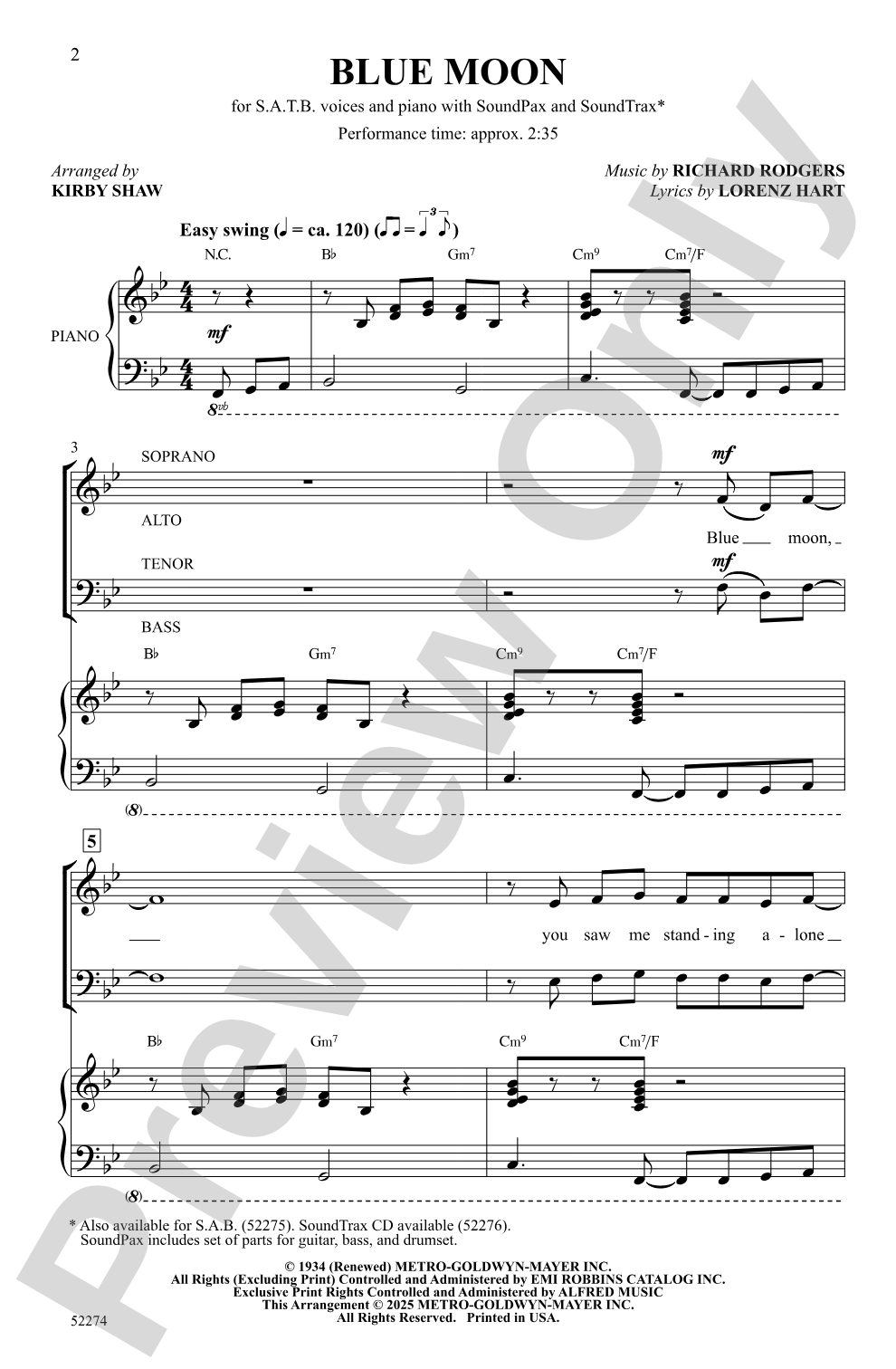
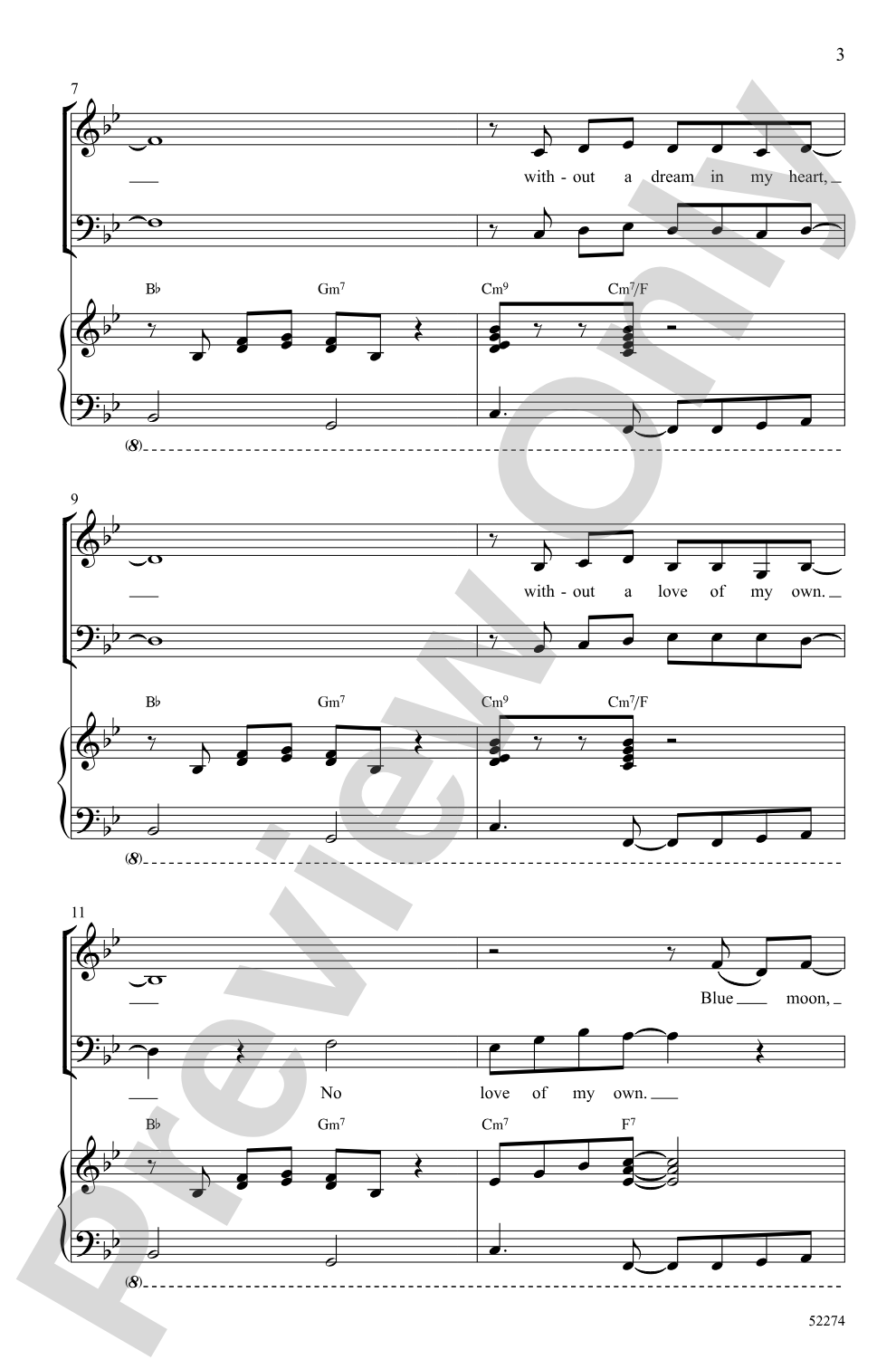

Blue Moon: SATB Choral Octavo
Music by Richard Rodgers, lyrics by Lorenz Hart / arr. Kirby Shaw
Item: 00-PO-0007617
$2.35
Minimum order quantity: 20 copies
One moment…
Description
Just in time for the movie of the same name, this Great American Songbook standard remains timeless as ever in a slick arrangement by Kirby Shaw. Tasteful vocal jazz harmonies and singable swing rhythms freshen up this beloved Rodgers and Hart classic. While neither voicing is difficult, the SAB voicing allows beginning groups to experience the style. SoundPax includes parts for guitar, bass, and drumset.


Blue Moon: SATB Choral Octavo isn't in MakeMusic Cloud just yet...but it could be. Let us know you'd like to see it, and you'll help shape what comes next. In the meantime, start a free trial and dive into thousands of interactive titles your students can play along with today.
Request This Title
Tell us you want it.
Start Your Free Trial
Explore everything that's ready to play right now.
Sample Audio
1
Audio File
--:--
0:00
0:00
Sample Video
Additional Details
Series:
Alfred Pop Choral Series
Publisher:
Alfred Music
Page Count:
12
SKU:
00-PO-0007617
More about this title
About the Composer: Richard Rodgers
Richard Rodgers (1902-1979) fundamentally shaped American musical theater through his collaborations with lyricist Lorenz Hart and later Oscar Hammerstein II. His melodies are instantly recognizable, designed to sit comfortably in the voice while remaining sophisticated enough to reward careful interpretation. Rodgers understood how to write for singers at every level, making his standards enduringly popular in choral settings.
Beyond Broadway, Rodgers' songs became the foundation of the Great American Songbook, performed by jazz singers, concert artists, and choirs for generations. His compositional clarity and harmonic sensibility make his work ideal for teaching music theory through living repertoire.
Why we love this
Kirby Shaw's arrangement captures the sophistication of a jazz standard while keeping both voicings accessible for developing choirs. The inclusion of optional guitar, bass, and drumset parts transforms this into a genuine small jazz combo experience rather than a traditional choral piece, giving students a taste of how Great American Songbook repertoire actually sounds in performance. Your singers will feel the style immediately.
What to expect
Nostalgic yet contemporary, with the elegance of a 1940s supper club and the groove of a modern jazz ensemble. The melody floats over rich, jazz-colored harmonies that create warmth and sophistication. You'll feel the swing in your body from the first phrase.
Who it's for
Intermediate to advanced high school choirs and community ensembles looking to expand into jazz-influenced repertoire without compromising musicality. The SATB voicing demands solid blend and intonation but rewards groups that can nail the style with a genuinely sophisticated sound. Beginning groups can use the simpler SAB voicing to learn the arrangement's jazz vocabulary.
How to get the most out of it
- Shape the melodic phrases as though you're singing over a live rhythm section. The swing rhythms only swing when the phrasing breathes naturally; avoid metronomic precision.
- Blend the jazz harmonies by listening vertically. These Rodgers-era voicings rely on voices locking their attacks and releases together, so rehearse each chord in isolation before running full phrases.
- Encourage the rhythm section to use the SoundPax accompaniment parts as a foundation for interpretation rather than a script. A subtle brush pattern or walking bass line brings authenticity that a backing track alone cannot.
- Treat the swung rhythms as conversational between voices. Point out moments where one section answers another, and conduct those exchanges with natural musical phrasing.
How to use it
Program this alongside other Great American Songbook standards to create a thematic concert focused on classic American song. The movie connection makes it relevant for a fall or winter concert, and the optional rhythm section parts allow you to feature those instrumentalists meaningfully. It also bridges vocal jazz and traditional choral literature, making it ideal for a concert that demonstrates stylistic range.
Skills your students will build
- Singing swing rhythms with appropriate articulation and phrasing
- Blending jazz harmonies and tracking chord movement by ear
- Responding to rhythm section accompaniment in real time
- Interpreting a standard from the American songbook tradition
- Balancing precision with stylistic flexibility