
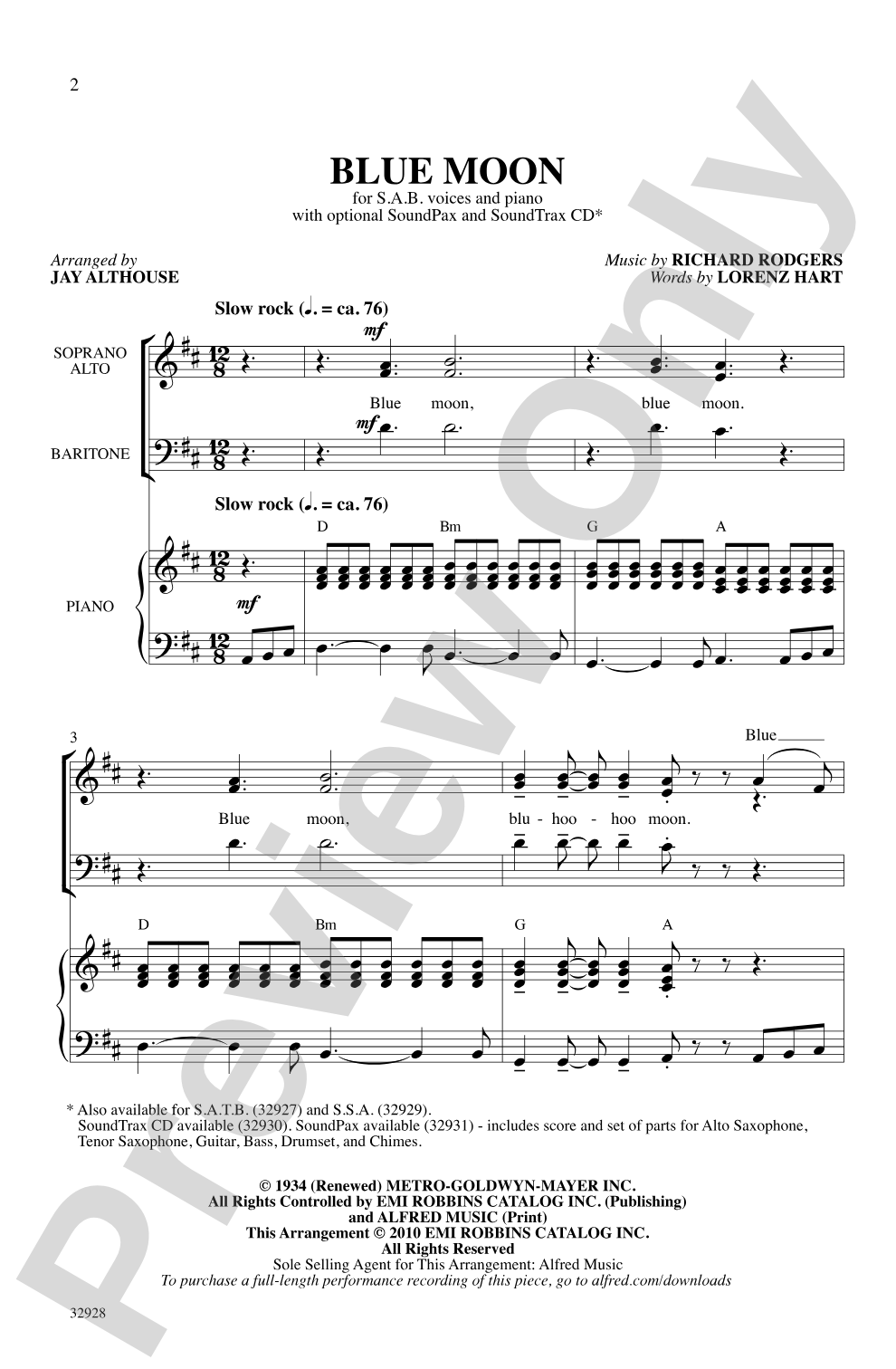
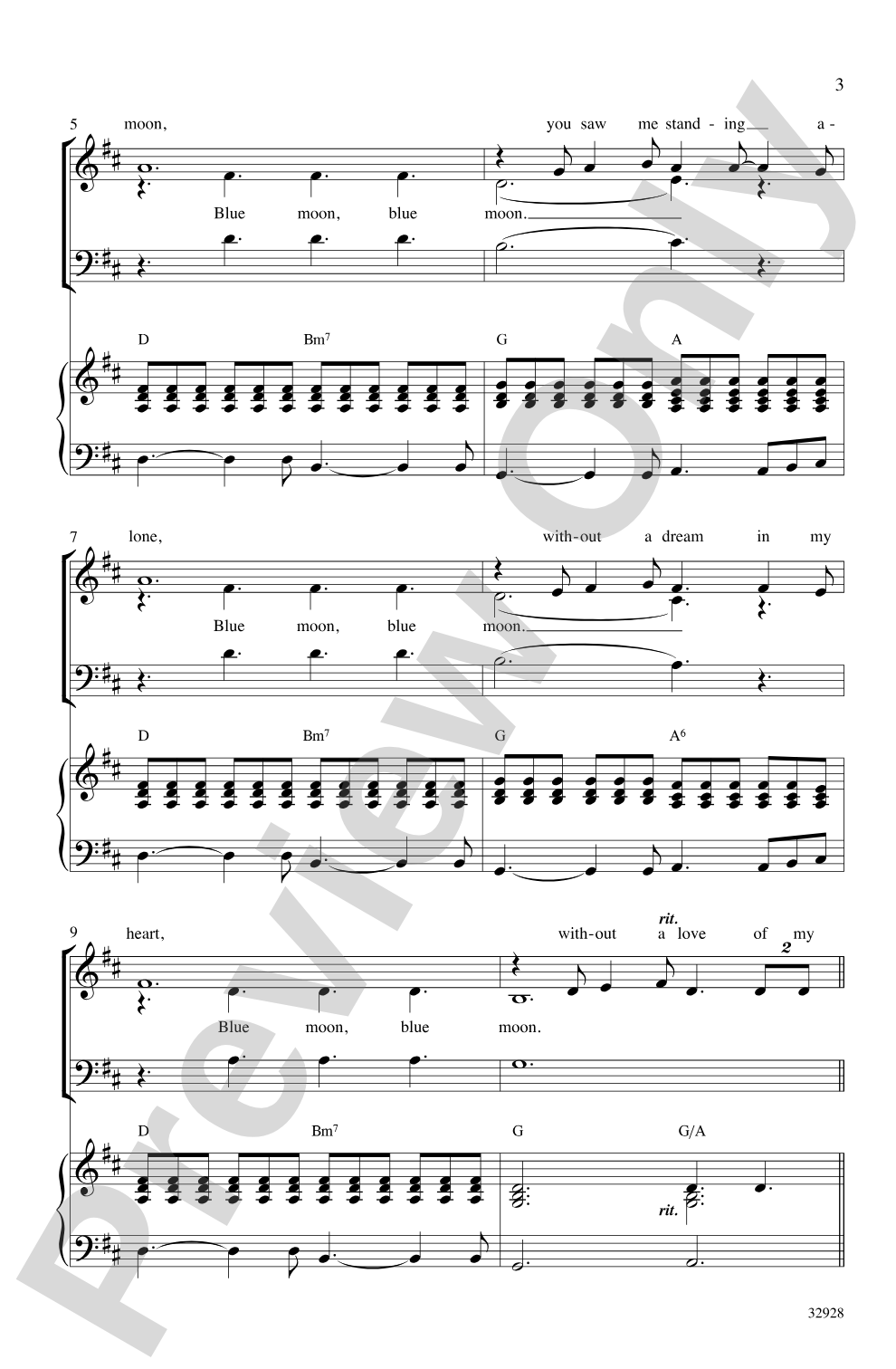

Blue Moon: SAB Choral Octavo
Music by Richard Rodgers, words by Lorenz Hart / arr. Jay Althouse
Item: 00-PO-0002924
$2.25
Minimum order quantity: 20 copies
One moment…
Related Items
Blue Moon: SoundTrax Digital Audio Download |
$27.99
|
View | |
Blue Moon: SATB Choral Octavo |
$2.10
|
View | |
Blue Moon: SSA Choral Octavo |
$2.10
|
View | |
Blue Moon: Choral SoundPax |
$30.00
|
View | |
Blue Moon: SATB Choral Octavo |
$2.10
|
View | |
Blue Moon: SAB Choral Octavo |
$2.25
|
View | |
Blue Moon: SSA Choral Octavo |
$2.10
|
View | |
Blue Moon: Choral Octavo SoundTrax CD |
$27.99
|
View | |
Blue Moon: Choral SoundPax |
$30.00
|
View |
Description
Only once in a blue moon does a song like this come along! This Rodgers and Hart hit has been recorded by legions of stars. Jay's arrangement starts soulfully, then kicks into The Marcels' 1961 doo-wop version.


Blue Moon: SAB Choral Octavo isn't in MakeMusic Cloud just yet...but it could be. Let us know you'd like to see it, and you'll help shape what comes next. In the meantime, start a free trial and dive into thousands of interactive titles your students can play along with today.
Request This Title
Tell us you want it.
Start Your Free Trial
Explore everything that's ready to play right now.
Sample Audio
1
Audio File
--:--
0:00
0:00
Sample Video
No sample videos found.
Additional Details
Series:
Alfred Archive Edition: Alfred Pop Choral Series
Publisher:
Alfred Music
Page Count:
12
SKU:
00-PO-0002924
More about this title
About the Composer: Richard Rodgers
Richard Rodgers (1902-1979) composed some of the most enduring melodies in American musical theater. Working first with lyricist Lorenz Hart and later with Oscar Hammerstein II, Rodgers crafted songs that moved seamlessly from concert halls to popular radio to film, establishing a standard for melodic writing that shaped generations of songwriters.
For music educators, Rodgers' catalog offers a rare gift: songs that are immediately recognizable to audiences, musically sophisticated enough to sustain interest, and flexible enough to work across skill levels and programming contexts. "Blue Moon" exemplifies his gift for writing a hook that sticks without sacrificing harmonic elegance.
Why we love this
Jay Althouse's arrangement captures the song's full arc without requiring a large ensemble. The arrangement moves from a soulful opening into the infectious doo-wop energy of The Marcels' version, giving your singers a stylistic journey they can sink their teeth into while keeping the vocal ranges comfortable for SAB voicing. Audiences will recognize the tune instantly, and your singers get to explore both sophisticated pop arranging and period-specific style work in one piece.
What to expect
The opening wraps the listener in a lush, romantic warmth, the kind of sound that made "Blue Moon" a standard. Then, without warning, the groove shifts into the playful, percussive energy of early 1960s doo-wop. There's joy and style confidence in that contrast, and it rewards singers who can hold both moods with conviction.
Who it's for
Choirs ready to explore twentieth-century popular song with harmonic sophistication. This works for high school choirs with mixed voices, community choirs seeking a recognizable crowd pleaser, and collegiate groups wanting a fun, musically substantive break from classical repertoire.
How to get the most out of it
- Balance the smooth legit singing in the opening section against the rhythmic precision the doo-wop section demands. These two styles use different breath support and articulation, so isolate each section in rehearsal to build clarity.
- Use the recorded accompaniment to lock into the doo-wop groove once you reach The Marcels' section. The backbeat and percussion give crucial reference points that keep students from dragging the rhythm.
- Shape the transition between the soulful opening and the doo-wop kick thoughtfully. A clean cutoff and a beat of space will heighten the contrast and keep the arrangement from feeling disjointed.
- Teach the doo-wop syllables and rhythms as a unit before layering in pitches. Nonsense syllables are the entry point to style authenticity, not an afterthought.
How to use it
Program this as a second-half opener to refresh an audience after weightier classical or contemporary pieces. The instant recognition and energy shift make it excellent for bridging into a set of popular songs, or pair it with other midcentury standards for a themed program exploring how American songwriters shaped popular music.
Skills your students will build
- Blending soulful phrasing with legit vocal production
- Reading and executing doo-wop rhythmic patterns and syllables
- Stylistic contrast and transitions within a single piece
- Working with recorded accompaniments to maintain groove and ensemble lock
- Voice part independence in three-part mixed voicing