
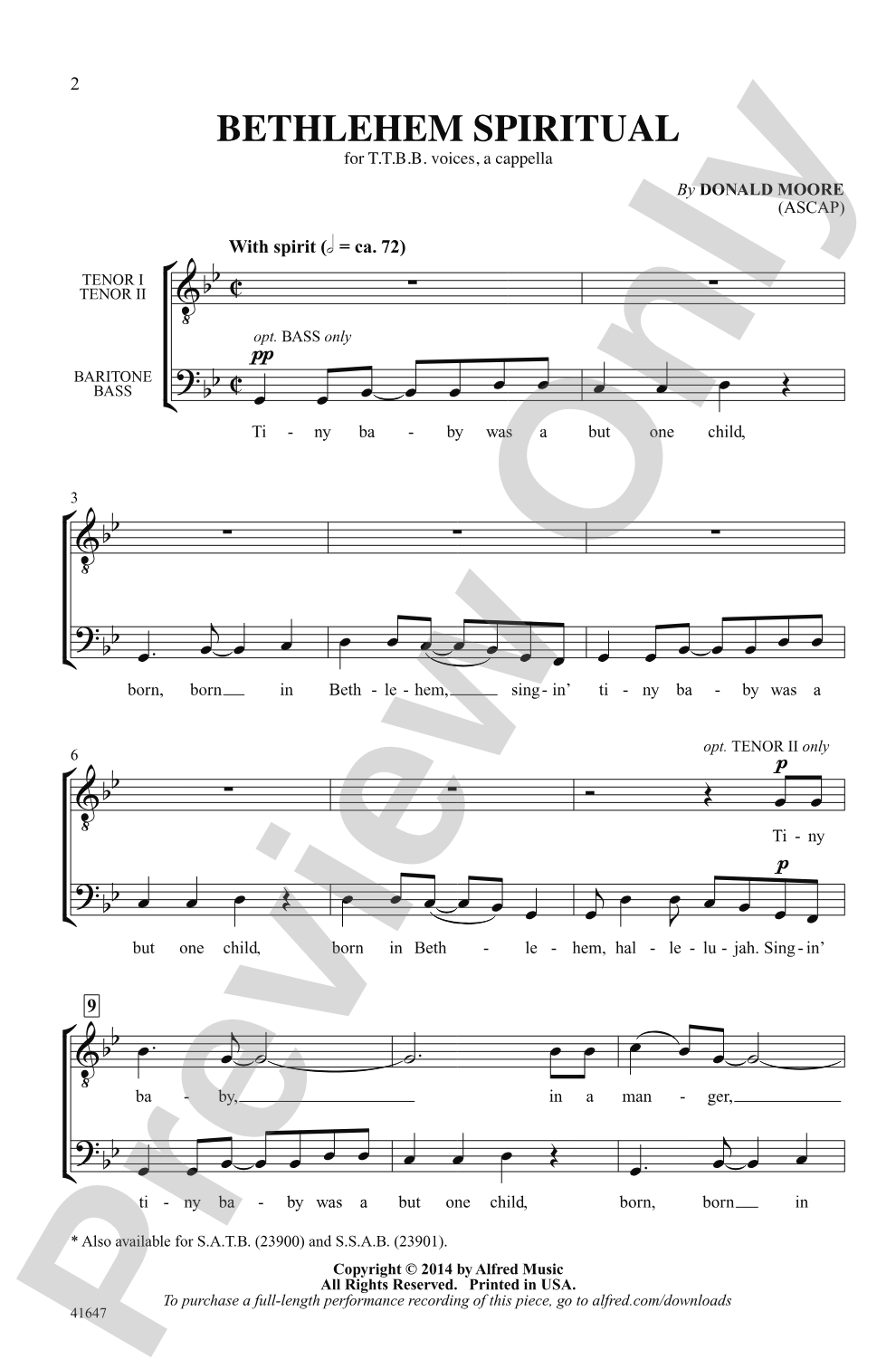
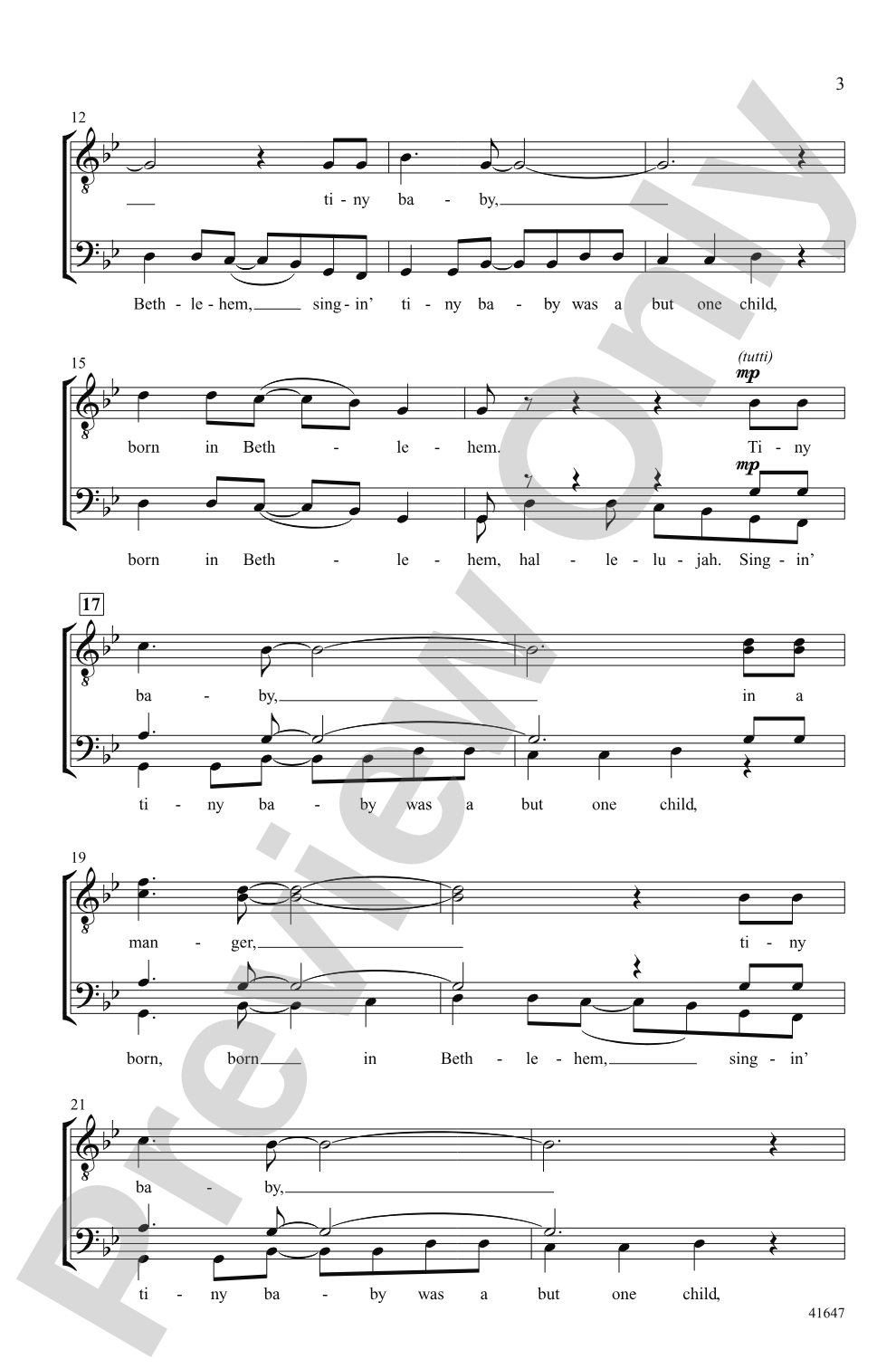

Bethlehem Spiritual: TTBB, a cappella Choral Octavo
Words and music by Donald Moore
Item: 00-PO-0001852
$1.85
Minimum order quantity: 20 copies
Pickup currently not available
Related Items
Bethlehem Spiritual: SATB, a cappella Choral Octavo |
$2.05
|
View | |
Bethlehem Spiritual: SSAB, a cappella Choral Octavo |
$2.25
|
View | |
Bethlehem Spiritual: SATB, a cappella Choral Octavo |
$2.05
|
View | |
Bethlehem Spiritual: SSAB, a cappella Choral Octavo |
$2.25
|
View | |
Bethlehem Spiritual: TTBB, a cappella Choral Octavo |
$1.85
|
View |
Description
The guys in your choir will shine singing this a cappella original that sounds like a traditional spiritual. Opens with a syncopated ostinato, adds a compelling minor-key melody, and expands into full four-part harmony. Gradually, voice parts disappear one by one, fading to the end. Newly Available for TTBB. This title is available in Music Prodigy.


Bethlehem Spiritual: TTBB, a cappella Choral Octavo isn't in MakeMusic Cloud just yet...but it could be. Let us know you'd like to see it, and you'll help shape what comes next. In the meantime, start a free trial and dive into thousands of interactive titles your students can play along with today.
Request This Title
Tell us you want it.
Start Your Free Trial
Explore everything that's ready to play right now.
Sample Audio
1
Audio File
--:--
0:00
0:00
Sample Video
No sample videos found.
Additional Details
Series:
Alfred Choral Designs
Publisher:
Alfred Music
Page Count:
8
SKU:
00-PO-0001852
More about this title
About the Composer: Donald Moore
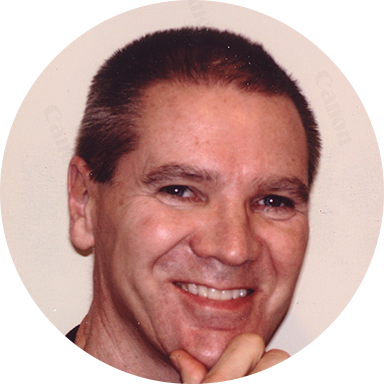
Donald Moore earned his Bachelor of Music in organ performance and Master of Arts in Teaching from Kent State University. He serves as Organist-Choirmaster at Pilgrim United Church of Christ in Cuyahoga Falls, Ohio, and has built a catalog exceeding 500 published compositions across sacred, secular, educational, and pop idioms. His works appear regularly at state contests and festivals as well as at state, regional, national, and international music conventions.
Moore's contributions to American choral music have earned him seventeen ASCAP Composers Standard Awards and recognition by the American Choral Directors Association as one of 400 elite composers in the history of American choral writing. His compositions span choral works, organ and piano pieces, and eight educational books, published through Alfred Music, BriLee Music, Warner Brothers Publications, Hal Leonard, Heritage Music Press, and Coronet Press.
Why we love this
Moore captures the essence of the spiritual tradition while crafting something fresh: the syncopated ostinato opening immediately signals rhythmic sophistication, and the minor-key melody carries genuine emotional weight without requiring complex harmonic writing. The gradual reduction of voices at the end gives you a natural, elegant way to shape the piece dramatically, and your guys will feel confident singing what sounds like something timeless.
What to expect
The syncopated opening feels modern and energetic, giving way to a soulful minor-key melody that evokes the spiritual tradition without pastiche. As voices gradually disappear, the texture becomes intimate and reflective, creating a sense of quiet resignation or acceptance that honors the emotional core of the spiritual form.
Who it's for
This arrangement suits TTBB choirs looking for repertoire with character and accessibility. Directors seeking a cappella sacred music that feels traditional yet contemporary will find Moore's work rewarding both to rehearse and perform.
How to get the most out of it
- Establish the syncopated ostinato with precision in rehearsal; lock it in the rhythm section (tenors and basses) before layering the melody to keep the opening clear and propulsive.
- Attend to balance as voices drop out near the end. The reduction is a compositional feature, not a problem to fix, so bring singers along to understand that their absence serves the music.
- Shape the minor-key melody with warmth and slight rubato. A cappella singing in a minor tonality benefits from singers who listen across parts and adjust intonation in real time.
- Use the fade as an opportunity for dynamic control. The piece need not end at a whisper; a controlled, unified diminuendo conveys intentionality better than simply getting softer.
How to use it
Position this in a sacred or holiday concert as a reflective moment that complements more jubilant seasonal fare. The eight-page format and accessible four-part writing make it practical for holiday concerts or ecumenical services where a cappella sacred music is expected.
Skills your students will build
- Singing syncopated rhythmic patterns as an ensemble ostinato
- Balancing melody against sustained harmonic voices in a cappella contexts
- Intonation awareness in minor-key harmonic movement
- Dynamic control and phrasing across a gradually thinning texture
- Understanding voice-leading and part independence in TTBB writing