
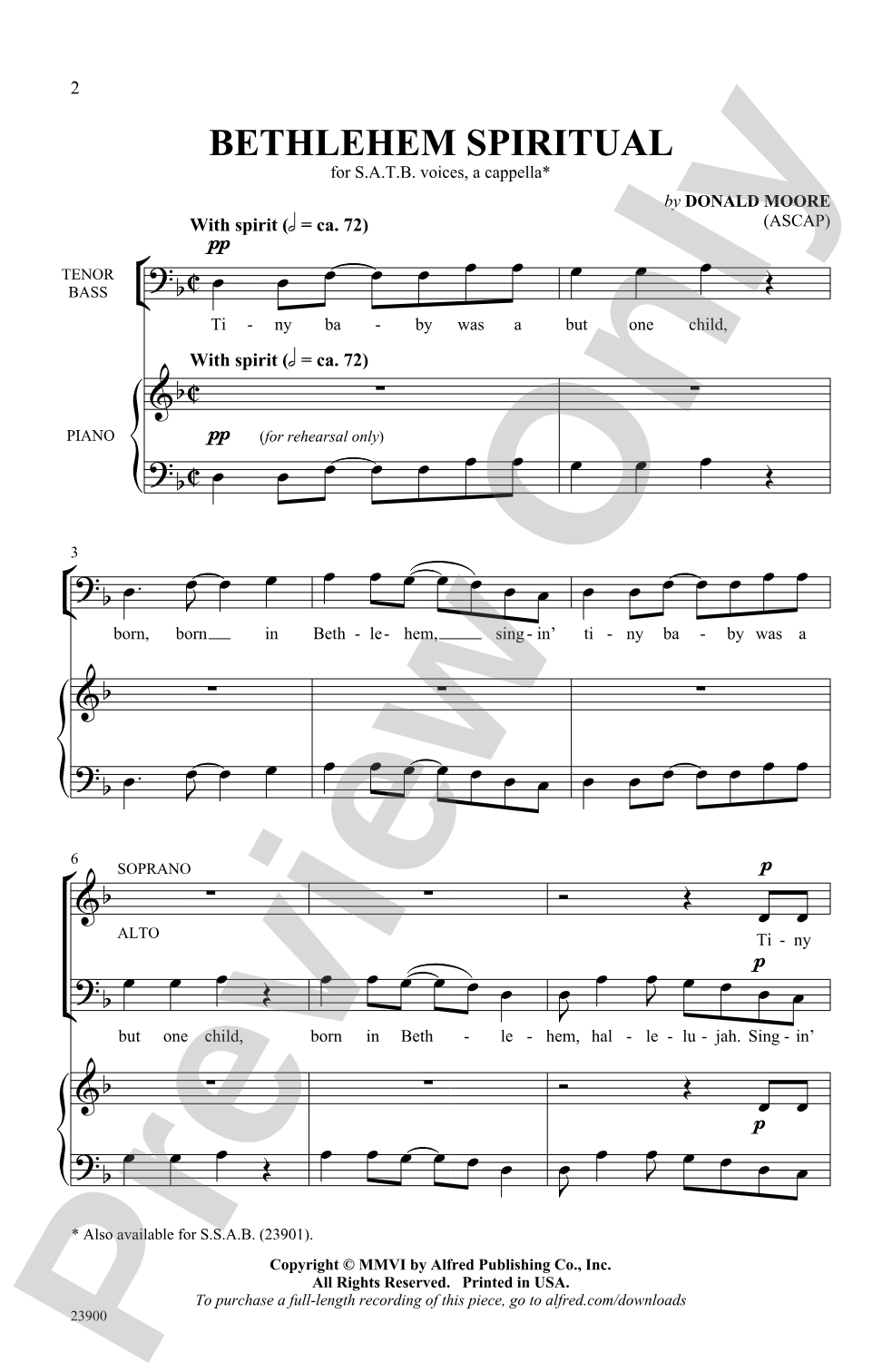
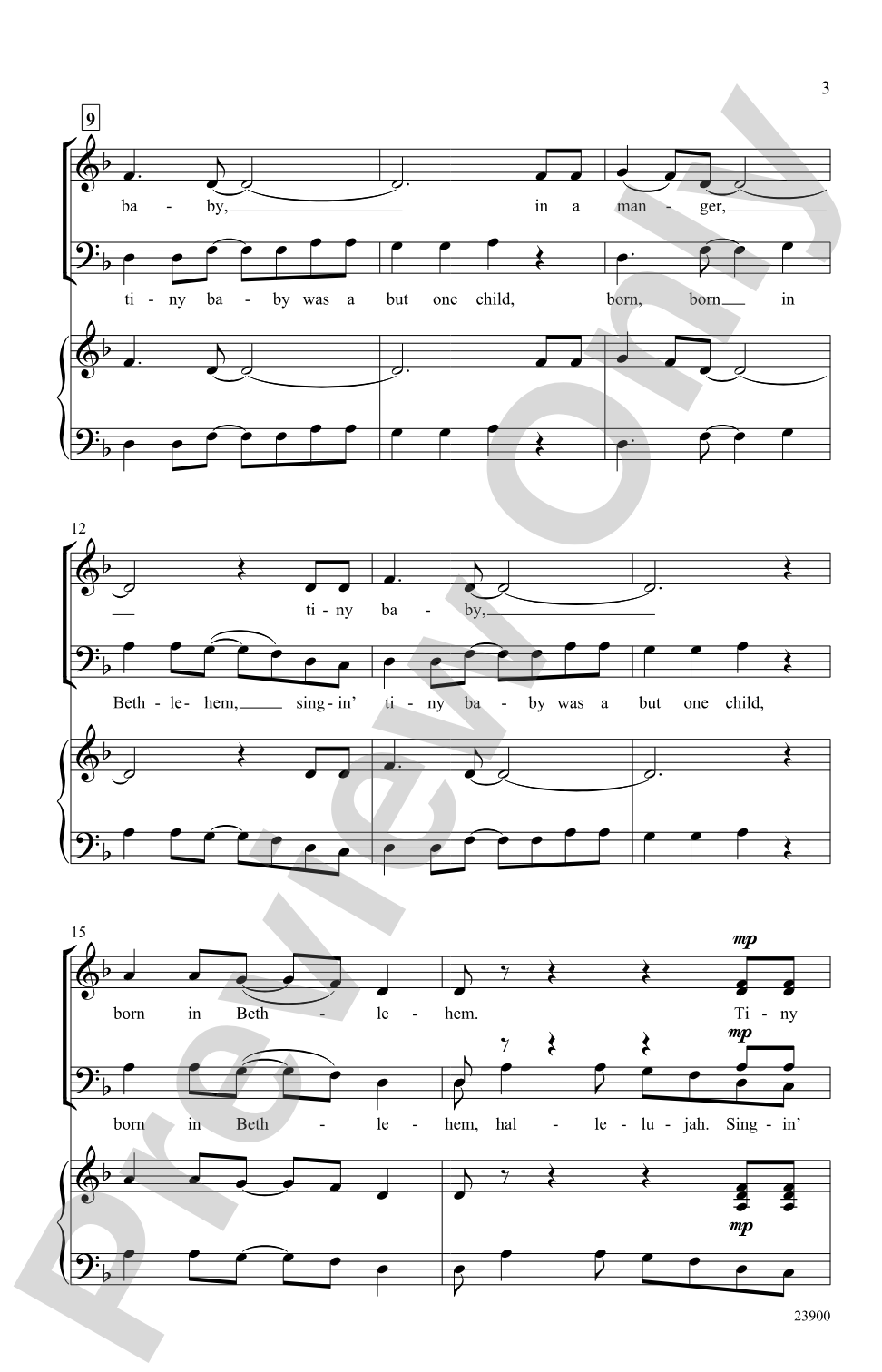
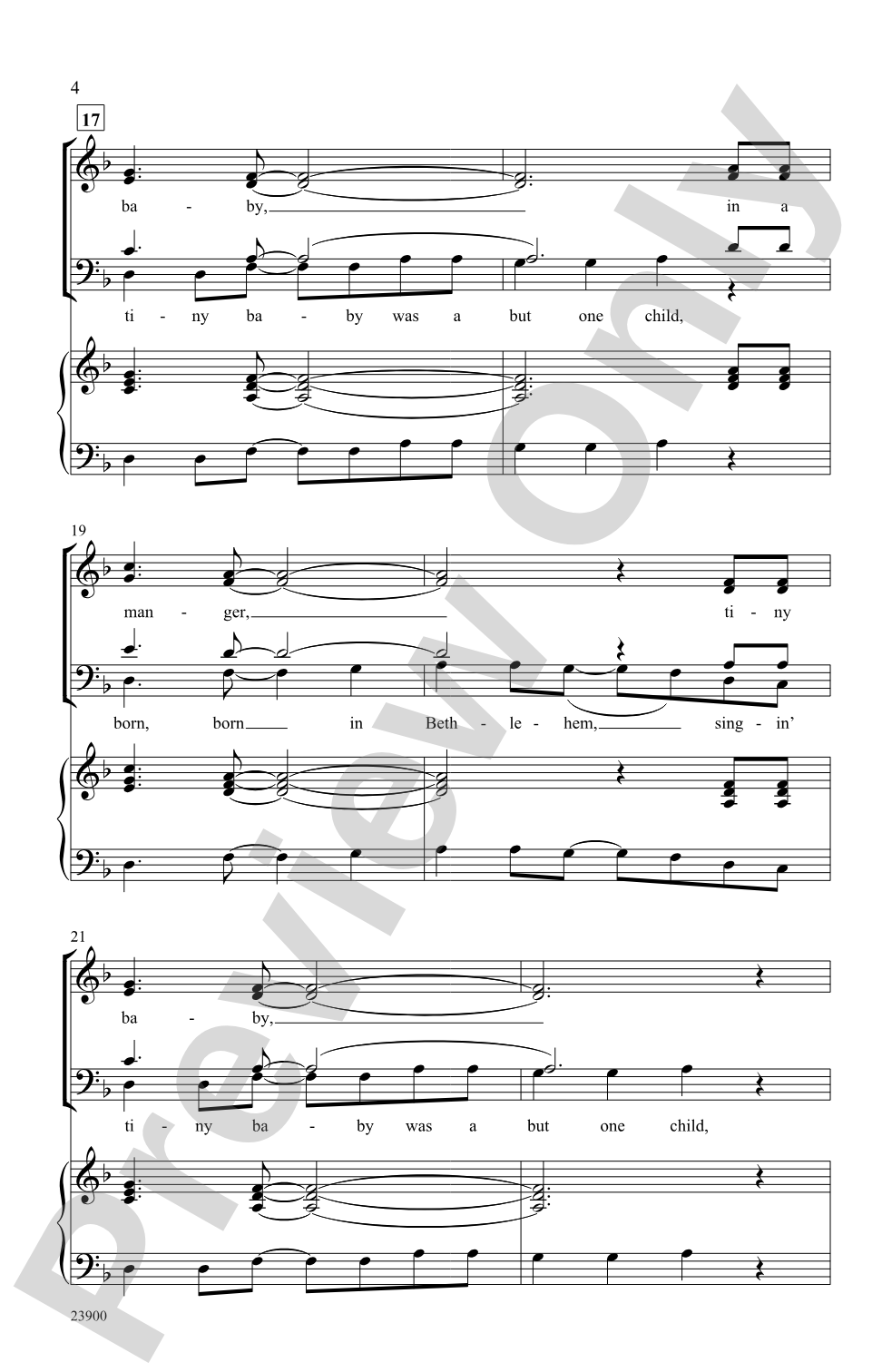

Bethlehem Spiritual: SATB, a cappella Choral Octavo
Words and music by Donald Moore
Item: 00-PO-0000013
$2.05
Minimum order quantity: 20 copies
Pickup currently not available
Related Items
Bethlehem Spiritual: SSAB, a cappella Choral Octavo |
$2.25
|
View | |
Bethlehem Spiritual: TTBB, a cappella Choral Octavo |
$1.85
|
View | |
Bethlehem Spiritual: SATB, a cappella Choral Octavo |
$2.05
|
View | |
Bethlehem Spiritual: SSAB, a cappella Choral Octavo |
$2.25
|
View | |
Bethlehem Spiritual: TTBB, a cappella Choral Octavo |
$1.85
|
View |
Description
The guys in your choir will shine singing this a cappella original that sounds like a traditional spiritual. Opens with a syncopated ostinato, adds a compelling minor-key melody, and expands into full four-part harmony. Gradually, voice parts disappear one by one, fading to the end. Newly Available for TTBB.


Bethlehem Spiritual: SATB, a cappella Choral Octavo isn't in MakeMusic Cloud just yet...but it could be. Let us know you'd like to see it, and you'll help shape what comes next. In the meantime, start a free trial and dive into thousands of interactive titles your students can play along with today.
Request This Title
Tell us you want it.
Start Your Free Trial
Explore everything that's ready to play right now.
Sample Audio
1
Audio File
--:--
0:00
0:00
Sample Video
No sample videos found.
Additional Details
Series:
Alfred Choral Designs
Publisher:
Alfred Music
Page Count:
12
SKU:
00-PO-0000013
More about this title
About the Composer: Donald Moore

Donald Moore earned his Bachelor of Music in organ performance and Master of Arts in Teaching from Kent State University. As Organist-Choirmaster at Pilgrim United Church of Christ in Cuyahoga Falls, Ohio, he brings both liturgical expertise and pedagogical vision to his work.
Moore has published over 500 compositions across sacred, secular, educational, and pop idioms with major publishers including Alfred Music, Hal Leonard, Heritage Music Press, and others. His works appear regularly at state and national music festivals; he is a seventeen-time recipient of the ASCAP Composers Standard Award and was recently recognized by the American Choral Directors Association as one of 400 composers of historical significance in American choral music.
Why we love this
Moore captures the harmonic warmth and rhythmic drive of traditional spirituals while crafting something entirely his own. The syncopated opening immediately engages singers and listeners alike, and the gradual reduction of voices toward the end creates a moment of genuine musical artistry that rewrites itself each time you perform it.
What to expect
The syncopated opening immediately establishes a rhythmic energy that feels both rooted in tradition and rhythmically urgent. As the minor-key melody enters and voices build into full four-part harmony, the piece expands into a moment of collective vocal power before gradually dissolving, leaving the final notes suspended like a benediction.
Who it's for
SATB choirs with solid intonation and rhythmic confidence will find this piece rewarding; the syncopation and harmonic language require singers who can lock in without accompaniment. This is an excellent choice for choirs ready to move beyond unison spirituals into genuine four-part arranging that still sounds authentic and accessible.
How to get the most out of it
- Establish the syncopated ostinato with precision in rehearsal before layering the melody; even small timing inconsistencies will undermine the groove that makes this piece distinctive.
- Shape the minor-key melody with phrasing that honors the spiritual tradition without oversentimentalizing it; think resilience rather than lament.
- Rehearse the voice part reductions carefully so each exit feels intentional and controlled rather than accidental; use dynamics and breath placement to signal what's happening.
- Balance the four-part harmony sections so no single voice drowns out the others; the strength of this arrangement lies in the blend, not individual projection.
How to use it
This works beautifully as a spiritual for Christmas services or holiday concerts, anchoring a program with its authentic character. It also stands on its own in secular contexts as a showcase for your choir's blend and intonation; consider pairing it with contrasting repertoire to highlight the piece's unique harmonic and rhythmic language.
Skills your students will build
- Syncopated rhythm reading and consistent ensemble execution in a cappella settings
- Pitch control and sustaining intonation without instrumental support across four parts
- Harmonic blend and balance in minor-key voicing
- Following a conductor's cues for dynamic shaping and voice part entries and exits
- Interpretation of spiritual style and emotional authenticity