
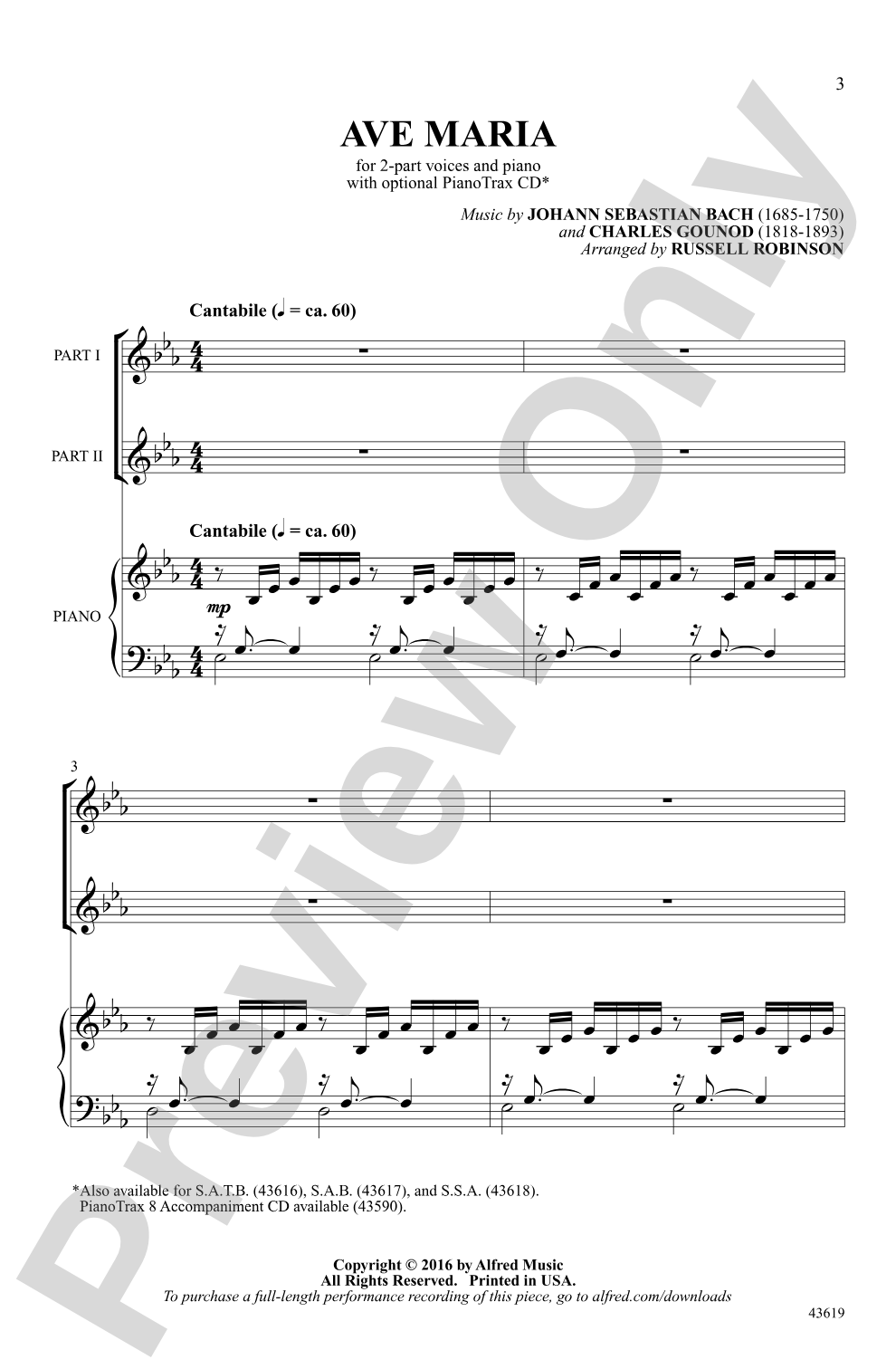

Ave Maria: 2-Part Choral Octavo
Music by Johann Sebastian Bach and Charles Gounod / arr. Russell Robinson
Item: 00-PO-0003591
$1.90
Minimum order quantity: 20 copies
Pickup currently not available
Description
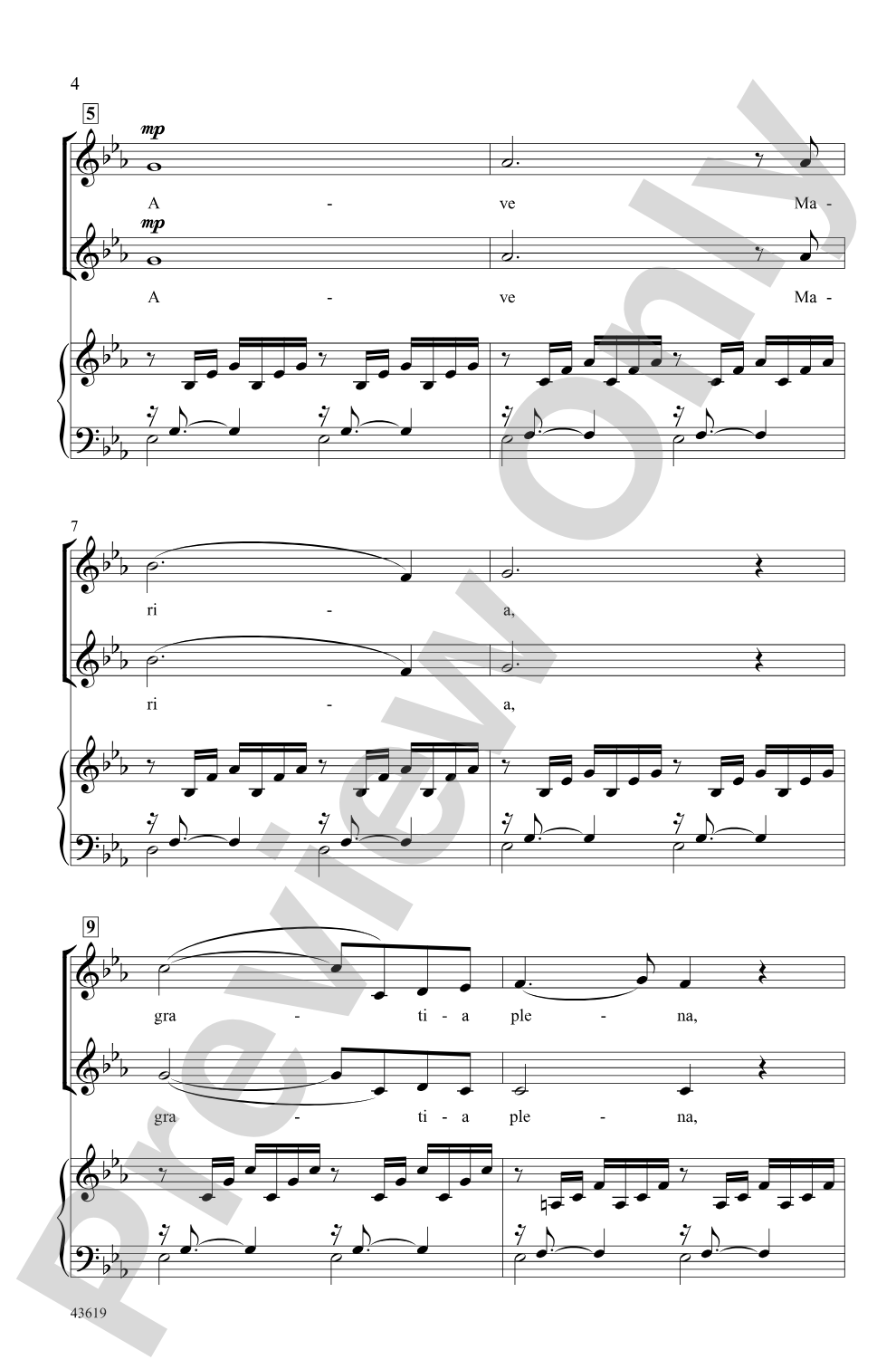
Introducing Gounod's beloved "Ave Maria," based on a prelude from J. S. Bach's Well-Tempered Clavier, in an accessible choral arrangement. The melody passes through all voices, while well-written choral parts provide support. An excellent way to introduce not one, but two master composers!


Ave Maria: 2-Part Choral Octavo isn't in MakeMusic Cloud just yet...but it could be. Let us know you'd like to see it, and you'll help shape what comes next. In the meantime, start a free trial and dive into thousands of interactive titles your students can play along with today.
Request This Title
Tell us you want it.
Start Your Free Trial
Explore everything that's ready to play right now.
Sample Audio
1
Audio File
--:--
0:00
0:00
Sample Video
No sample videos found.
Additional Details
Series:
Alfred Choral Designs
Publisher:
Alfred Music
Page Count:
12
SKU:
00-PO-0003591
More about this title
About the Composer: Johann Sebastian Bach
Johann Sebastian Bach (1685–1750) stands as one of the most influential composers in Western music history. His mastery of counterpoint, harmonic language, and structural design established foundations that composers have built upon for nearly three centuries. Bach's output spans sacred cantatas, instrumental works of staggering complexity, and keyboard music that remains central to music education across all levels.
Bach's Well-Tempered Clavier, from which this arrangement draws its harmonic foundation, represents a pinnacle of his keyboard writing. Originally conceived as a pedagogical work exploring all major and minor keys, it has become one of the most studied and performed collections in classical music. His ability to craft elegant melodies within rigorous harmonic frameworks makes his work endlessly adaptable to new contexts, as Gounod's later setting demonstrates.
Why we love this
This arrangement offers choral directors a rare opportunity to layer two canonical composers in a single rehearsal. Robinson's setting keeps the focus on the soaring melody while distributing it across all voices, ensuring every singer experiences the tune's elegance. The piece works equally well as a concert closer, festival selection, or a moment of genuine beauty in a mixed program.
What to expect
The piece radiates quiet dignity and reverence. Gounod's melody floats above Bach's harmonic foundation, creating a sense of uplift that feels both intimate and profound. Even in a simple two-part texture, the harmonic sophistication and melodic grace convey a timelessness that audiences recognize immediately.
Who it's for
Choirs with solid fundamentals in unison and basic two-part singing will find this piece accessible and rewarding. The arrangement suits intermediate-level choirs preparing for contests, festivals, or concert programming. Directors seeking literature that introduces singers to classical composition without overwhelming younger or less experienced ensembles have found success with this setting.
How to get the most out of it
- Balance the melody carrier with appropriate support from the accompanying voice part; the secondary line should enhance rather than compete with the primary tune.
- Shape the melody's arch by attending to breath placement; mark natural phrase breaks and resist the urge to breathe at every rest.
- Sustain pure vowel sounds on the Latin text, particularly on longer note values, to allow the harmonic richness to resonate fully.
- Work the piece in sections initially, identifying where each voice takes or yields the primary line, then rehearse full sections to build awareness of the overall trajectory.
How to use it
Program this as a concert encore or sacred section highlight; its brevity and emotional impact make it ideal for closing a set or providing contrast within a longer program. It works beautifully alongside other Bach arrangements or as a standalone moment of reflection in a festival competition. The piece also serves well as a teaching tool for introducing singers to the concept of harmonic accompaniment and motivic melody.
Skills your students will build
- Singing sustained legit lines while maintaining ensemble blend
- Reading and executing Latin text with proper vowel formation
- Understanding the relationship between melody and harmonic support in choral writing
- Listening to a secondary voice part without being pulled away from the primary melodic line