

Ave Maria: SSA Choral Octavo
Music by Johann Sebastian Bach and Charles Gounod / arr. Russell Robinson
Item: 00-PO-0003590
$1.90
Minimum order quantity: 20 copies
Pickup currently not available
Related Items
Ave Maria: SATB Choral Octavo |
$1.90
|
View | |
Ave Maria: SAB Choral Octavo |
$2.05
|
View | |
Ave Maria: 2-Part Choral Octavo |
$1.90
|
View | |
Ave Maria: SATB Choral Octavo |
$1.90
|
View | |
Ave Maria: SAB Choral Octavo |
$2.05
|
View | |
Ave Maria: SSA Choral Octavo |
$1.90
|
View | |
Ave Maria: 2-Part Choral Octavo |
$1.90
|
View |
Description
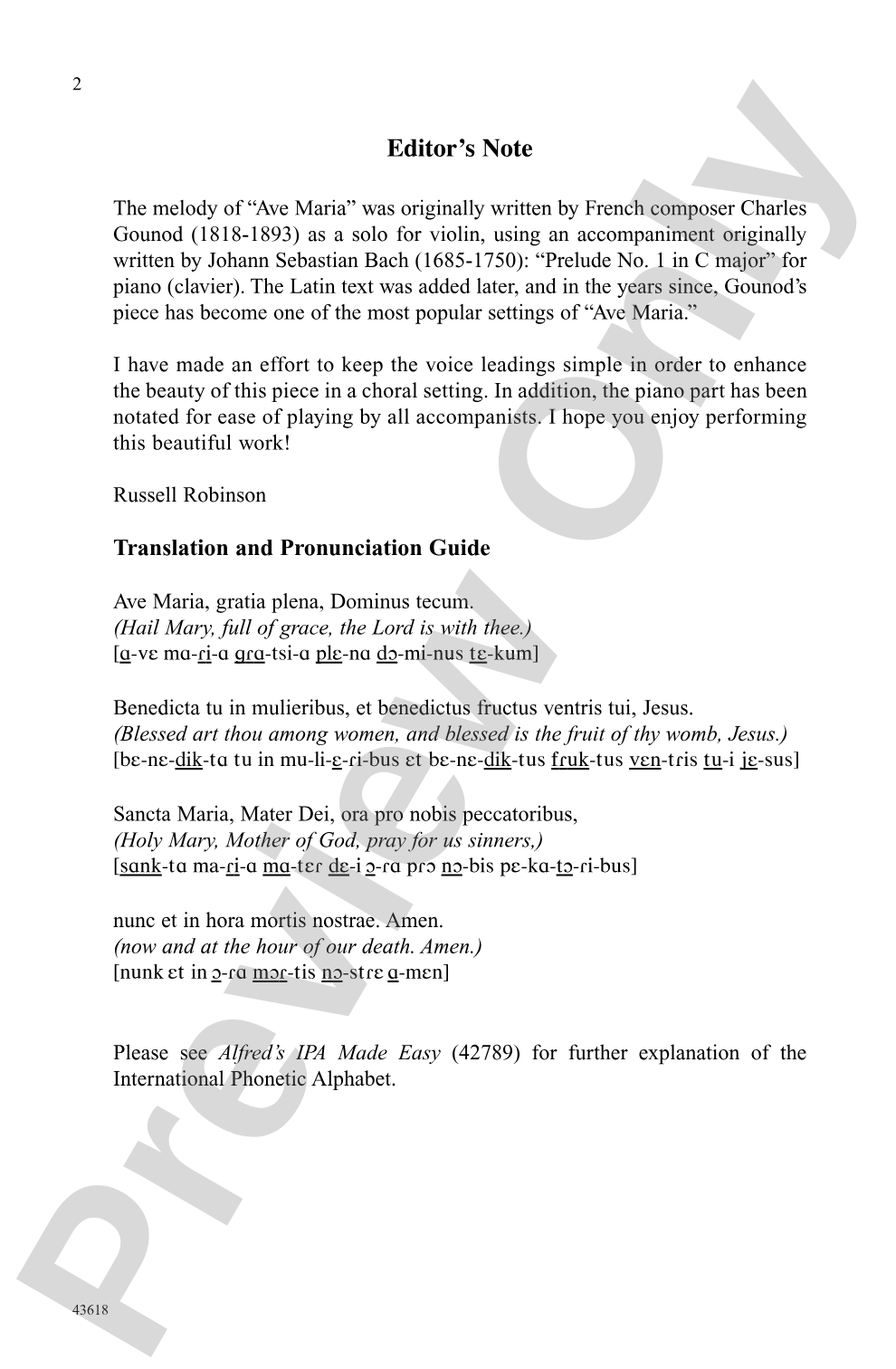
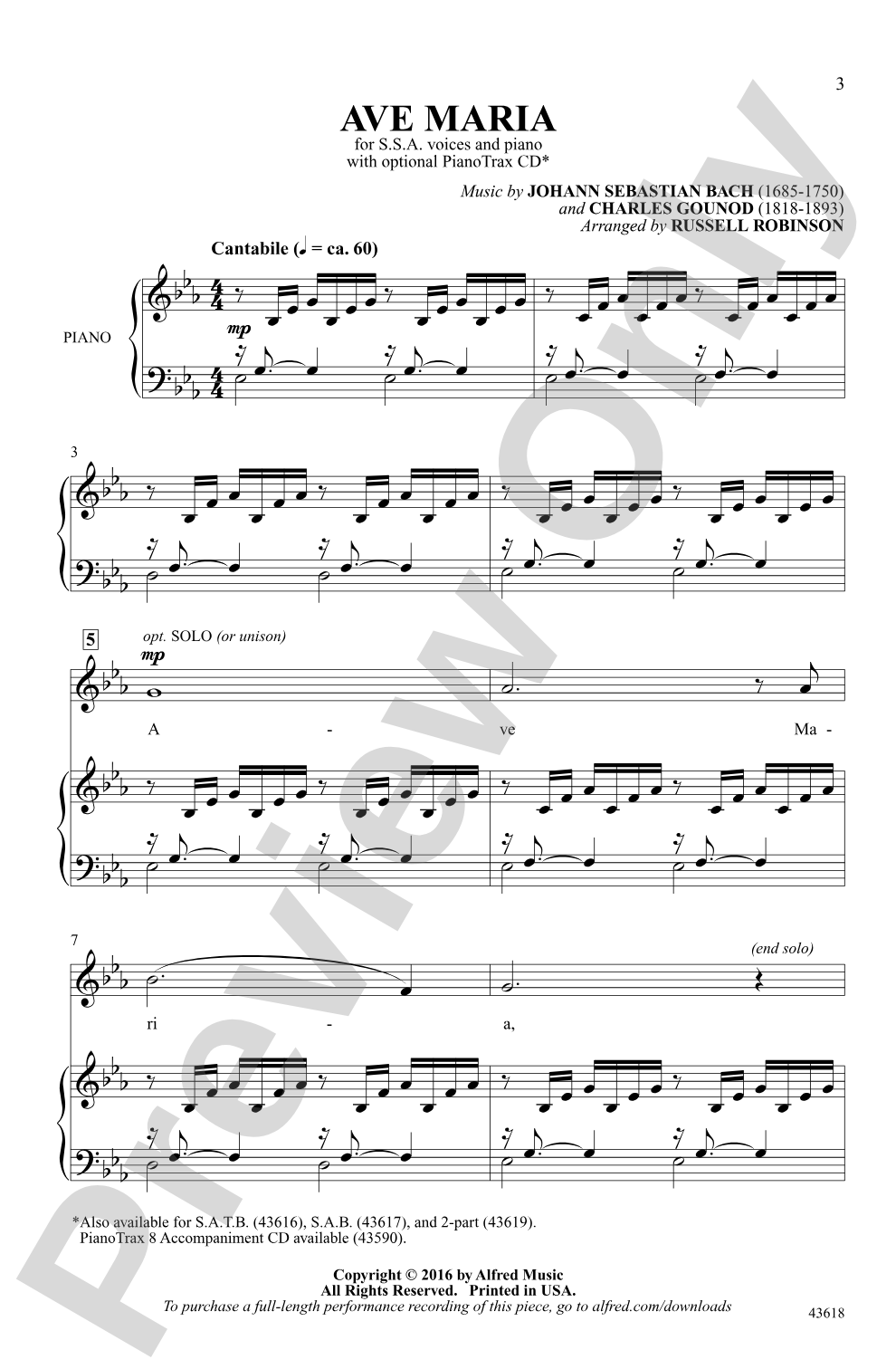
Introducing Gounod's beloved "Ave Maria," based on a prelude from J. S. Bach's Well-Tempered Clavier, in an accessible choral arrangement. The melody passes through all voices, while well-written choral parts provide support. An excellent way to introduce not one, but two master composers!


Ave Maria: SSA Choral Octavo isn't in MakeMusic Cloud just yet...but it could be. Let us know you'd like to see it, and you'll help shape what comes next. In the meantime, start a free trial and dive into thousands of interactive titles your students can play along with today.
Request This Title
Tell us you want it.
Start Your Free Trial
Explore everything that's ready to play right now.
Sample Audio
1
Audio File
--:--
0:00
0:00
Sample Video
No sample videos found.
Additional Details
Series:
Alfred Choral Designs
Publisher:
Alfred Music
Page Count:
12
SKU:
00-PO-0003590
More about this title
About the Composer: Johann Sebastian Bach
Johann Sebastian Bach (1685-1750) stands as one of history's most influential composers, creating a body of work that bridges the late Baroque and early Classical periods. His intricate counterpoint, harmonic innovation, and mastery of fugal writing established foundations that composers studied for centuries. The Well-Tempered Clavier, from which this piece's harmonic framework originates, remains a cornerstone of music education and performance.
Bach's influence extends far beyond his own era. Later composers, including Gounod, drew inspiration from his harmonic language and structural clarity. For choral directors, Bach's music teaches the relationship between individual voice independence and collective beauty, a principle that defines excellent choral writing.
Why we love this
This arrangement captures the prayer-like quality of Gounod's melodic gift while grounding it in Bach's harmonic sophistication. Russell Robinson's writing ensures that all three voices remain engaged and singable, avoiding the trap of reducing lower parts to mere accompaniment. Directors gain the pedagogical bonus of teaching two master composers simultaneously, making this an efficient and musically enriching choice for concert programming.
What to expect
Ave Maria carries the contemplative stillness of private prayer. Gounod's melody floats over Bach's steady harmonic foundation, creating a sense of support and grace rather than drama. The piece feels unhurried and reverent, inviting singers and audiences alike into a moment of genuine musical reflection.
Who it's for
This octavo works well for treble choirs of intermediate to advancing singers who have solid intonation and understand how to balance parts. It's accessible enough for a developing choir to learn quickly, yet sophisticated enough to hold the attention of experienced singers. Directors preparing for festivals, sacred concerts, or those seeking repertoire that combines spiritual depth with compositional education will find this valuable.
How to get the most out of it
- Encourage singers to hear the harmonic movement beneath the melody; Bach's progression creates its own emotional arc that supports the text without requiring extra interpretive gestures.
- Balance the melody line carefully across voices since it passes through all three parts. Mark where the tune moves so singers understand when they're accompanying and when they're carrying the primary voice.
- Shape phrases around the text's cadences rather than measure lines. The prayer's natural punctuation often falls between bar lines, and following that arc keeps the piece from feeling metrically rigid.
- Use dynamics conservatively. This piece's power comes from clarity and blend rather than dramatic contrast; keep the dynamic range modest to maintain intimacy appropriate to a sacred text.
How to use it
Program this alongside other sacred works to anchor a concert's devotional arc, or pair it with secular pieces to highlight masterwork arrangements as a compositional approach. It also fits naturally into a "Composers Teaching Composers" concert that explores musical lineage and influence. Consider placing it toward the end of a concert where its gentle character and spiritual content can provide a meaningful close.
Skills your students will build
- Voice independence and part awareness in three-part writing
- Tracking a melodic line as it moves between voice parts
- Balancing melody and accompaniment roles within a single arrangement
- Interpreting baroque harmonic progressions through singing
- Phrase shaping aligned with text rather than bar lines