

Ave Maria: SATB Choral Octavo
Music by Johann Sebastian Bach and Charles Gounod / arr. Russell Robinson
Item: 00-PO-0003588
$1.90
Minimum order quantity: 20 copies
Pickup currently not available
Related Items
Ave Maria: SAB Choral Octavo |
$2.05
|
View | |
Ave Maria: SSA Choral Octavo |
$1.90
|
View | |
Ave Maria: 2-Part Choral Octavo |
$1.90
|
View | |
Ave Maria: SATB Choral Octavo |
$1.90
|
View | |
Ave Maria: SAB Choral Octavo |
$2.05
|
View | |
Ave Maria: SSA Choral Octavo |
$1.90
|
View | |
Ave Maria: 2-Part Choral Octavo |
$1.90
|
View |
Description
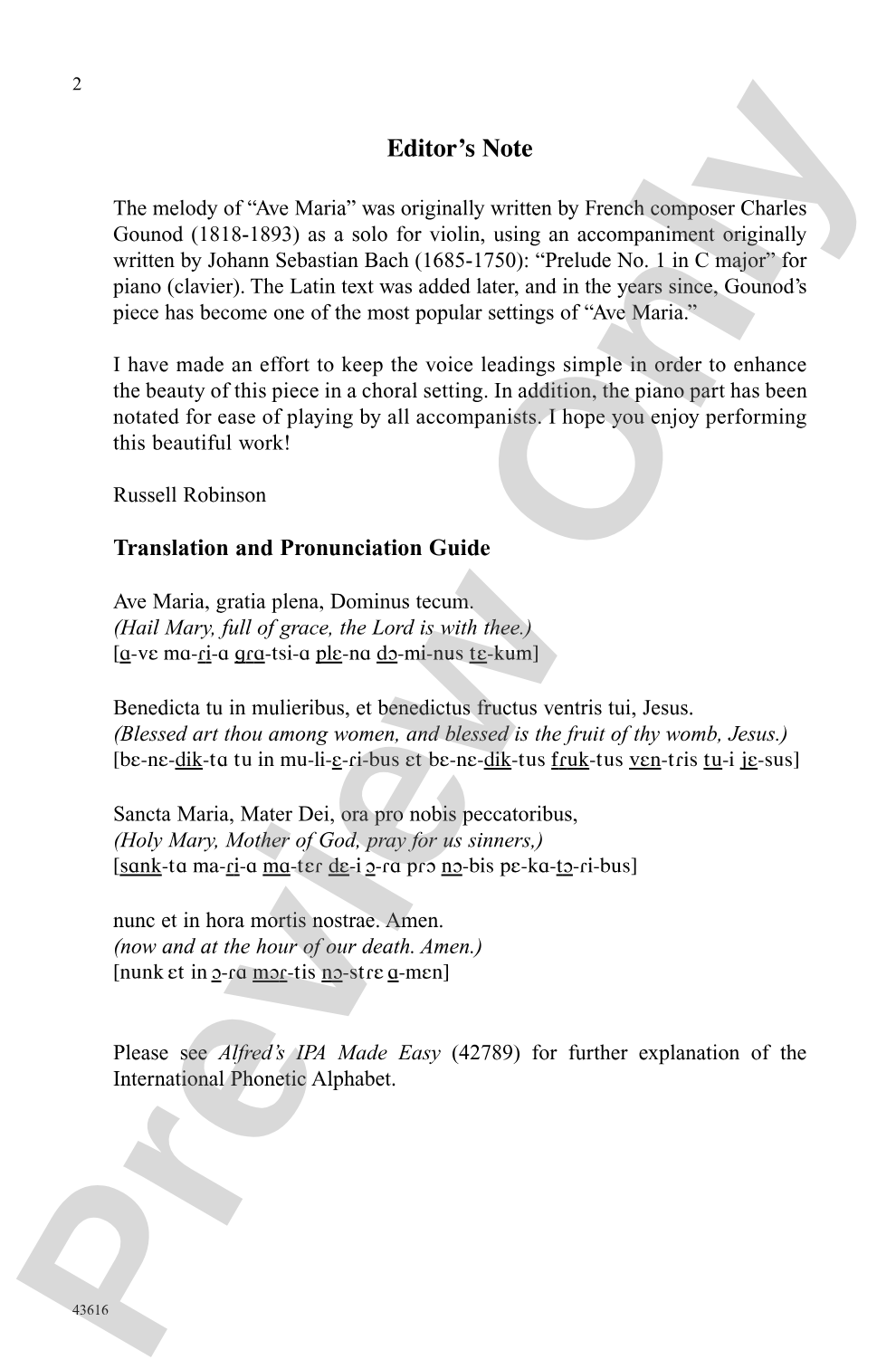
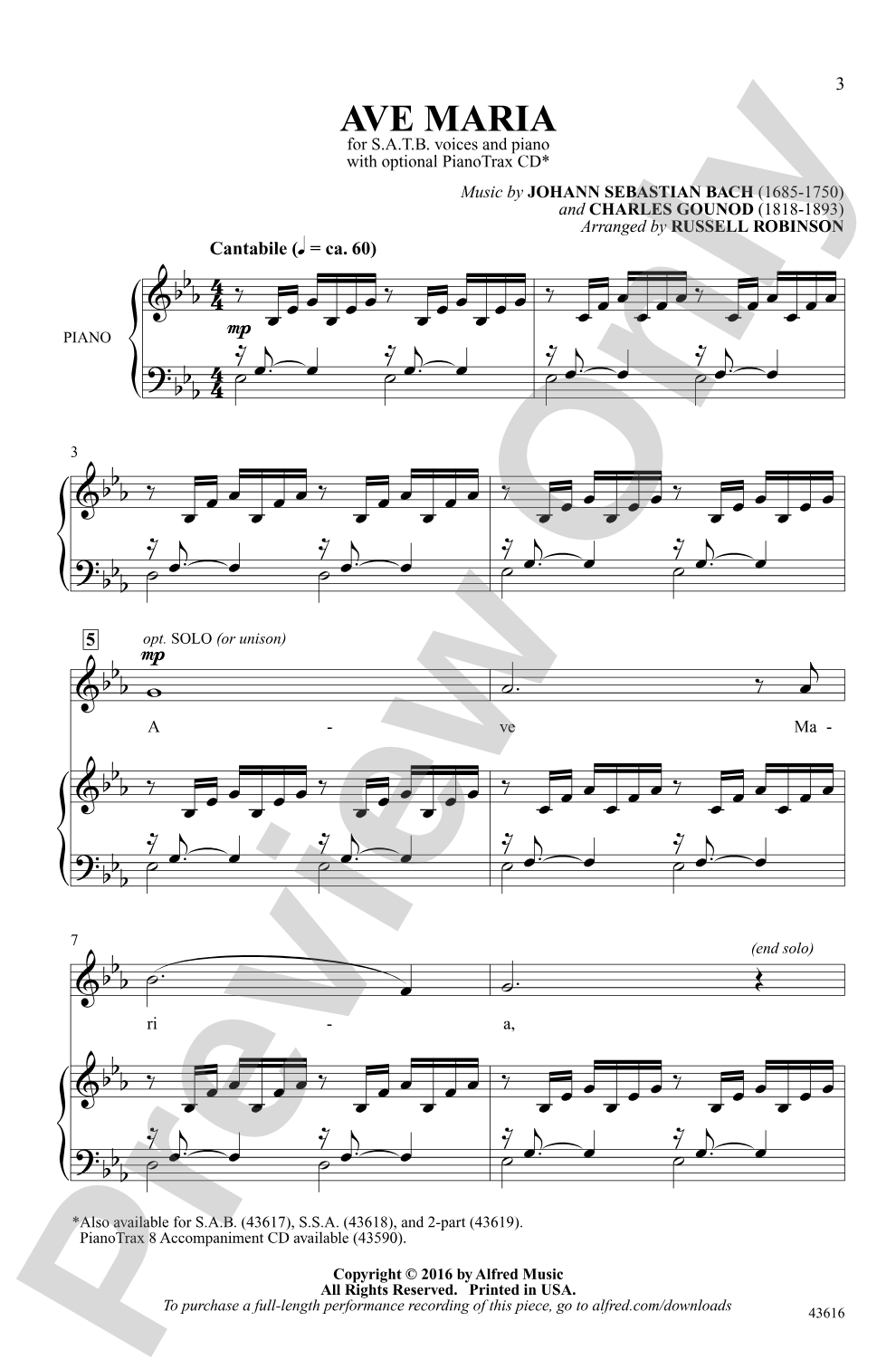
Introducing Gounod's beloved "Ave Maria," based on a prelude from J. S. Bach's Well-Tempered Clavier, in an accessible choral arrangement. The melody passes through all voices, while well-written choral parts provide support. An excellent way to introduce not one, but two master composers!


Ave Maria: SATB Choral Octavo isn't in MakeMusic Cloud just yet...but it could be. Let us know you'd like to see it, and you'll help shape what comes next. In the meantime, start a free trial and dive into thousands of interactive titles your students can play along with today.
Request This Title
Tell us you want it.
Start Your Free Trial
Explore everything that's ready to play right now.
Sample Audio
1
Audio File
--:--
0:00
0:00
Sample Video
Additional Details
Series:
Alfred Choral Designs
Publisher:
Alfred Music
Page Count:
12
SKU:
00-PO-0003588
More about this title
About the Composer: Johann Sebastian Bach
Johann Sebastian Bach (1685-1750) stands as one of history's most profound and systematic composers. His mastery of counterpoint, fugal writing, and harmonic innovation shaped the course of Western music. Bach's output across all genres—from sacred cantatas to instrumental works—reveals a composer driven by both technical brilliance and deep spiritual conviction.
Why we love this
Russell Robinson's arrangement honors both composers by letting the melody sing through every voice while maintaining the harmonic richness of Gounod's original meditation on Bach's prelude. Your singers get to experience one of the most recognizable melodies in sacred music while engaging with Bach's architecture underneath. It's a sophisticated choice that doesn't require a soprano-heavy soprano section to succeed.
What to expect
This arrangement unfolds as a gentle spiral of voices, each one discovering the melody anew. The harmonic language feels both reverent and intimate, drawing listeners into a space of quiet contemplation. There's beauty in how the familiar tune emerges from different voices, creating unity while honoring the individual character of each part.
Who it's for
Choirs ready to tackle music where all four voices carry melodic responsibility. This works for treble-dominated ensembles, mixed choirs with solid lower voices, and chamber choirs seeking repertoire that balances accessibility with musical depth. Contest and festival performers will appreciate material that demonstrates sophisticated arranging without excessive technical demands.
How to get the most out of it
- Balance the melody carrier against the supporting voices each time it shifts. The handoff between parts needs clarity without sacrificing the legato line that defines this piece.
- Shape the phrase arcs collaboratively. Because all voices share the tune at different moments, every section becomes responsible for maintaining the piece's lyrical momentum.
- Keep the accompaniment transparent. The harmonic foundation matters, but it should never overshadow the flowing melodic line that connects all four parts.
- Use a moderate tempo that allows singers to sustain long phrases without rushing. This arrangement rewards singers who can control breath placement across complete musical ideas.
How to use it
Position this as a centerpiece for a sacred music concert or as a bridge between repertoire exploring Baroque influences and later Romantic arrangers. It pairs well with unaccompanied settings of Bach originals or with other spirituals and hymn arrangements. The familiar melody makes it accessible for opening programs aimed at broader audiences while the compositional sophistication keeps musicians engaged.
Skills your students will build
- Voice independence while maintaining phrase cohesion across multiple simultaneous melodic lines
- Recognition of motivic material moving between voice parts
- Sustaining expressive long tones while singing accompanying harmony
- Understanding how arrangers adapt and layer existing compositions