
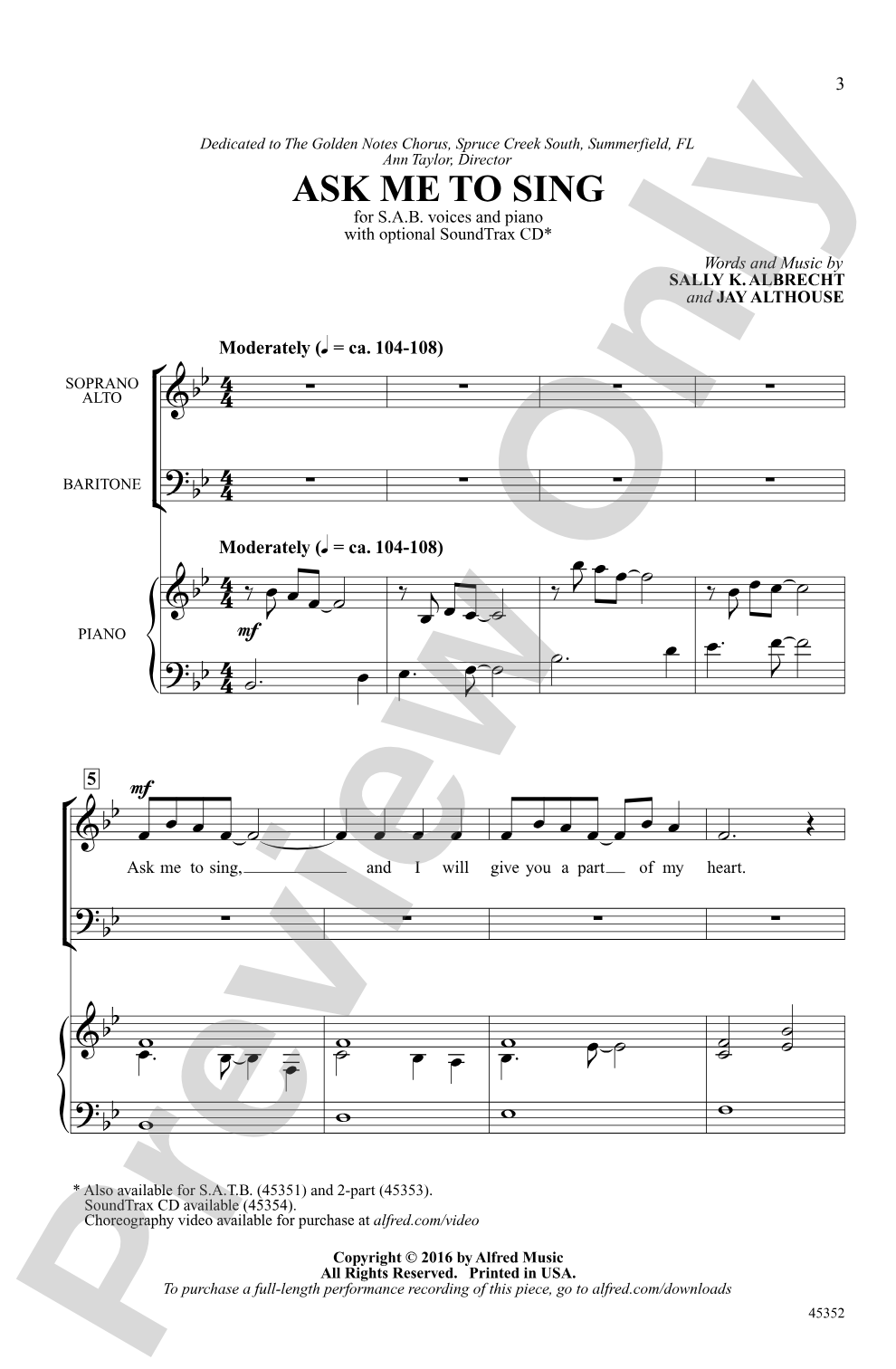
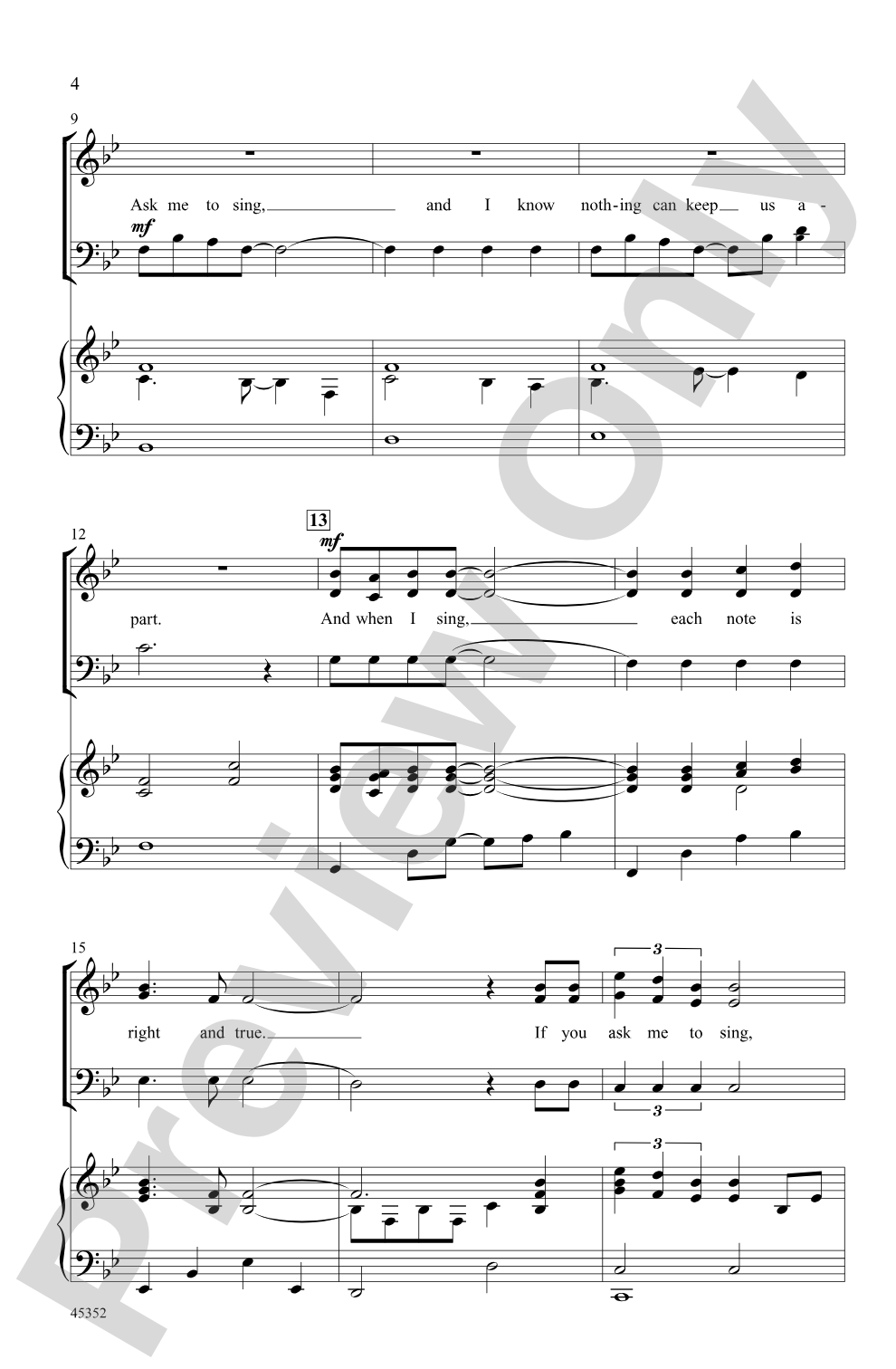

Ask Me to Sing: SAB Choral Octavo
Words and music by Sally K. Albrecht and Jay Althouse
Item: 00-PO-0003611
$1.90
Minimum order quantity: 20 copies
Pickup currently not available
Related Items
Ask Me to Sing: SoundTrax Digital Audio Download |
$27.99
|
View | |
Ask Me to Sing: SATB Choral Octavo |
$2.05
|
View | |
Ask Me to Sing: 2-Part Choral Octavo |
$1.90
|
View | |
Ask Me to Sing: SATB Choral Octavo |
$2.05
|
View | |
Ask Me to Sing: SAB Choral Octavo |
$1.90
|
View | |
Ask Me to Sing: 2-Part Choral Octavo |
$1.90
|
View | |
Ask Me to Sing: Choral Octavo SoundTrax CD |
$27.99
|
View |
Description
"Ask me to sing, and I'll give you a part of my soul. Ask me to sing, and I feel happy and hopeful and whole." Powerful as an opener, closer, or for a combined choir concert, this inspirational contemporary musical-theater-style choral opens simply and builds to an exquisite finish. Don't miss the choreography on the Step One! DVD and at alfred.com/video.


Ask Me to Sing: SAB Choral Octavo isn't in MakeMusic Cloud just yet...but it could be. Let us know you'd like to see it, and you'll help shape what comes next. In the meantime, start a free trial and dive into thousands of interactive titles your students can play along with today.
Request This Title
Tell us you want it.
Start Your Free Trial
Explore everything that's ready to play right now.
Sample Audio
1
Audio File
--:--
0:00
0:00
Sample Video
No sample videos found.
Additional Details
Series:
Alfred Choral Designs
Publisher:
Alfred Music
Page Count:
12
SKU:
00-PO-0003611
More about this title
About the Composer: Sally K. Albrecht
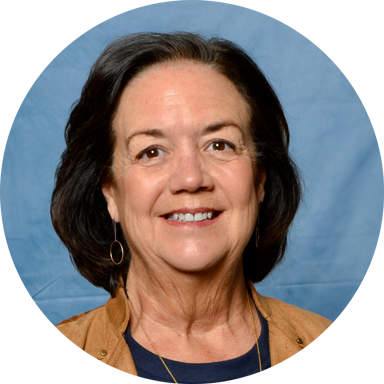
Sally K. Albrecht has shaped the landscape of contemporary choral music for over three decades, first as Director of School Choral, Vocal, and Elementary Publications at major educational music publishers and later as a sought-after clinician and conductor. Since 1987, she has received annual ASCAP Special Music Awards and maintains over 600 choral publications in print, alongside 75 larger works for stage and concert. Her conducting has graced honor choir festivals at Lincoln Center, Carnegie Hall, and The Kennedy Center, and her particular expertise in choral movement has influenced how directors approach physicality and expression in the rehearsal room.
Albrecht earned degrees from Rollins College (B.A., Music and Theater, 1976), the University of Miami (M.A. in Drama, 1977; M.M. in Accompanying, 1979), and has taught at Oakland University, Jersey City State College, and Meredith College. She served as Chair of the Board of Trustees for Omicron Delta Kappa National Leadership Honor Society and received their "Pillar of Leadership" award. In 2021, both the University of Miami Frost School of Music and Rollins College honored her as a Distinguished Alumna. She lives in Wake Forest, North Carolina with her husband, composer and arranger Jay Althouse.
Why we love this
Albrecht and Althouse have crafted a piece that works equally well as a concert bookend or a competitive showcase; the progression from intimate vulnerability to soaring finish gives singers genuine arc to perform. The accessible SAB voicing invites broader participation without sacrificing harmonic interest, and the contemporary musical-theater idiom resonates with students who might not connect with traditional choral idioms. Choreography options (available through Step One! DVD and online) transform a solid piece into a memorable moment without requiring dancers or elaborate staging.
What to expect
The piece opens like a confession, quiet and vulnerable, with lyrics that ask singers to consider their own relationship to music-making. From that intimate beginning, the harmonies widen and the accompaniment swells until the finish arrives with genuine uplift, leaving singers and listeners feeling affirmed and hopeful.
Who it's for
Middle school and high school choirs, treble-focused ensembles, and combined choirs seeking repertoire that balances accessibility with artistic depth. Directors programming concert openers or closers will find this piece immediately engaging for singers and audiences alike.
How to get the most out of it
- Begin with minimal accompaniment or unaccompanied singing in the opening phrase to establish the intimate, personal quality; build the texture gradually as the piece develops so the choir feels the emotional architecture they're constructing.
- Attend to the text as actively as the melody. The specificity of "Ask me to sing, and I'll give you a part of my soul" demands genuine phrasing and breath choices that honor meaning, not just musical phrases.
- If using the recorded accompaniment, rehearse without it first so students own the harmonic progression and tempo before relying on external support.
- Keep the finish soaring but not rushed; the exquisite ending Albrecht has written needs time to resonate both acoustically and emotionally in the hall.
How to use it
Program this as a concert opener to set an emotional and artistic tone immediately, or as a powerful closer that sends the audience home with inspiration. The contemporary musical-theater style bridges traditional and popular idioms, making it effective when programming alongside both standard choral repertoire and newer works.
Skills your students will build
- Balancing unaccompanied singing with accompaniment support
- Building dynamic and textural intensity over extended phrases
- Sustaining legit singing tone in a contemporary musical-theater idiom
- Text interpretation and emotional authenticity in performance
- Three-part SAB voice independence while maintaining blend