
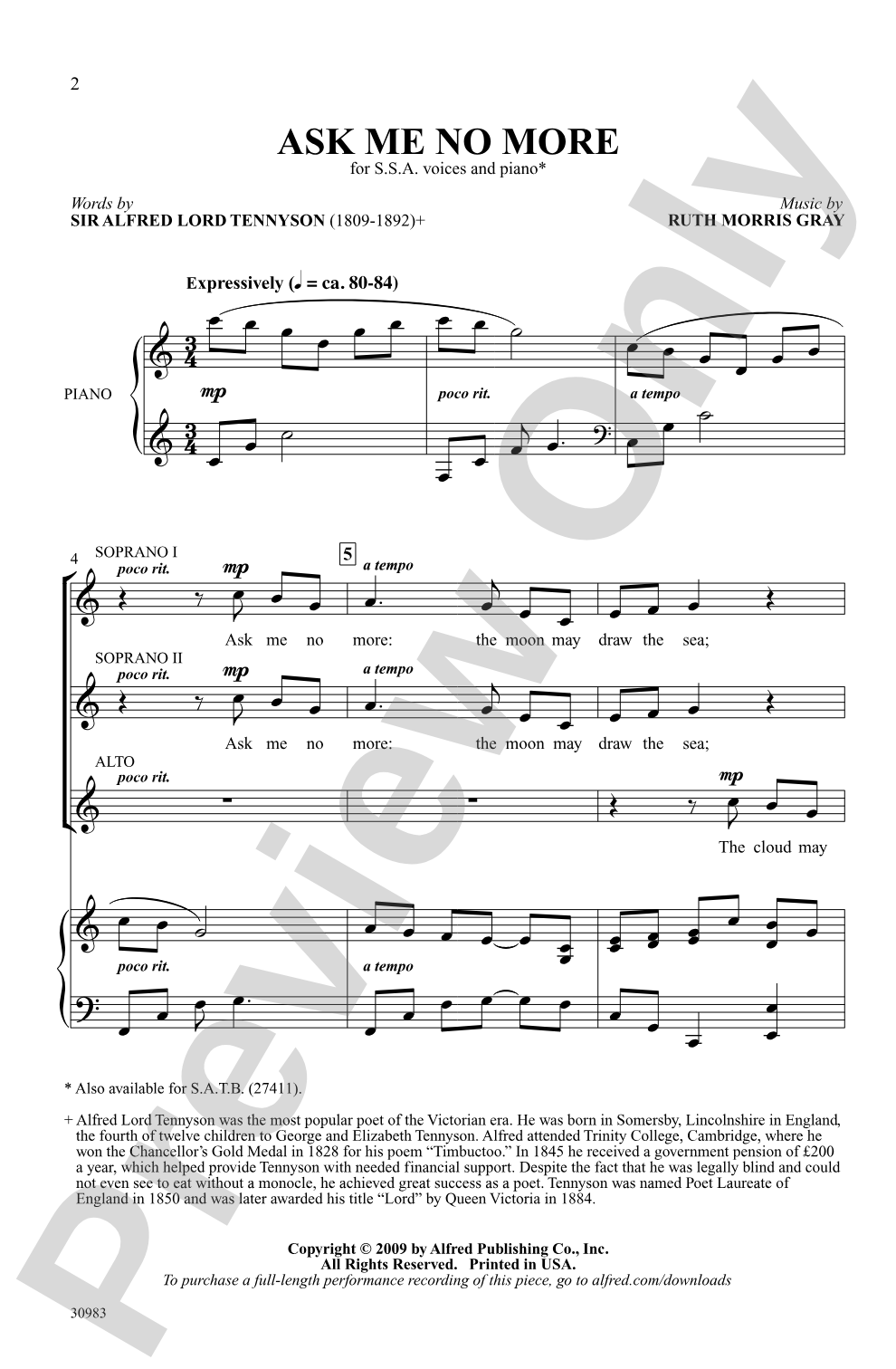
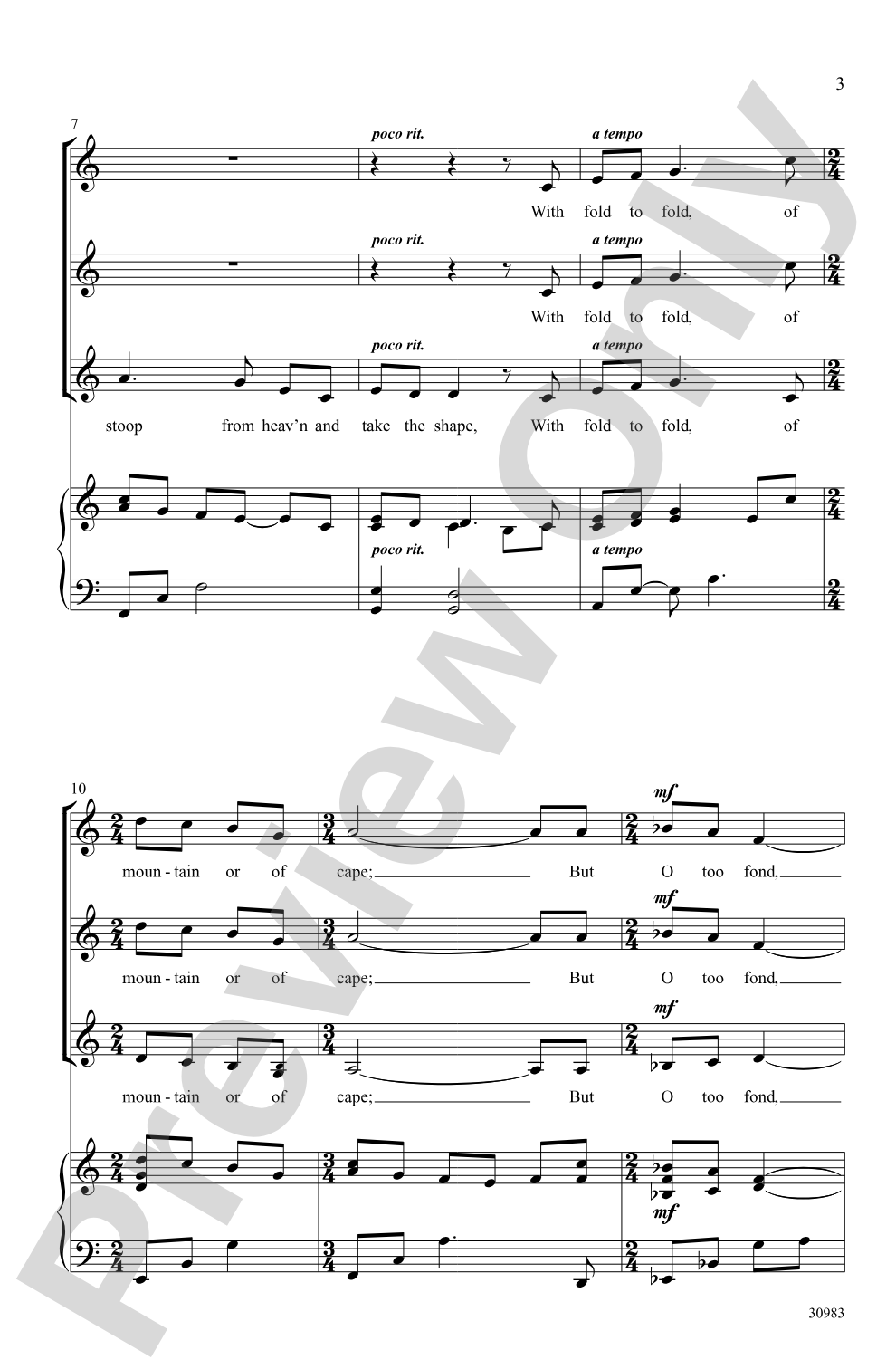

Ask Me No More: SSA Choral Octavo
Text by Sir Alfred Lord Tennyson, music by Ruth Morris Gray
Item: 00-PO-0000731
$2.25
Minimum order quantity: 20 copies
Pickup currently not available
Description
The words of Sir Alfred Lord Tennyson are beautifully set in this lush, contemporary choral for distinguished choirs. Seamless metric changes, rich vocal harmonies, and a graceful piano motif vividly capture the poetic mood. An exquisite work with a haunting melodic theme.


Ask Me No More: SSA Choral Octavo isn't in MakeMusic Cloud just yet...but it could be. Let us know you'd like to see it, and you'll help shape what comes next. In the meantime, start a free trial and dive into thousands of interactive titles your students can play along with today.
Request This Title
Tell us you want it.
Start Your Free Trial
Explore everything that's ready to play right now.
Sample Audio
1
Audio File
--:--
0:00
0:00
Sample Video
No sample videos found.
Additional Details
Series:
Lawson-Gould
Publisher:
Alfred Music
Page Count:
12
SKU:
00-PO-0000731
More about this title
About the Composer: Ruth Morris Gray

Ruth Morris Gray has composed over 100 choral works while directing choirs at Rosemead High School since 2004. She holds a Bachelor of Music in Piano Performance and Composition from Biola University and a Master of Arts in Music Composition from UC Santa Barbara, along with her California Single Subject Music Credential from Cal State Northridge.
Beyond the rehearsal room, Gray brings her passions for travel, reading, and active pursuits (including e-biking with her husband, Douglas) into her compositions. Her dual expertise in piano and voice informs the sophisticated harmonic language and vocal writing that characterize her published works.
Why we love this
Gray captures Tennyson's emotional restraint through compositional restraint, letting the metric shifts and harmonic richness do the heavy lifting rather than overselling the sentiment. This is the kind of contemporary choral writing that impresses adjudicators and audiences alike because it trusts the text and the singers to carry meaning.
What to expect
The piece unfolds with quiet elegance, its lush harmonies and seamless metric shifts creating a dreamlike intimacy. There's a haunting quality to the melodic line—poignant without being sentimental, reflective without lingering too long on any single emotion.
Who it's for
This work suits advanced or competitive SSA choirs with secure sight-readers and attention to nuance. It's ideal for distinguished ensembles preparing for festivals or contests who want a contemporary piece that showcases lyrical maturity and harmonic sophistication.
How to get the most out of it
- Approach the metric changes as natural speech patterns rather than technical obstacles; mark the transitions in rehearsal as emotional or textual anchors so singers understand when and why the meter shifts.
- Balance the vocal lines so the haunting melodic theme remains audible across all three parts; the piano motif should frame the voices without competing for attention.
- Pay attention to vowel shaping through the rich harmonic progressions; sustain clarity in the upper voices where the delicate textures live.
How to use it
Program this alongside other contemporary art songs or romantic-era poetry settings to create a cohesive recital section. Its refined character makes it particularly effective in a concert devoted to Tennyson or 19th-century literature, where it can bridge classical and modern sensibilities.
Skills your students will build
- Singing through metric modulation while maintaining phrasing integrity
- Balancing three-part SSA textures with independent melodic lines
- Interpreting literary meaning through contemporary harmonic language
- Ensemble precision in works with complex rhythmic relationships