
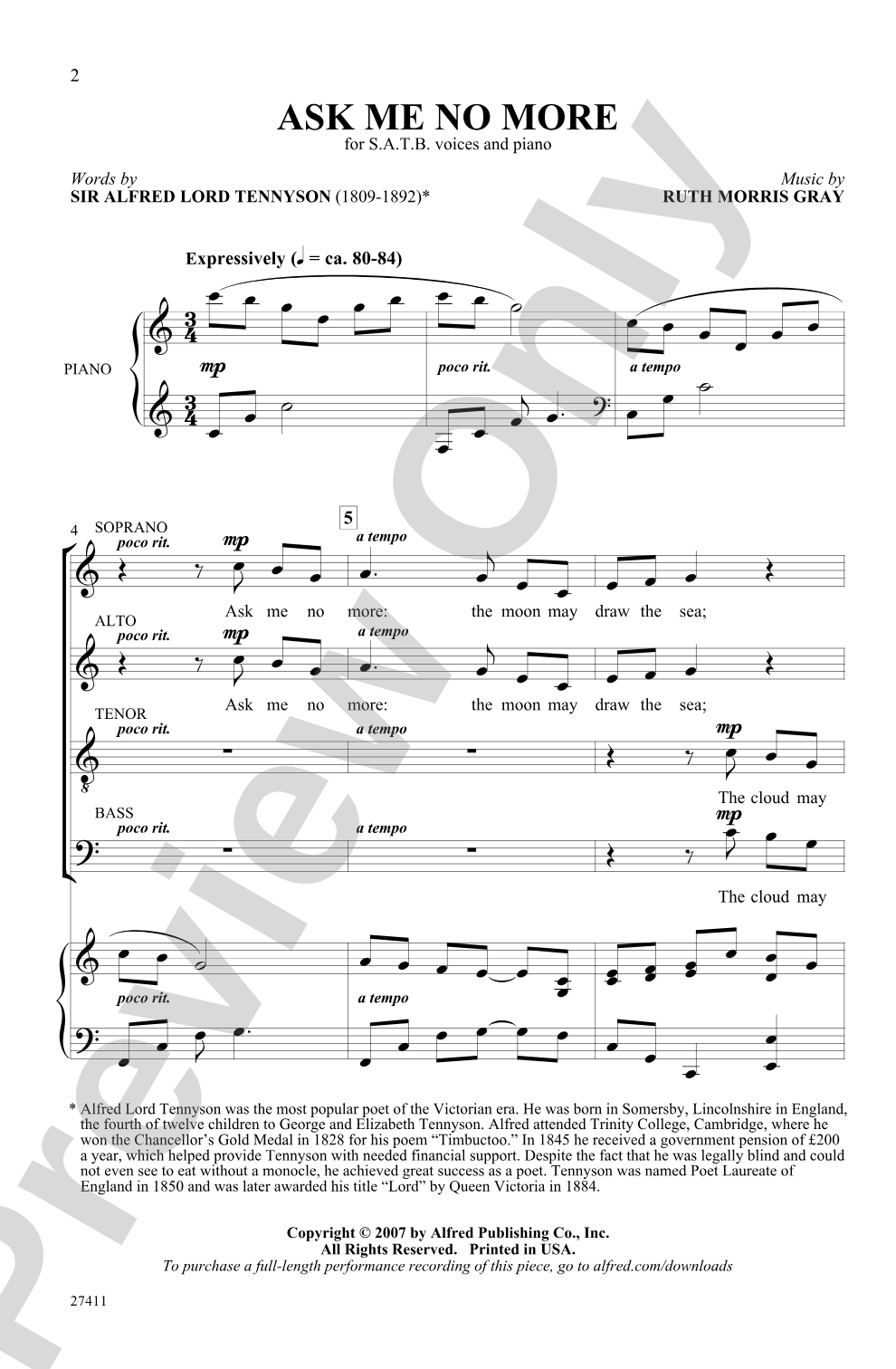
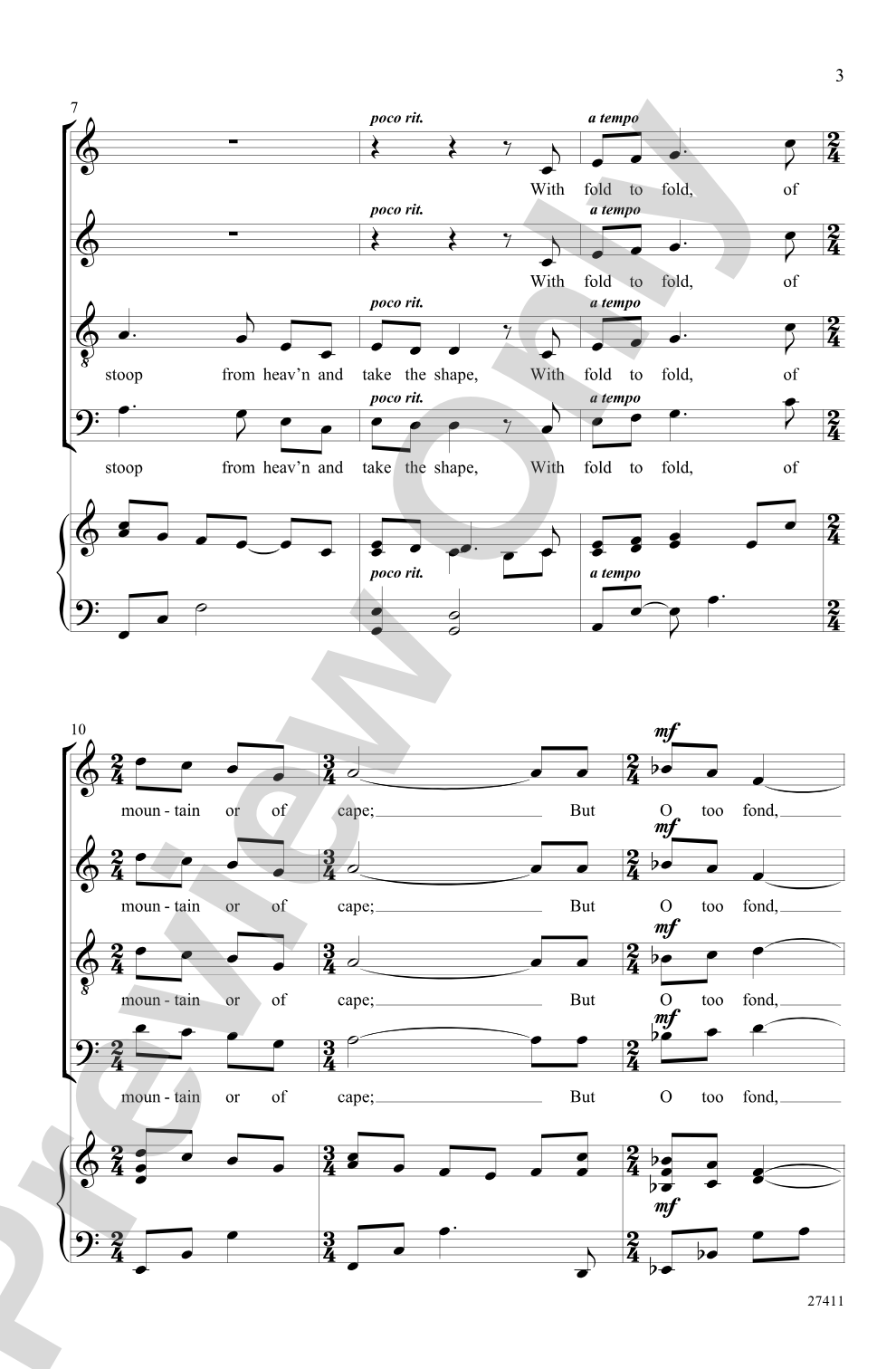

Ask Me No More: SATB Choral Octavo
Text by Sir Alfred Lord Tennyson, music by Ruth Morris Gray
Item: 00-PO-0000405
$2.25
Minimum order quantity: 20 copies
Pickup currently not available
Description
The words of Sir Alfred Lord Tennyson are beautifully set in this lush, contemporary choral for distinguished choirs. Seamless metric changes, rich vocal harmonies, and a graceful piano motif vividly capture the poetic mood. An exquisite work with a haunting melodic theme.


Ask Me No More: SATB Choral Octavo isn't in MakeMusic Cloud just yet...but it could be. Let us know you'd like to see it, and you'll help shape what comes next. In the meantime, start a free trial and dive into thousands of interactive titles your students can play along with today.
Request This Title
Tell us you want it.
Start Your Free Trial
Explore everything that's ready to play right now.
Sample Audio
1
Audio File
--:--
0:00
0:00
Sample Video
No sample videos found.
Additional Details
Series:
Alfred Archive Edition: Lawson-Gould Music Publishers
Publisher:
Alfred Music
Page Count:
12
SKU:
00-PO-0000405
More about this title
About the Composer: Ruth Morris Gray

Ruth Morris Gray has directed choirs at Rosemead High School in California since 2004, where she also teaches piano. She holds a Bachelor of Music in Piano Performance and Composition from Biola University and a Master of Arts in Music Composition from UC Santa Barbara, along with a California Single Subject Music Credential from Cal State Northridge.
With more than 100 published choral compositions to her name, Gray has established herself as a prolific voice in contemporary choral writing. Her work balances lyrical accessibility with compositional sophistication, making her pieces valuable additions to both festival and concert repertoires.
Why we love this
Gray's setting of Tennyson captures the emotional weight of the text through harmonic color and structural clarity rather than overcomplexity. The metric flexibility feels organic rather than awkward, and the piano writing provides both support and atmospheric texture that elevates the vocal lines without overshadowing them. Choirs consistently find this piece rewarding to rehearse and perform because it demands musical maturity while remaining singable across a range of vocal abilities.
What to expect
The piece opens with a sense of longing, and its harmonic language maintains an undercurrent of yearning throughout. The lush vocal textures create moments of richness and intimacy, while the seamless meter changes give the work a fluid, almost conversational quality that mirrors Tennyson's introspective poetry.
Who it's for
This work suits advanced high school choirs and college ensembles with strong sight-reading skills and interpretive maturity. It also fits well in concert-ready community choirs and festival-focused groups looking for repertoire that demonstrates vocal sophistication and musical depth.
How to get the most out of it
- Shape the phrase contours through dynamic control rather than tempo fluctuation; the metric changes will feel natural if each phrase has clear arrival points and breathing space.
- Balance the piano motif carefully so it remains audible without competing with the voices, especially during the more densely harmonized sections.
- Work through the harmonic transitions slowly during rehearsal to build ear confidence; once internalized, singers can move through key areas with security.
- Consider the overall arc across all 12 pages, allowing quieter moments to create contrast with fuller-voiced sections and making the haunting melodic theme feel earned rather than presented.
How to use it
This octavo works beautifully in a concert devoted to literary settings or romantic poetry in music. It can stand alone as a centerpiece or pair well with other contemporary sacred or secular works that share similar harmonic sensibilities. The piece is substantial enough to anchor a festival submission or serve as a pacing element in a longer concert program.
Skills your students will build
- Reading and executing seamless metric changes while maintaining musical continuity
- Blending complex four-part vocal harmonies with awareness of voice leading
- Responding to poetic text through nuanced dynamic and tonal shaping
- Balancing vowel consistency across shifting harmonic contexts