

As Time Goes By: SSA Choral Octavo
Words and music by Herman Hupfeld / arr. Russell Robinson
Level: Moderate
Item: 00-PO-0004834
$2.25
Minimum order quantity: 20 copies
One moment…
Related Items
As Time Goes By: SATB Choral Octavo |
$2.25
|
View | |
As Time Goes By: TBB Choral Octavo |
$2.25
|
View | |
As Time Goes By: SATB Choral Octavo |
$2.25
|
View | |
As Time Goes By: SSA Choral Octavo |
$2.25
|
View | |
As Time Goes By: TBB Choral Octavo |
$2.25
|
View | |
As Time Goes By: Choral Octavo SoundTrax CD |
$21.95
|
View |
Description
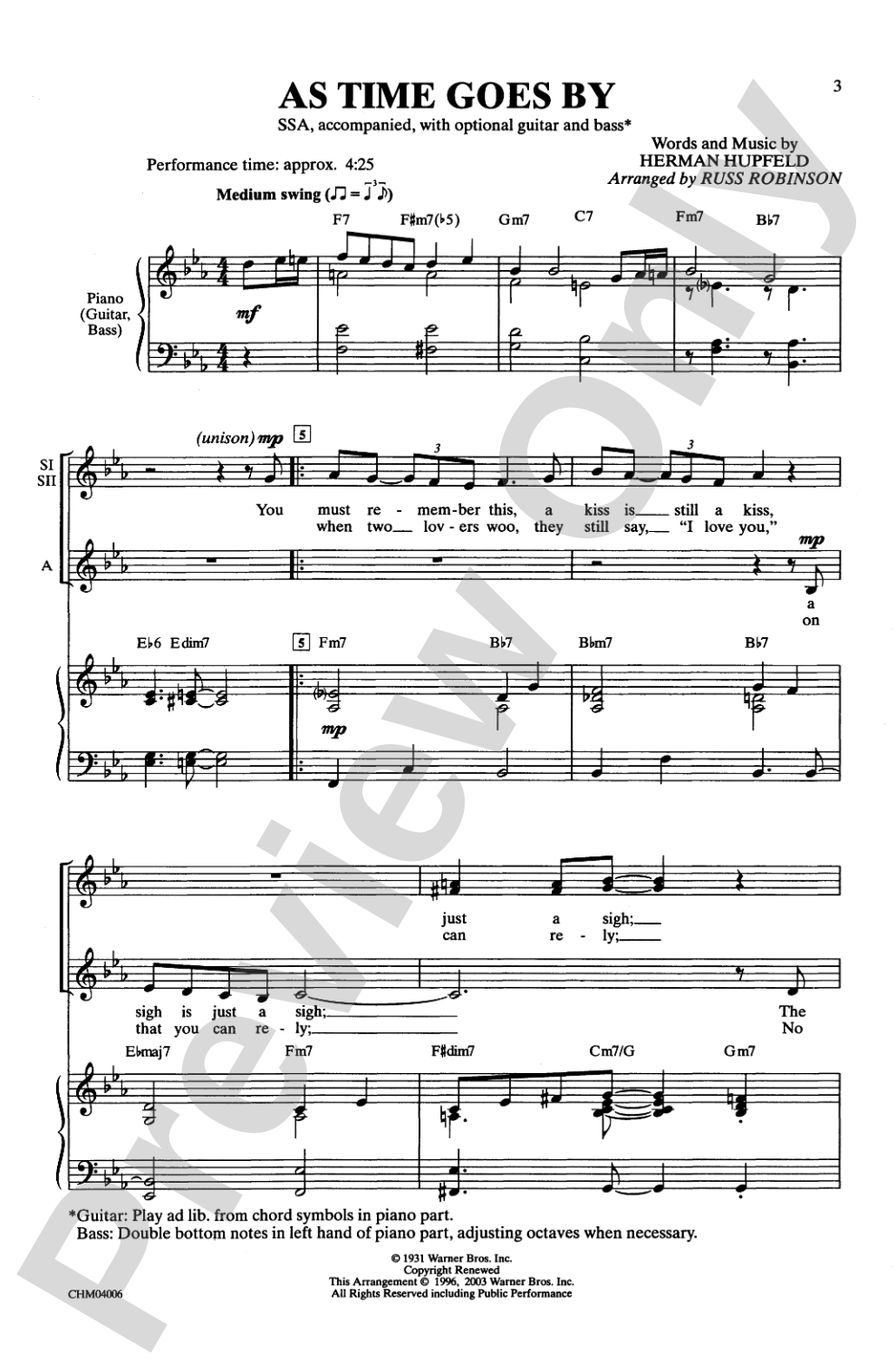
From the classic, award-winning motion-picture Casablanca comes this exceptional swing ballad. Who can forget that famous opening line: "You must remember this, a kiss is just a kiss, a sigh is just a sigh." Now your men's and women's choirs can perform this superb Russell Robinson arrangement. Consider utilizing the exceptional accompaniment track.


As Time Goes By: SSA Choral Octavo isn't in MakeMusic Cloud just yet...but it could be. Let us know you'd like to see it, and you'll help shape what comes next. In the meantime, start a free trial and dive into thousands of interactive titles your students can play along with today.
Request This Title
Tell us you want it.
Start Your Free Trial
Explore everything that's ready to play right now.
Sample Audio
No sample audio found.
Sample Video
No sample videos found.
Additional Details
Series:
Alfred Archive Edition: Alfred Pop Choral Series
Publisher:
Alfred Music
Page Count:
12
SKU:
00-PO-0004834
More about this title
About the Composer: Herman Hupfeld
Herman Hupfeld (1894-1951) was an American composer and lyricist who wrote primarily for theater and film during the golden age of Hollywood. Though he composed numerous songs throughout his career, he achieved lasting fame through his work on the 1942 film Casablanca, where "As Time Goes By" became an iconic standard that would outlive the film itself and enter the permanent American songbook.
Why we love this
Russell Robinson's SSA arrangement captures the nostalgic elegance of the original while making it genuinely singable for mixed-age choirs. The moderate difficulty level and recorded accompaniment mean you can program this at winter or spring concerts without extensive rehearsal time, yet it never sounds like a shortcut. Audiences will recognize it instantly, and your singers will feel the weight of performing something genuinely iconic.
What to expect
Nostalgic and intimate, like listening to a conversation between two people who understand each other without needing to say much. The melody carries a gentle melancholy beneath its famous opening, and the swing rhythm gives it forward motion even as the lyrics invite reflection on how little changes in matters of the heart.
Who it's for
Choirs seeking a standard that works across age groups and voice types, from high school SSA ensembles to community and adult choirs using the SSAA voicing. Directors who want to program Hollywood standards alongside more contemporary material will find this gives singers exposure to the swing ballad idiom without requiring extensive jazz training or complicated harmonies.
How to get the most out of it
- Approach the melody with rubato; swing ballads live in the space between strict time and freedom. Use the recorded accompaniment as a rhythmic anchor while allowing your soloists or section leaders to breathe and shape phrases naturally.
- Balance the voices so the melody remains clear without the inner parts disappearing. The SSA voicing means upper voices dominate, so listen carefully to ensure the alto line stays connected and audible rather than becoming padding.
- Let the text carry the emotional weight. This song thrives on the tenderness of its lyrics, not on vocal fireworks. Coach singers to sing through the words as if they're speaking to someone directly.
- Pay attention to diction in "a kiss is just a kiss"—crisp consonants on the repeated sibilants keep the phrase from muddying, and they also land the humor of the sentiment clearly.
How to use it
This works beautifully in a concert themed around standards, classic film music, or love songs across the decades. It also serves as an elegant closer to a program section, offering audiences a moment of recognition and warmth without requiring them to sit through anything experimental or unfamiliar. Consider pairing it with other mid-century popular repertoire for a cohesive set.
Skills your students will build
- Singing swing rhythm accurately while maintaining clarity of melody and text
- Balancing homophonic and polyphonic textures within the same arrangement
- Shaping lyrical, non-operatic phrasing with rubato and sensitivity to text
- Listening to inner voice independence while supporting the top-line melody