
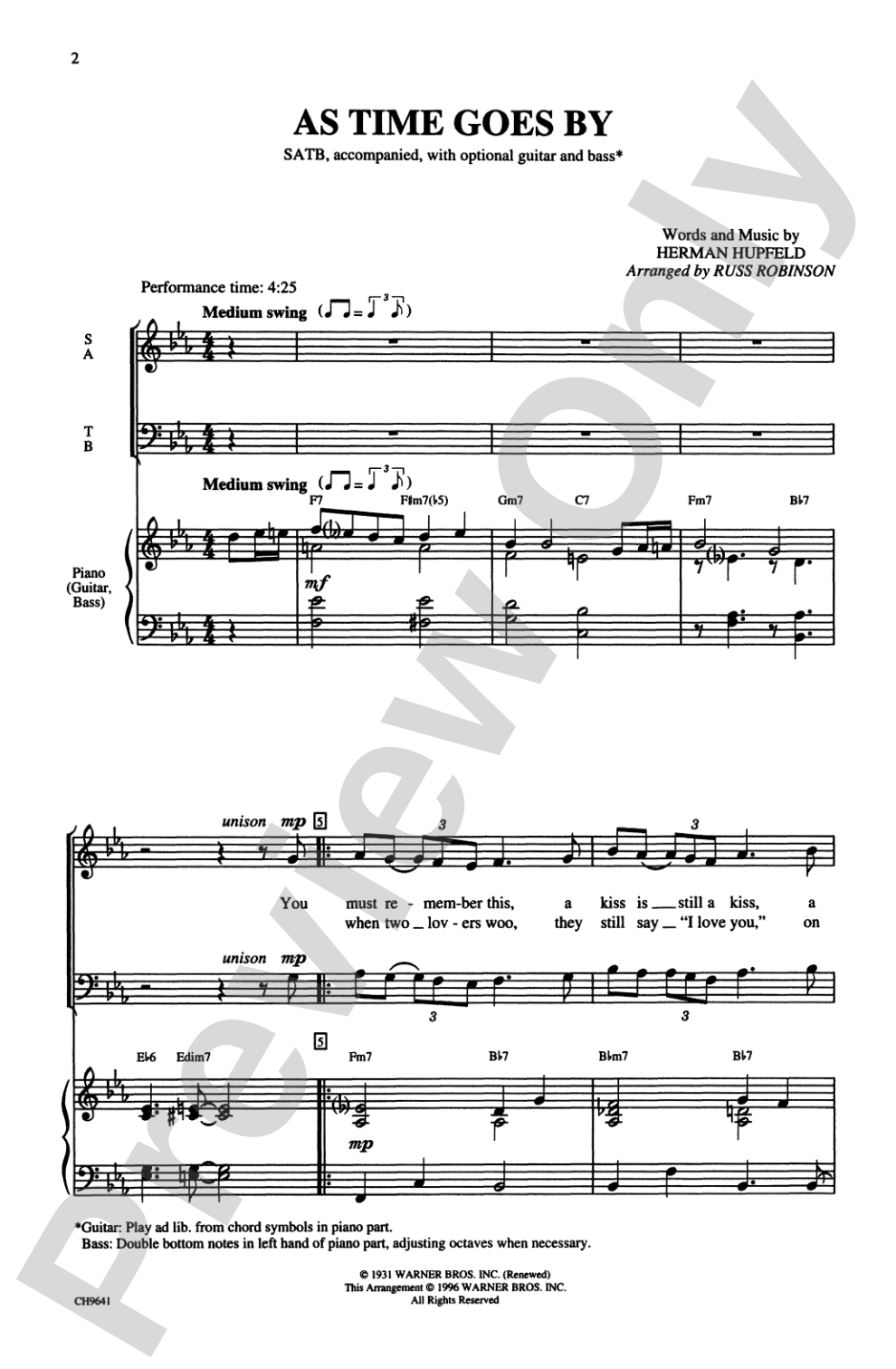
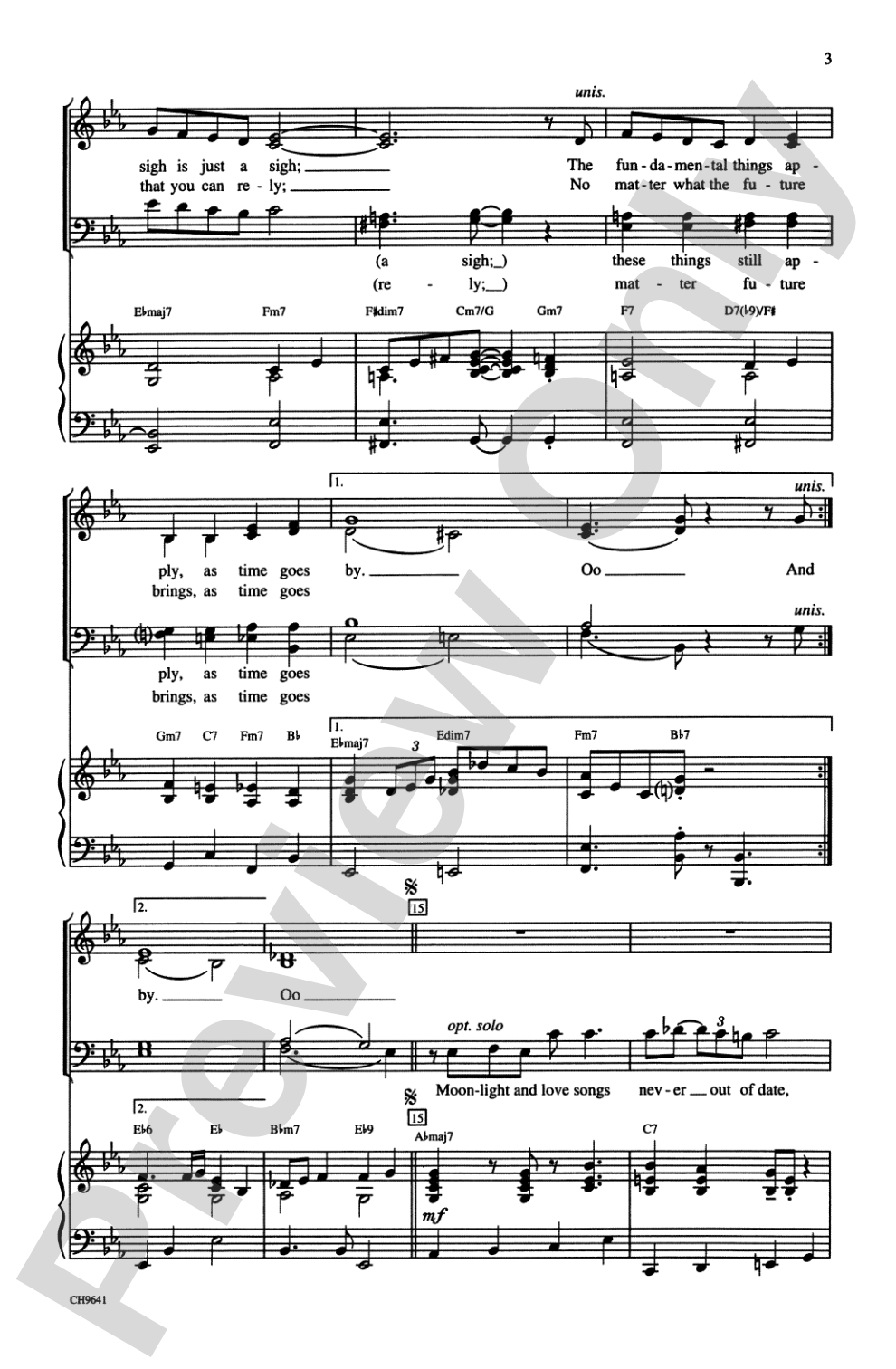

As Time Goes By: SATB Choral Octavo
Words and music by Herman Hupfeld / arr. Russell Robinson
Level: Moderate
Item: 00-PO-0004707
$2.25
Minimum order quantity: 20 copies
One moment…
Related Items
As Time Goes By: SSA Choral Octavo |
$2.25
|
View | |
As Time Goes By: TBB Choral Octavo |
$2.25
|
View | |
As Time Goes By: SATB Choral Octavo |
$2.25
|
View | |
As Time Goes By: SSA Choral Octavo |
$2.25
|
View | |
As Time Goes By: TBB Choral Octavo |
$2.25
|
View | |
As Time Goes By: Choral Octavo SoundTrax CD |
$21.95
|
View |
Description
From the classic, award-winning motion-picture Casablanca comes this exceptional swing ballad. Who can forget that famous opening line: "You must remember this, a kiss is just a kiss, a sigh is just a sigh." Now your men's and women's choirs can perform this superb Russell Robinson arrangement. Consider utilizing the exceptional accompaniment track.


As Time Goes By: SATB Choral Octavo isn't in MakeMusic Cloud just yet...but it could be. Let us know you'd like to see it, and you'll help shape what comes next. In the meantime, start a free trial and dive into thousands of interactive titles your students can play along with today.
Request This Title
Tell us you want it.
Start Your Free Trial
Explore everything that's ready to play right now.
Sample Audio
No sample audio found.
Sample Video
No sample videos found.
Additional Details
Series:
Alfred Archive Edition: Alfred Pop Choral Series
Publisher:
Alfred Music
Page Count:
8
SKU:
00-PO-0004707
More about this title
About the Composer: Herman Hupfeld
Herman Hupfeld (1894–1951) was an American songwriter whose gift for melody and sophisticated lyric writing made him a defining voice in early twentieth-century popular song. Though he composed for stage and film throughout his career, he remains best known for "As Time Goes By," which he wrote in 1931 and which achieved enduring fame when it was featured in the 1942 film Casablanca. His songs typically combined jazz-inflected harmonies with emotionally direct, memorable hooks that made them accessible to both amateur and professional performers.
For music educators, Hupfeld's work offers a bridge between classical training and the rhythmic and harmonic language of American popular song. His melodies are shaped with the care of a concert composer, making his pieces rewarding for choirs seeking to develop musicality and expression alongside contemporary style.
Why we love this
Russell Robinson's arrangement captures the nostalgic warmth and gentle swing of the original without oversimplifying the harmonic language. The SATB voicing sits comfortably for Grade 3 singers while retaining enough sophistication to keep ensemble directors engaged; the recorded accompaniment track removes the barrier of finding a skilled pianist, making this accessible for programs with limited accompaniment resources.
What to expect
"As Time Goes By" carries the unmistakable elegance of a golden-age Hollywood ballad, with a gentle swing rhythm that invites relaxed phrasing and introspective expression. The harmonic movement is warm and minor-tinged, evoking nostalgia and romantic reflection without sentimentality, making singers feel the emotional weight of the lyrics even as they navigate straightforward vocal lines.
Who it's for
This arrangement works for mixed choirs at the high school or early college level, as well as community and adult choruses seeking accessible repertoire with broad audience recognition. Directors looking to program a piece that bridges classical technique and contemporary style will find strong material here; audiences already familiar with the film often respond with immediate connection.
How to get the most out of it
- Balance the melody between soprano and alto sections during the opening phrase; Robinson's orchestration distributes the famous opening line across both parts, and clarity here sets the emotional tone for the entire piece.
- Use the recorded accompaniment as a structural anchor during early rehearsals, then gradually transition to live piano once the choir has internalized the harmonic progression and rhythmic feel.
- Shape the phrase "a sigh is just a sigh" with slight dynamic softening and gentler articulation to emphasize the wistful character rather than driving it forward.
- Encourage the men's section to sing with warmth rather than volume during their supporting moments; this piece relies on blended sonority and vulnerability, not projection.
How to use it
Program this as a closing piece on a concert celebrating American song or film music, where its recognizability will resonate with mixed-age audiences. It also pairs well with other mid-twentieth-century popular standards or with repertoire exploring themes of memory and time, offering a moment of reflective contrast within a larger set.
Skills your students will build
- Phrasing swing rhythm with appropriate relaxation rather than strict metronomic precision
- Blending treble voices on shared melodic material
- Singing with expressive dynamics across a narrow tessitura
- Reading and responding to jazz-influenced harmonic language
- Balancing stylistic authenticity with choral blend