
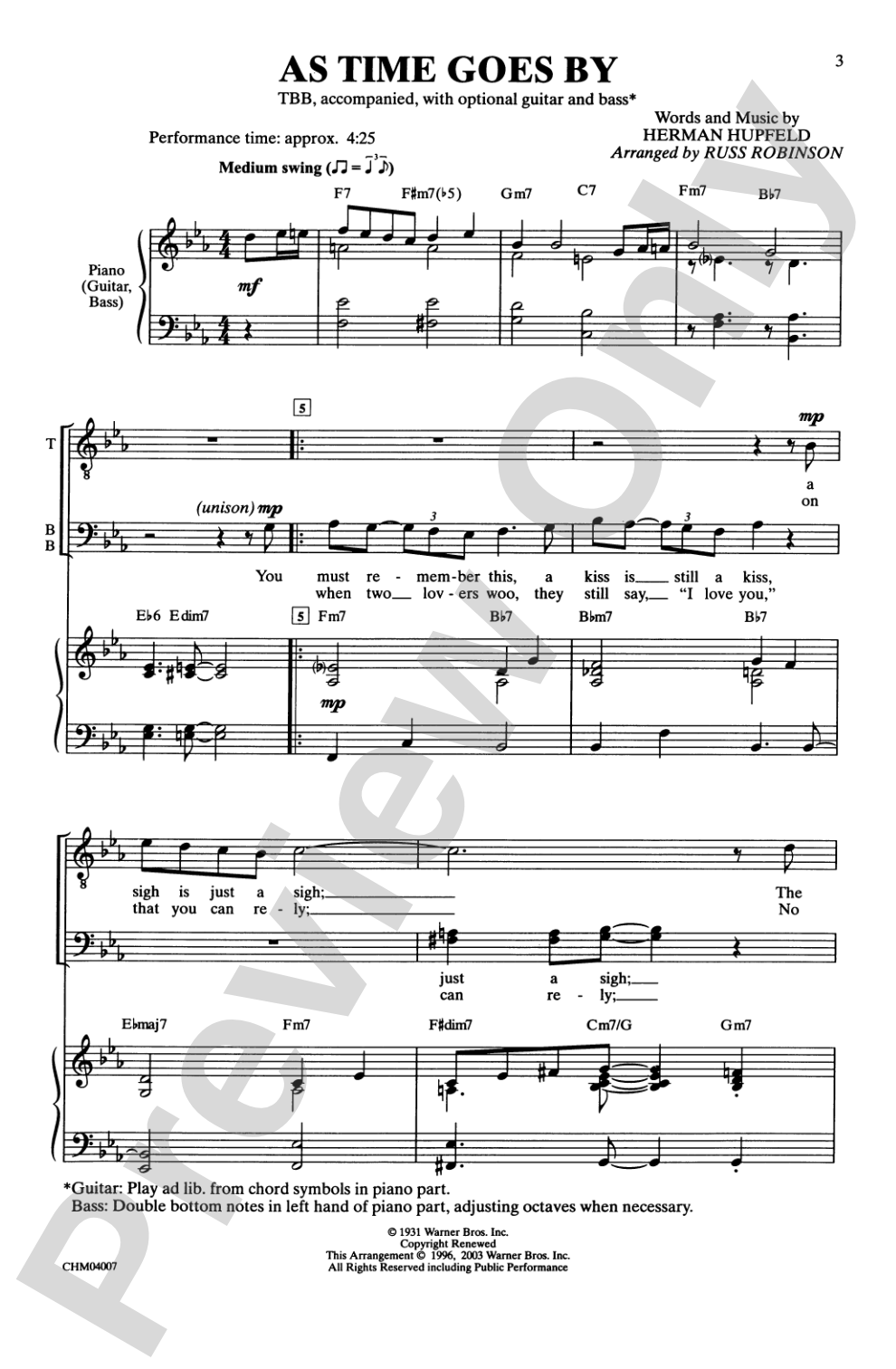
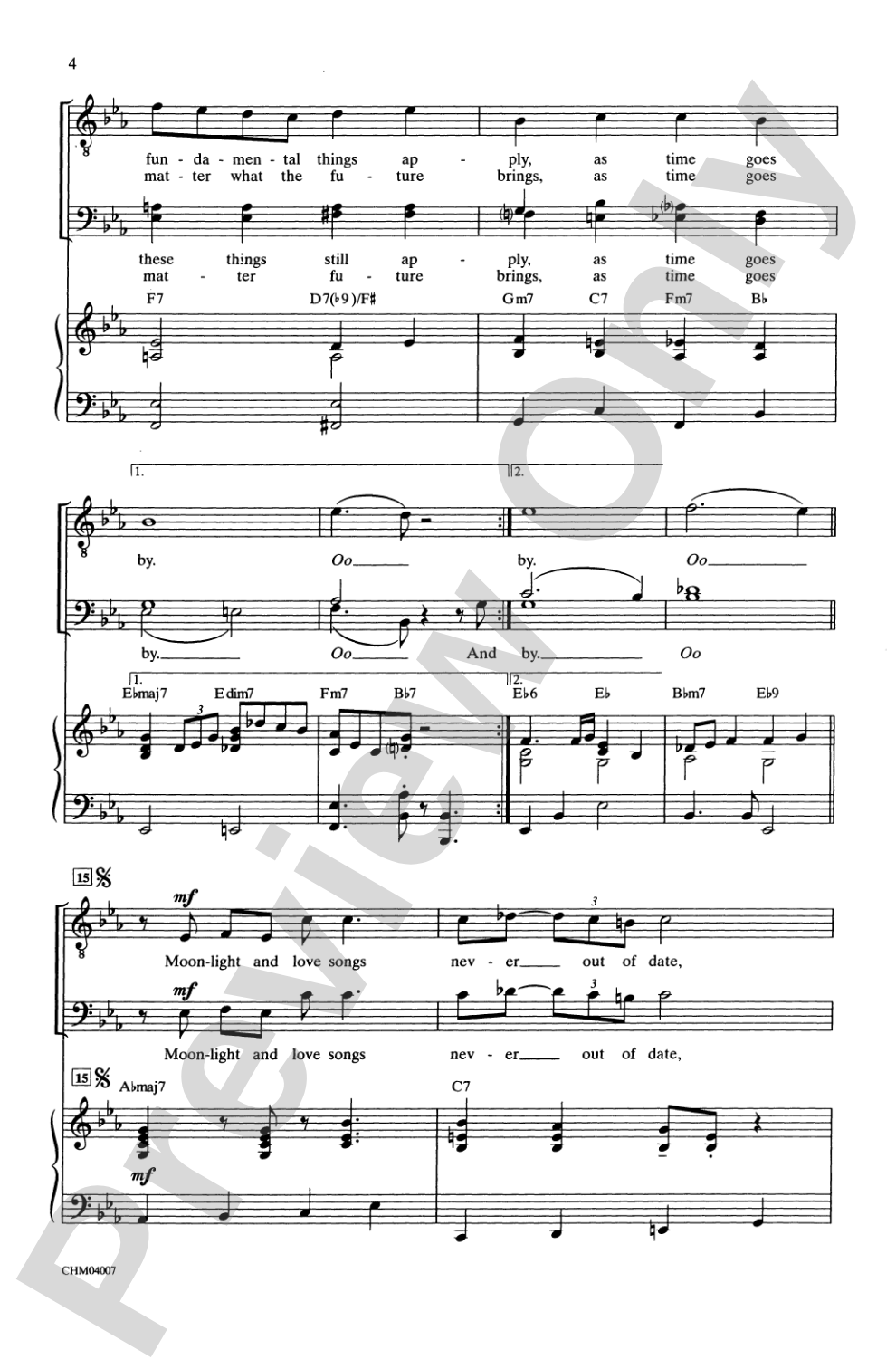

As Time Goes By: TBB Choral Octavo
Words and music by Herman Hupfeld / arr. Russell Robinson
Level: Moderate
Item: 00-PO-0006767
$2.25
Minimum order quantity: 20 copies
One moment…
Related Items
As Time Goes By: SATB Choral Octavo |
$2.25
|
View | |
As Time Goes By: SSA Choral Octavo |
$2.25
|
View | |
As Time Goes By: SATB Choral Octavo |
$2.25
|
View | |
As Time Goes By: SSA Choral Octavo |
$2.25
|
View | |
As Time Goes By: TBB Choral Octavo |
$2.25
|
View | |
As Time Goes By: Choral Octavo SoundTrax CD |
$21.95
|
View |
Description
From the classic, award-winning motion-picture Casablanca comes this exceptional swing ballad. Who can forget that famous opening line: "You must remember this, a kiss is just a kiss, a sigh is just a sigh." Now your men's and women's choirs can perform this superb Russell Robinson arrangement. Consider utilizing the exceptional accompaniment track.


As Time Goes By: TBB Choral Octavo isn't in MakeMusic Cloud just yet...but it could be. Let us know you'd like to see it, and you'll help shape what comes next. In the meantime, start a free trial and dive into thousands of interactive titles your students can play along with today.
Request This Title
Tell us you want it.
Start Your Free Trial
Explore everything that's ready to play right now.
Sample Audio
No sample audio found.
Sample Video
No sample videos found.
Additional Details
Series:
Alfred Pop Choral Series
Publisher:
Alfred Music
Page Count:
12
SKU:
00-PO-0006767
More about this title
About the Composer: Herman Hupfeld
Herman Hupfeld (1894-1951) was an American composer and lyricist who created some of the most enduring standards of the Great American Songbook. "As Time Goes By," written for the 1931 play "Everybody Comes to Rick's," became immortalized when it was featured in the 1942 film Casablanca, where it underscores one of cinema's most iconic moments. Hupfeld's gift for memorable melody and emotionally resonant lyrics made him a sought-after writer for both stage and screen throughout the golden age of American popular song.
Why we love this
Russell Robinson's arrangement captures the sophisticated swing character of this jazz standard while keeping it entirely singable for mixed voices at the moderate level. The arrangement honors the song's cinema legacy without requiring elaborate staging, making it an elegant choice for concerts that celebrate American musical theater and film.
What to expect
There's an unhurried elegance to this arrangement, with the kind of sophisticated harmonies that suggest a dimly lit piano bar and a moment suspended in time. The swing ballad character invites singers to find both lyrical warmth and subtle rhythmic sophistication, creating a performance that feels intimate even in a concert hall.
Who it's for
This octavo works beautifully for mixed choirs of all experience levels, from high school programs to community ensembles. Because it accommodates TBB, TTB, and TTBB voicings, you can use it whether your group leans treble-heavy or has strong lower voices.
How to get the most out of it
- Encourage the rhythm section to listen closely to the recorded accompaniment track during rehearsals so singers can internalize the swing feel without rushing or dragging the tempo.
- Shape the famous opening line with natural speech rhythm and warmth; resist the impulse to over-phrase or underscore its familiarity.
- Balance the part-writing so that inner voices support the melody without overshadowing it, especially in passages where chords thicken.
- Work the recorded accompaniment into dress rehearsals well before performance so the ensemble can settle into the groove together.
How to use it
Program this alongside other standards and movie classics to build a set that appeals to audiences who love American songbook material and cinema history. It also pairs naturally with other swing-era repertoire or as a lovely contrast to more contemporary pop arrangements.
Skills your students will build
- Singing swing rhythms (triplet feel, articulation of syncopation)
- Balancing choral blend in jazz harmonies
- Phrasing a lyrical melody with rubato and natural speech inflection
- Ensemble cohesion with recorded accompaniment
- Interpreting dynamics and color changes in a ballad structure