
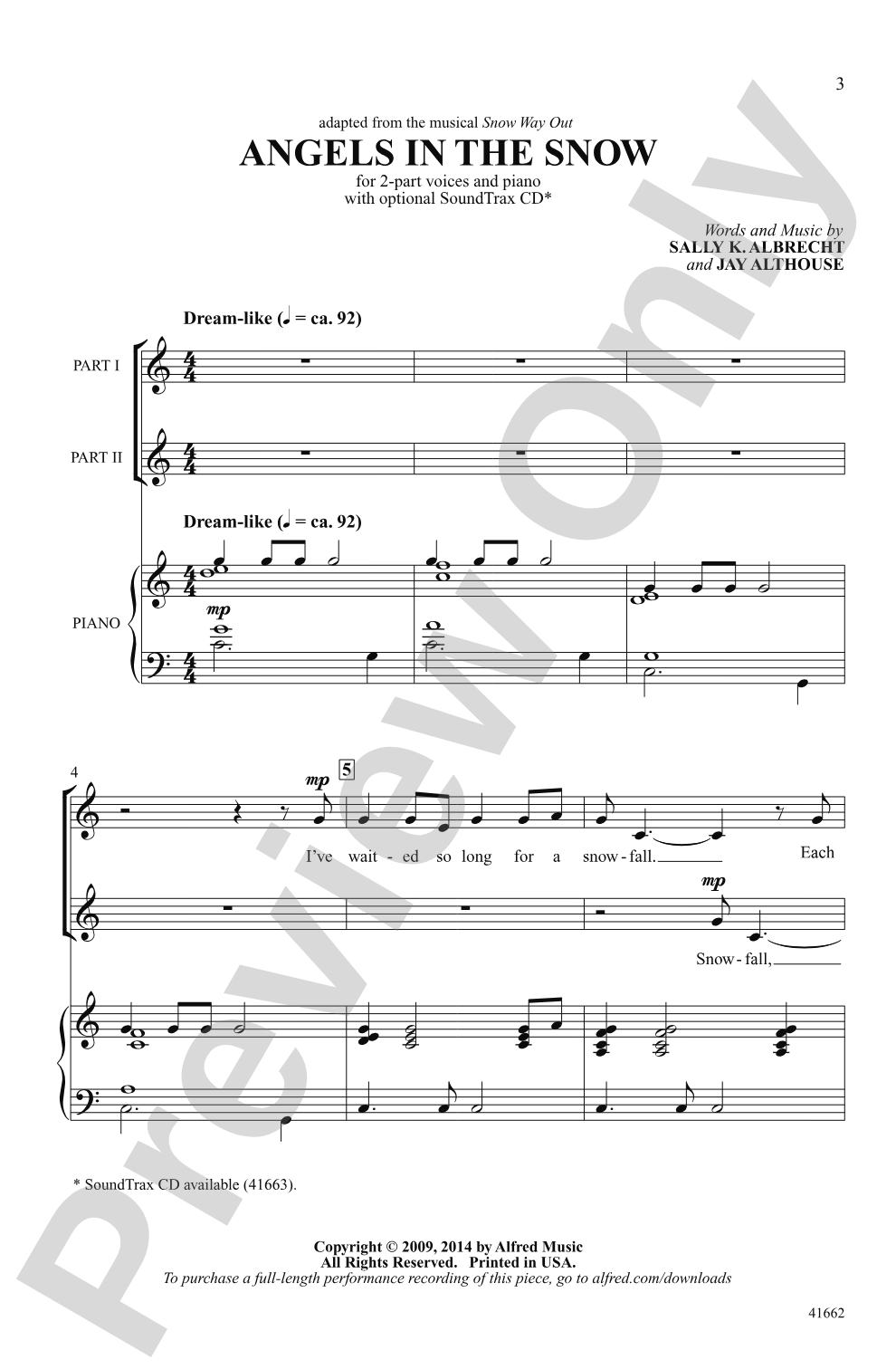

Angels in the Snow: 2-Part Choral Octavo
Words and music by Sally K. Albrecht and Jay Althouse
Item: 00-PO-0001858
$1.85
Minimum order quantity: 20 copies
Pickup currently not available
Description
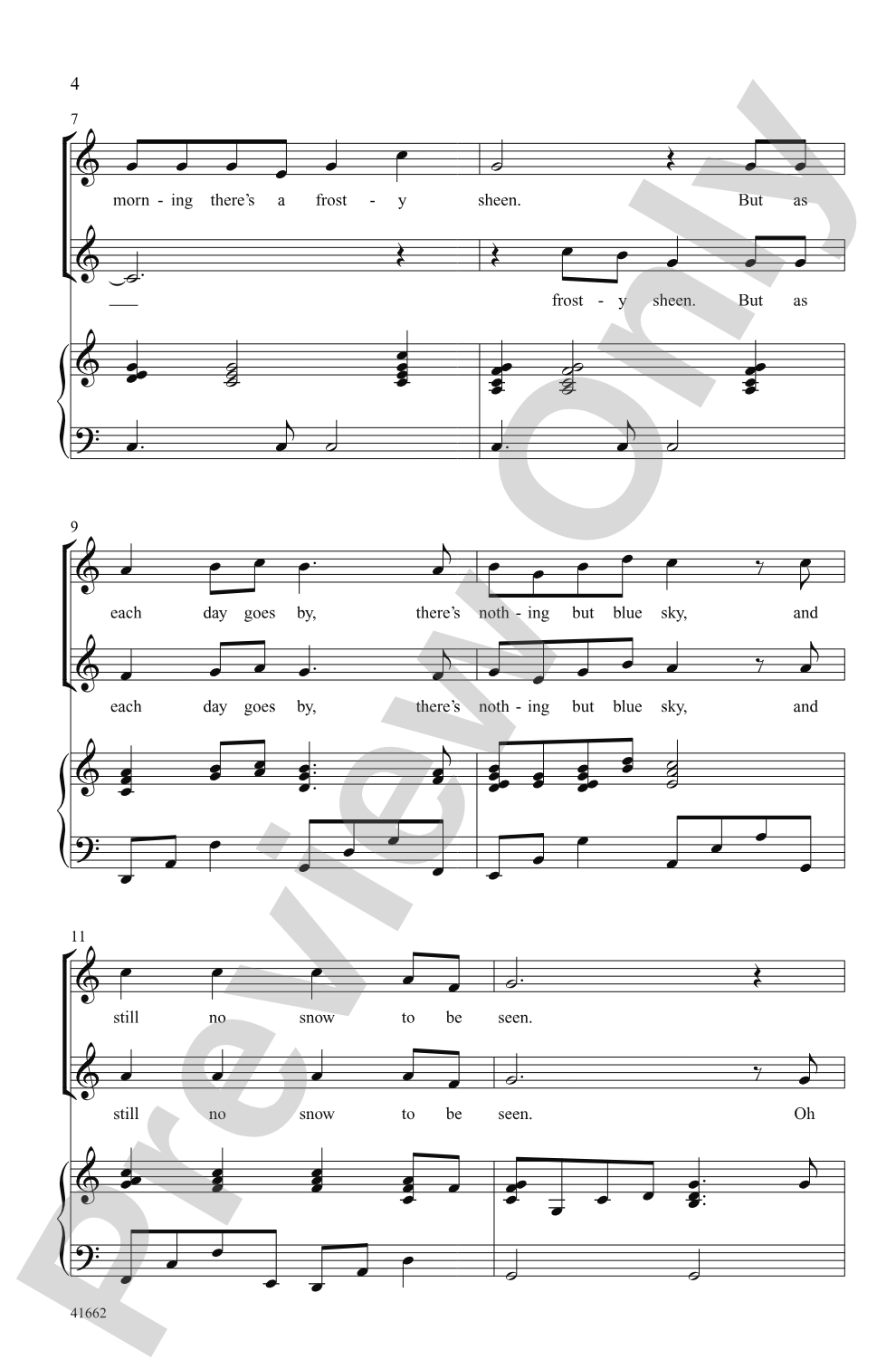
Here's a warm, wintertime ballad with no mention of the holidays. A dreamy text longs for snow and captures the delight of making snow angels. Delicate and independent voice parts overlap throughout, with just a few sparkling moments of harmony. Enchanting! This title is available in Music Prodigy.


Angels in the Snow: 2-Part Choral Octavo isn't in MakeMusic Cloud just yet...but it could be. Let us know you'd like to see it, and you'll help shape what comes next. In the meantime, start a free trial and dive into thousands of interactive titles your students can play along with today.
Request This Title
Tell us you want it.
Start Your Free Trial
Explore everything that's ready to play right now.
Sample Audio
1
Audio File
--:--
0:00
0:00
Sample Video
No sample videos found.
Additional Details
Series:
Alfred Choral Designs
Publisher:
Alfred Music
Page Count:
12
SKU:
00-PO-0001858
More about this title
About the Composer: Sally K. Albrecht

Sally K. Albrecht has shaped American choral music for over three decades as a composer, conductor, and clinician with a distinctive focus on choral movement. Since 1987, she has received annual ASCAP Special Music Awards and maintains more than 600 published choral works alongside 75 songbooks and musicals in active circulation. She has led honor choirs at major venues including Lincoln Center, Carnegie Hall, and The Kennedy Center, and served as Director of School Choral, Vocal, and Elementary Publications for leading educational music publishers, including a long tenure at Alfred Music.
Albrecht holds degrees from Rollins College (B.A., Music and Theater, 1976), the University of Miami (M.A. in Drama, 1977; M.M. in Accompanying, 1979), and has taught at Oakland University, Jersey City State College, and Meredith College. She is a 2021 Distinguished Alumna honoree from both the University of Miami Frost School of Music and Rollins College, where she serves on the Board of Trustees. She and her husband, composer and arranger Jay Althouse, reside in Wake Forest, North Carolina.
Why we love this
Albrecht and Althouse craft a winter piece that feels genuinely wintry without leaning on holiday sentiment, giving you fresh seasonal programming options. The independent, overlapping voice parts create real musical interest for developing singers while the sparse harmonic moments land with real impact. This is the kind of piece that shows your singers what thoughtful, economical writing sounds like.
What to expect
The music floats like snowfall itself. Delicate, unhurried phrases overlap and drift across the choir in a way that feels natural and unforced, while occasional moments of harmonic convergence create small, shimmering focal points. There's enchantment here without sentimentality.
Who it's for
This piece works beautifully for middle school and early high school choirs seeking accessible 2-part literature with genuine musical substance. It suits singers who are ready for independent voice parts but still benefit from the simplicity of a two-voice texture.
How to get the most out of it
- Shape the overlapping phrases with clear breath points so each voice part retains its melodic independence even when lines intertwine.
- Lean into the dreamy quality by avoiding excessive vibrato in the upper voices; let the text about snow and angels guide your tone choice toward something ethereal.
- Balance the two parts carefully during the independent sections so neither voice dominates; think duet, not harmony.
- Use the recorded accompaniment as a rehearsal tool early on, but encourage singers to listen critically to how the piano fills the sonic space.
How to use it
Open a winter concert with this piece to set a contemplative, non-holiday tone that welcomes seasonal programming flexibility. It pairs well with other secular winter or nature-themed selections and works particularly strong as a transition piece between more energetic repertoire.
Skills your students will build
- Singing independent melodic lines while maintaining ensemble cohesion
- Sustaining phrase shapes across overlapping voice entries
- Balancing two equal parts without one dominating
- Listening for and executing sparse harmonic moments with precision
- Interpreting text expressively within a minimalist musical framework