
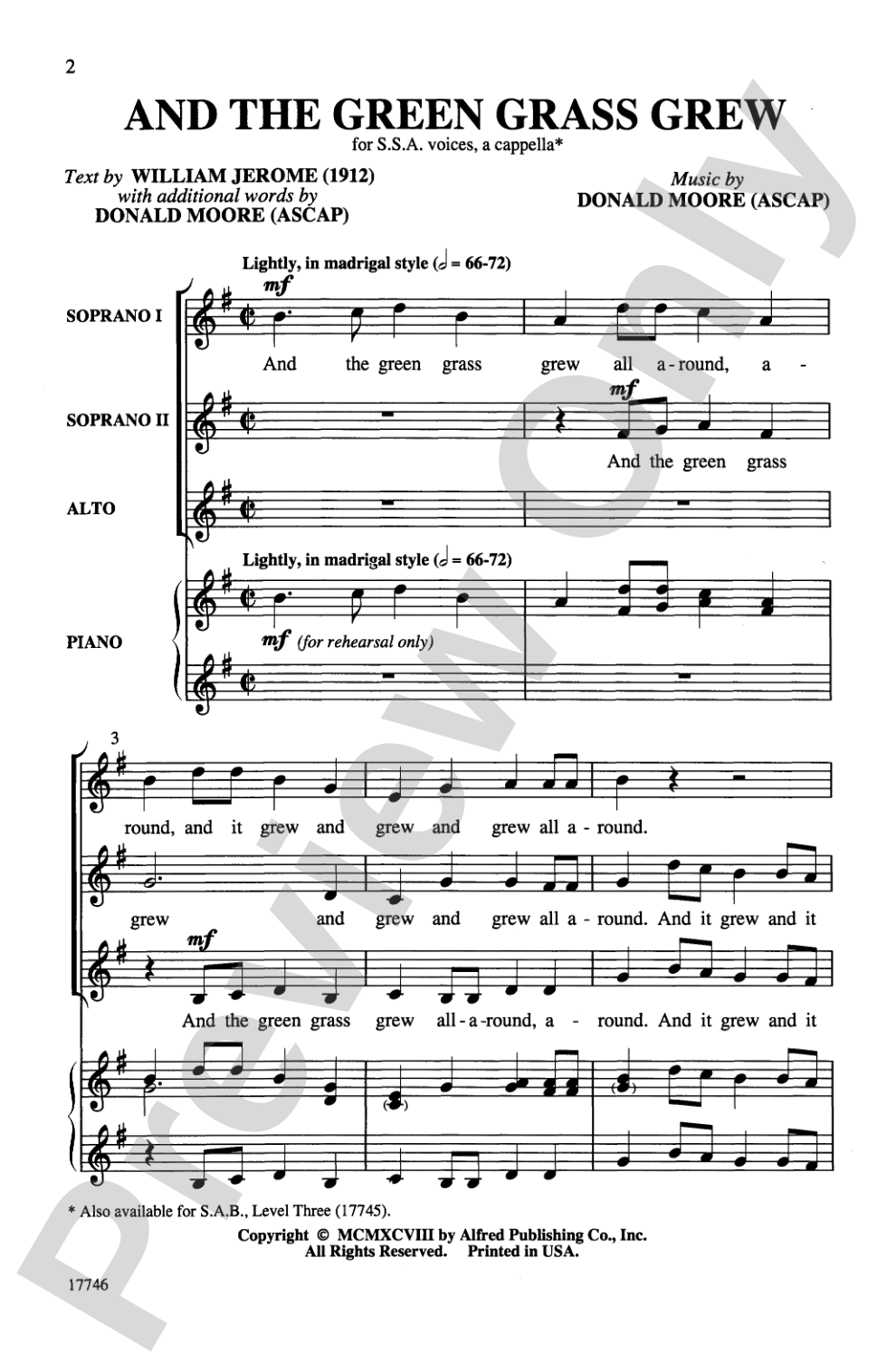

And the Green Grass Grew: SSA, a cappella Choral Octavo
Music by Donald Moore
Item: 00-PO-0002115

$2.25
Minimum order quantity: 20 copies
Pickup currently not available
Description
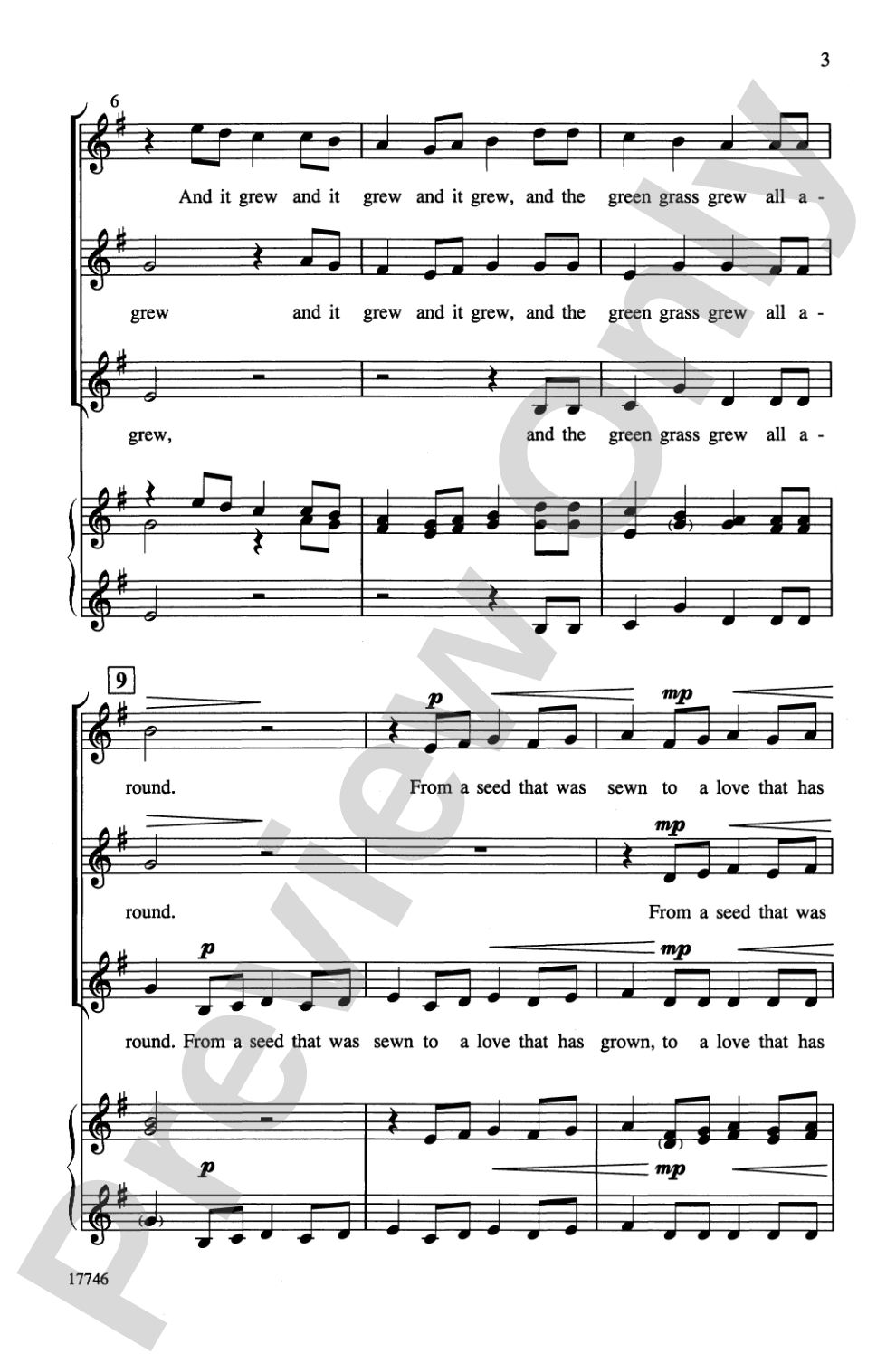
An original, newly composed madrigal written for developing SAB and SSA choirs. Great for any choir of any size learning to sing in the madrigal style. The unique text, written in 1912 by William Jerome, is perfect for madrigal singing and is especially appropriate in the spring. Echoes and repeated sections make for easy learning.


Don't just read it, hear it, play along with it, and watch your students grow with it. In MakeMusic Cloud, And the Green Grass Grew: SSA, a cappella Choral Octavo comes alive with professional accompaniment, adjustable tempo, and built-in practice tools that turn solo practice into real progress.
Open in the Player
Jump straight in and assign it today.
Start Your Free Trial
Open this title and explore the full library in minutes.
Sample Audio
1
Audio File
--:--
0:00
0:00
Sample Video
No sample videos found.
Additional Details
Series:
Alfred Archive Edition: Alfred Choral Designs
Publisher:
Alfred Music
Page Count:
8
SKU:
00-PO-0002115
More about this title
About the Composer: Donald Moore

Donald Moore earned his Bachelor of Music in organ performance and Master of Arts in Teaching from Kent State University. He serves as Organist-Choirmaster at Pilgrim United Church of Christ in Cuyahoga Falls, Ohio, and has composed over 500 works across sacred, secular, educational, and pop idioms published by Alfred Music, Hal Leonard, Heritage Music Press, and others. His compositions appear regularly at state and national festivals, and he has received the ASCAP Composers Standard Award seventeen times.
The American Choral Directors Association recognized Moore among 400 elite composers of historical significance in American choral music. Beyond his prolific output in choral and keyboard literature, he maintains an active involvement in competitive motorsports, managing a midget car racing team that campaigns nationally.
Why we love this
Moore crafted this piece specifically for SSA choirs developing their madrigal technique, and the echoing phrases and repetitive structures actually serve the learning process rather than simplifying the music. The 1912 text by William Jerome has genuine wit and spring-appropriate imagery, making this feel like an actual historical madrigal rather than a contemporary pastiche.
What to expect
The piece has the playful character of a traditional madrigal, with echoing phrases that create textural variety and invite ensemble dialogue. Spring imagery and the 1912 Jerome text give it a nostalgic, lyrical quality that feels both period-appropriate and genuinely charming.
Who it's for
SSA choirs in their second or third year of ensemble singing, particularly those approaching madrigals for the first time. It works equally well for developing treble choruses and mixed groups with sufficient upper voices, and the moderate length makes it accessible without overwhelming singers new to the style.
How to get the most out of it
- Balance the repeated text phrases so they feel like musical conversation rather than mechanical echo; consider varying dynamics between the original statement and its echo.
- Since there are no accompaniment parts to anchor tempo and tuning, establish a strong unison or octave entrance before the piece begins and check intonation during sectional rehearsals using a keyboard reference.
- Work the three voice parts separately first, paying particular attention to how each line moves through the text, then layer them to hear how the echo effects emerge from the counterpoint.
How to use it
Program this as part of a spring or end-of-year concert where madrigal style repertoire makes sense thematically; it pairs naturally with other secular choral works and provides a lighter moment in a program. The eight pages and moderate difficulty also make it suitable for concert festivals or adjudicated competitions where developing choirs need strong, contest-appropriate material.
Skills your students will build
- Singing Renaissance and madrigal style conventions in a contemporary composition
- Managing echo and imitation techniques across three vocal lines
- Sustaining intonation in a cappella singing without harmonic anchors
- Interpreting text-painting and musical phrasing in secular vocal music
- Blending SSA voicing and achieving balance between independent lines