

Amazing Grace: SSAA Choral Octavo
Arr. Jay Althouse
Item: 00-PO-0004244
$2.25
Minimum order quantity: 20 copies
Pickup currently not available
Description
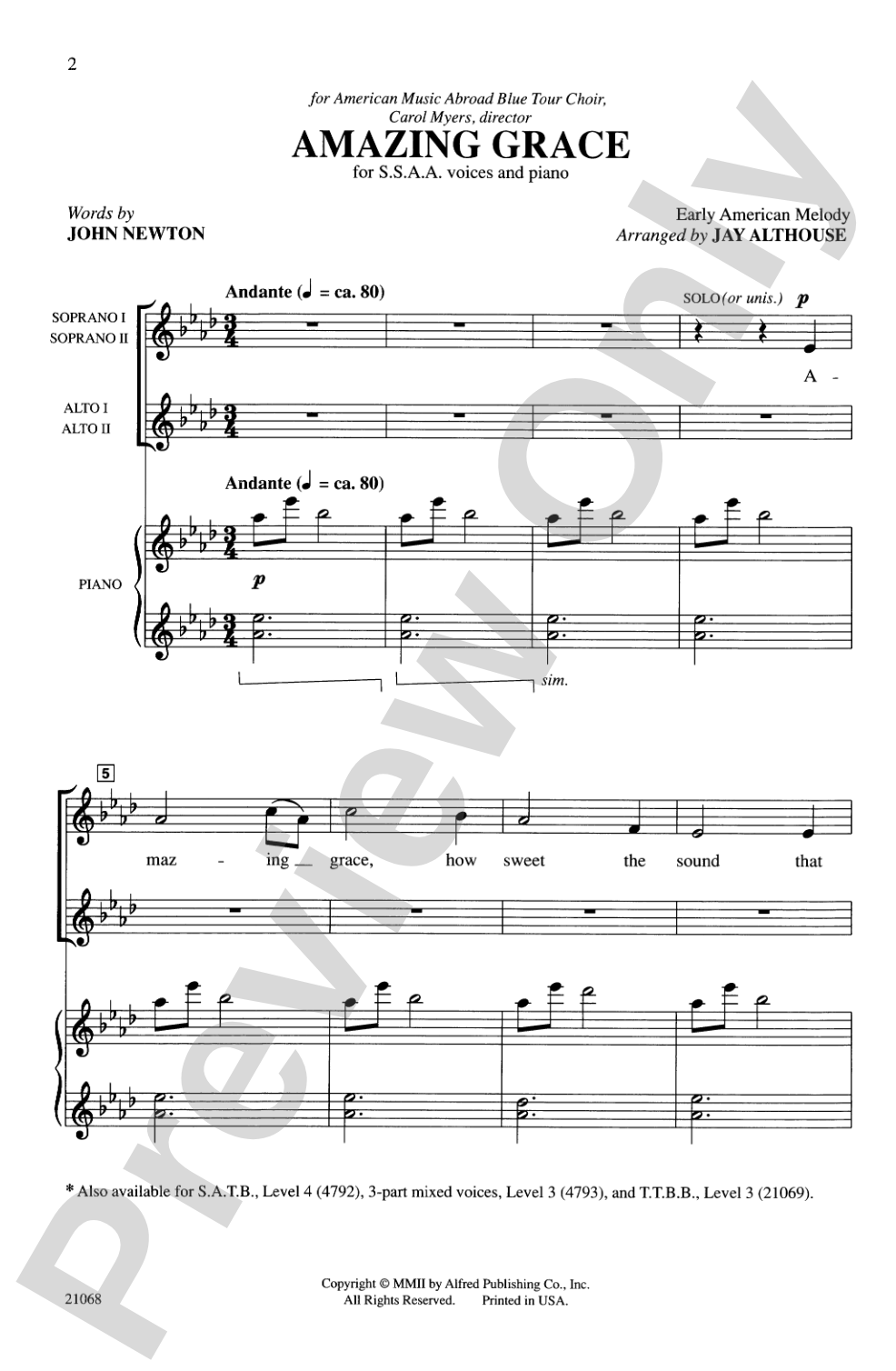
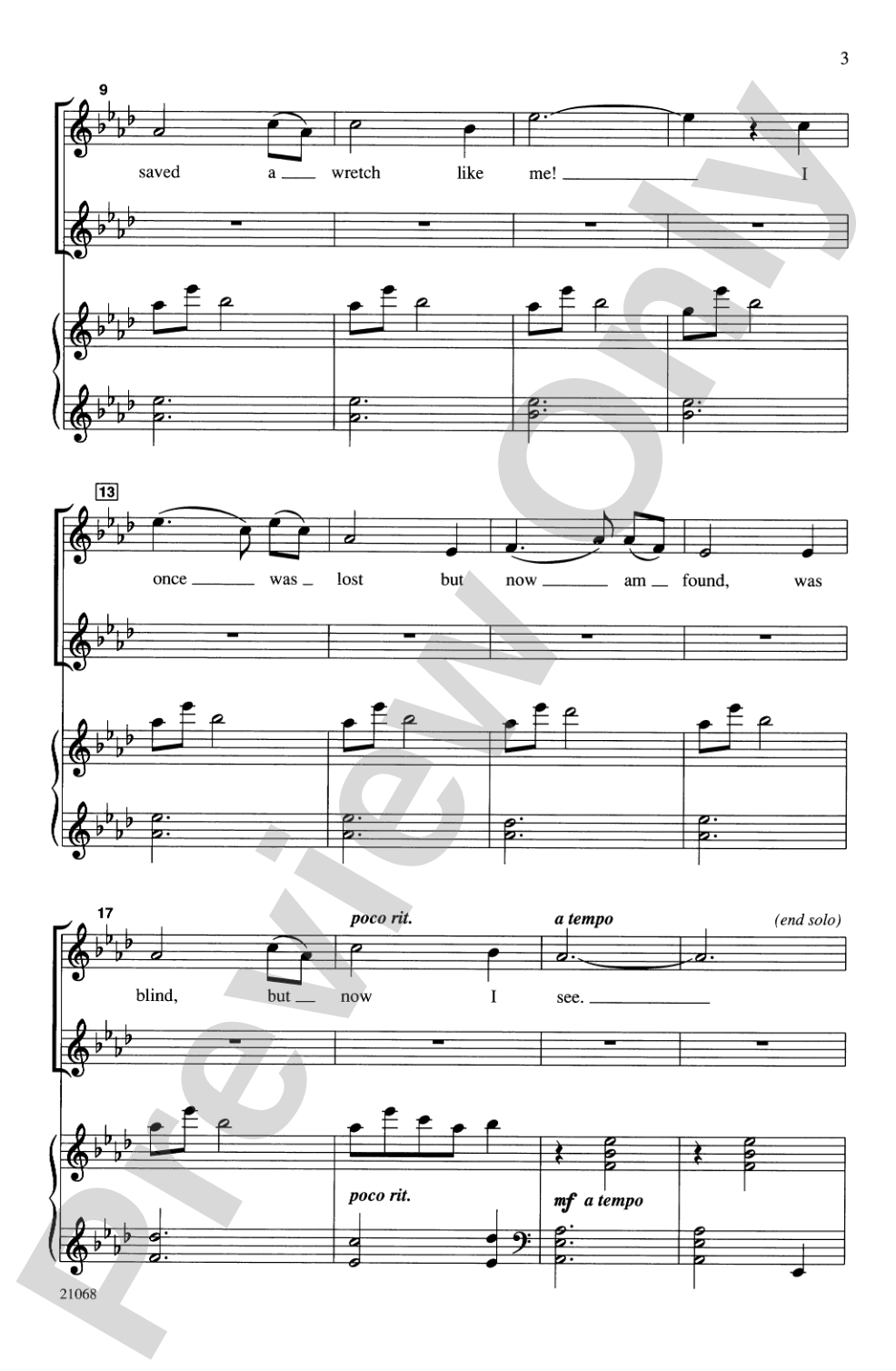
New! SSAA and TTBB editions of Jay Althouse's sensitive and elegant arrangement of America's favorite folk melody. Opens with a plaintive piano figure followed by an optional solo (or section). Features an a cappella section with a harmonization reminiscent of Copland. Amazing Grace is one of Jay's finest arrangements and has become a choral classic. Touchingly simple, yet sophisticated.


Amazing Grace: SSAA Choral Octavo isn't in MakeMusic Cloud just yet...but it could be. Let us know you'd like to see it, and you'll help shape what comes next. In the meantime, start a free trial and dive into thousands of interactive titles your students can play along with today.
Request This Title
Tell us you want it.
Start Your Free Trial
Explore everything that's ready to play right now.
Sample Audio
1
Audio File
--:--
0:00
0:00
Sample Video
No sample videos found.
Additional Details
Series:
Alfred Archive Edition: Alfred Choral Designs
Publisher:
Alfred Music
Page Count:
8
SKU:
00-PO-0004244
More about this title
About the Arranger: Jay Althouse

Jay Althouse holds degrees in Music Education and Music from Indiana University of Pennsylvania, where he was honored as a Distinguished Alumnus. His eight years working as a rights and licenses administrator at a major educational music publisher gave him deep insight into what works in the choral classroom and concert hall. He served on the Executive Board of the Music Publishers Association of America and remains a writer member of ASCAP, a regular recipient of their Special Award for compositions in standard music.
With more than 800 works in print across all choir levels, Althouse has established himself as one of America's most performed choral composers. Beyond composition, he has co-written children's musicals with his wife Sally K. Albrecht, compiled respected vocal solo collections including Folk Songs for Solo Singers, and authored widely used classroom resources like Ready to Read Music and One-Page Composer Bios. His arrangement I Hear America Singing, co-written with Albrecht, was performed by the San Francisco Girls and Boys Choirs at President Obama's inauguration in 2009. Althouse serves on the National Advisory Board of the Folk Art Society of America and contributes to its publications.
Why we love this
Althouse brings refinement to a melody every choral director knows, avoiding the trap of oversimplification without losing its spiritual core. The arc from the opening piano figure through the optional solo to the Copland-influenced a cappella section creates genuine dramatic shape, giving singers something substantive to build toward. This is the kind of arrangement that sounds effortless until you conduct it and discover how carefully every detail has been placed.
What to expect
There is quiet dignity here, the kind that comes from space and silence as much as from notes. The arrangement unfolds with the patience of a hymn yet carries enough harmonic sophistication to engage singers' ears and minds. You feel the weight of the melody's history without being overwhelmed by sentimentality.
Who it's for
Treble choirs at the intermediate level and above will find this arrangement both accessible and rewarding. Directors seeking a sacred piece that avoids cliché while remaining emotionally honest will appreciate Althouse's restraint and craft. This works equally well for festival performance, concert programming, or a service where depth of expression matters.
How to get the most out of it
- Shape the opening piano figure with subtle rubato; let it breathe before the first voices enter so the "plaintive" quality registers clearly.
- If using the optional solo, ensure the soloist stays connected to the ensemble's harmonic foundation rather than floating ahead, keeping the arrangement's elegance intact.
- The a cappella section demands precise intonation and blend; rehearse it without piano to develop the singers' sense of independence and harmonic awareness.
- Balance the familiar melody line with the inner voices during the return to piano accompaniment; Althouse's harmonization is too thoughtful to hide beneath the tune.
How to use it
Program this as a moment of reflection within a longer concert, where its understated elegance provides contrast to more exuberant repertoire. It serves equally well in a peace or brotherhood-themed program, or as a closing piece that leaves the audience in contemplative silence. The 8-page length makes it practical for a full rehearsal schedule without overshadowing lighter or more complex works on the same program.
Skills your students will build
- Singing independent melodic lines within four-part harmony
- Sustaining intonation in a cappella singing
- Blending treble voices across different registers
- Responding to dynamic shaping and rubato with ensemble precision
- Interpreting sacred choral literature with emotional authenticity rather than excessive dramatization