

Amazing Grace: 3-Part Mixed Choral Octavo
Arr. Jay Althouse
Item: 00-PO-0002459
$2.25
Minimum order quantity: 20 copies
Pickup currently not available
Description
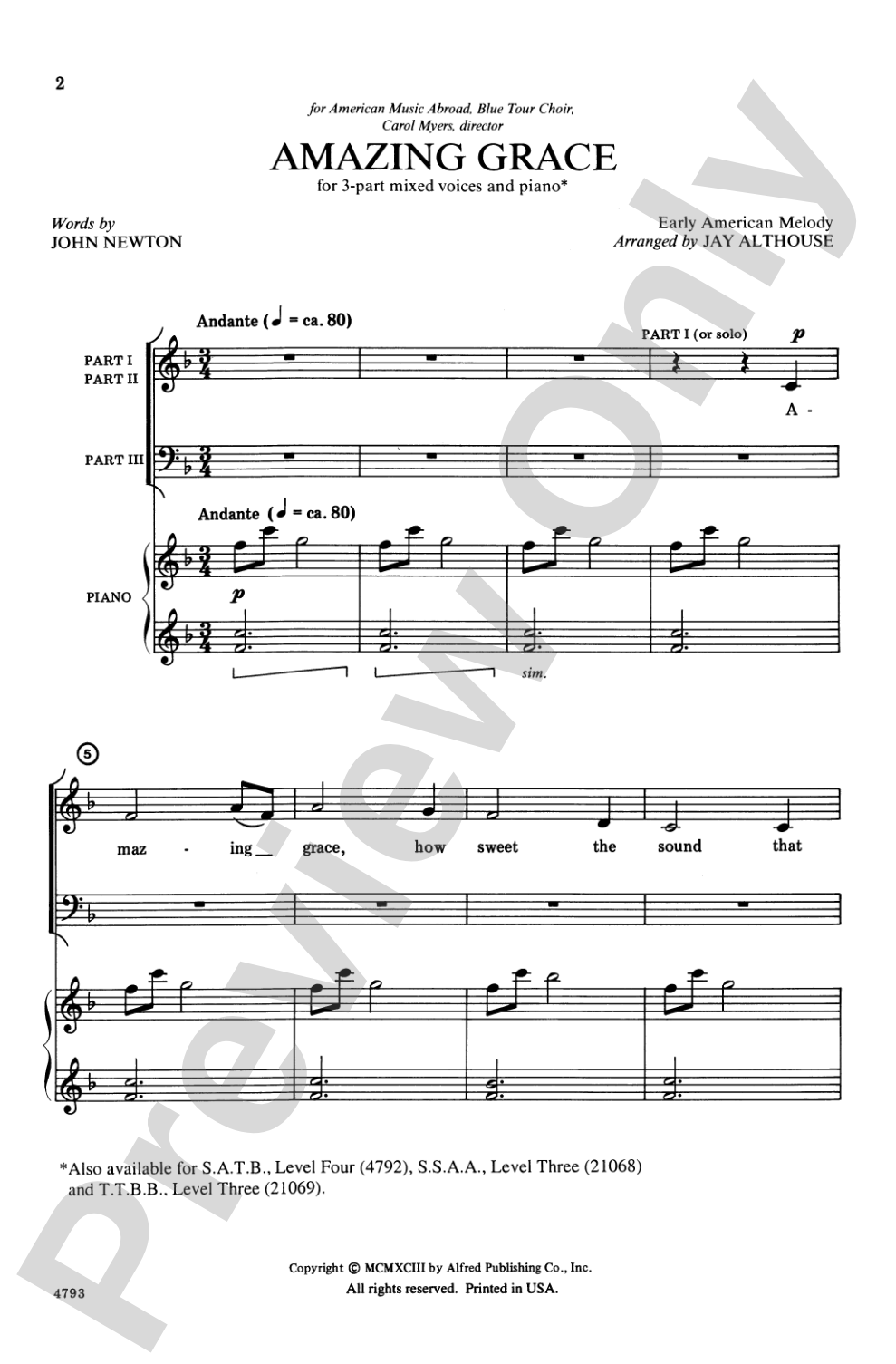
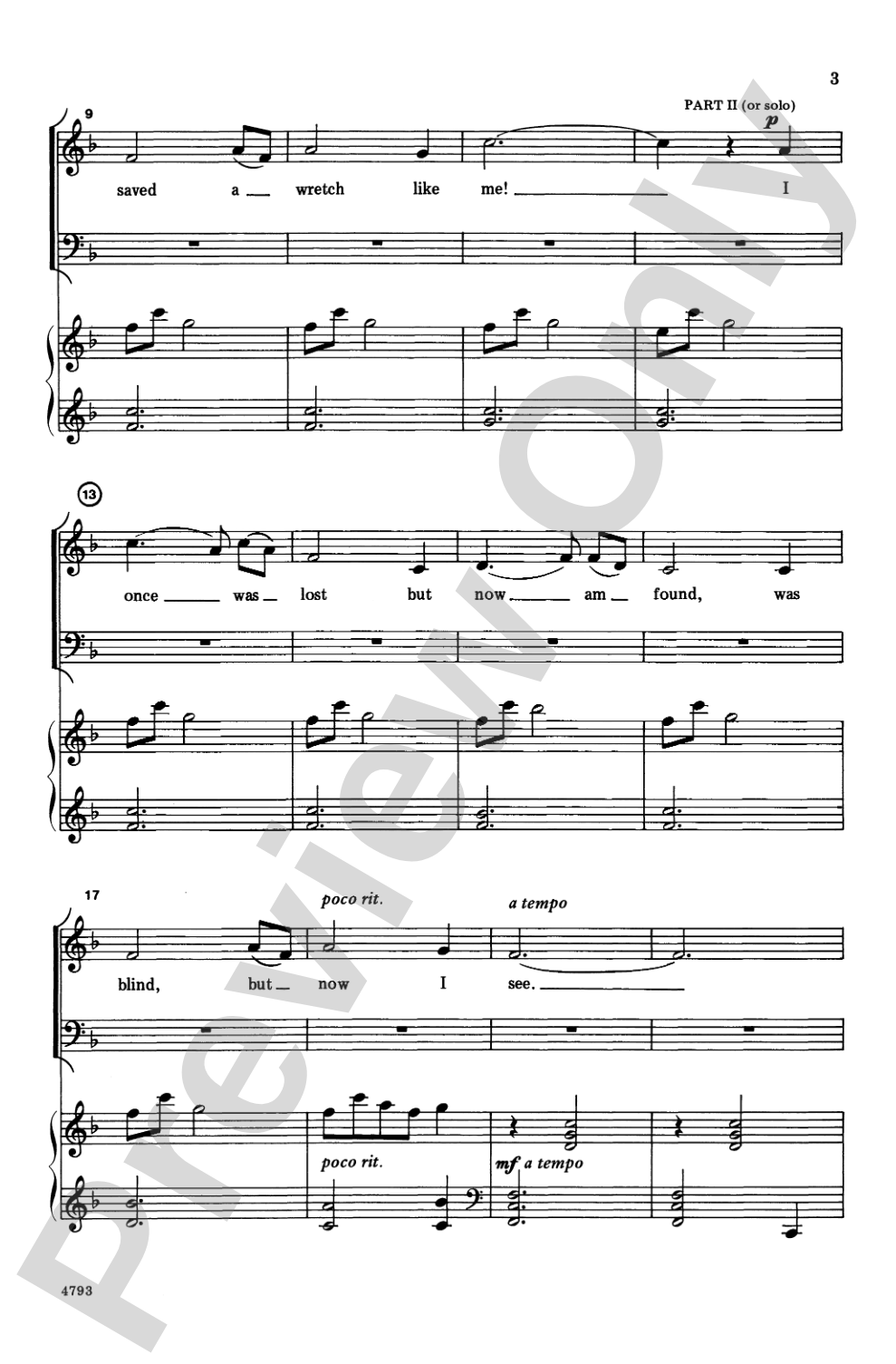
It's a sensitive and elegant setting of America's favorite folk melody. Opens with a haunting piano figure followed by a soprano solo (or section). Features an a cappella section with a harmonization reminiscent of Copland. AMAZING GRACE is one of Jay Althouse's finest arrangements and could become a choral classic. A touchingly simple, yet sophisticated arrangement.


Amazing Grace: 3-Part Mixed Choral Octavo isn't in MakeMusic Cloud just yet...but it could be. Let us know you'd like to see it, and you'll help shape what comes next. In the meantime, start a free trial and dive into thousands of interactive titles your students can play along with today.
Request This Title
Tell us you want it.
Start Your Free Trial
Explore everything that's ready to play right now.
Sample Audio
1
Audio File
--:--
0:00
0:00
Sample Video
No sample videos found.
Additional Details
Series:
Alfred Archive Edition: Alfred Choral Designs
Publisher:
Alfred Music
Page Count:
8
SKU:
00-PO-0002459
More about this title
About the Arranger: Jay Althouse

Jay Althouse holds degrees in Music Education and Music from Indiana University of Pennsylvania, where he was honored as a Distinguished Alumnus. Early in his career, he spent eight years in music publishing as a rights and licenses administrator, serving concurrently on the Executive Board of the Music Publishers Association of America. His prolific output as a composer now exceeds 800 choral works performed regularly across the English-speaking world.
Beyond composition, Althouse has shaped music education through collaborations with his wife Sally K. Albrecht on children's musicals and influential instructional resources including The Complete Choral Warm-up Book and Accent on Composers. He compiled and edited several acclaimed vocal collections and has authored classroom materials on music fundamentals. A recognized advocate for American folk music traditions, he currently serves on the National Advisory Board of the Folk Art Society of America and contributes to scholarly discourse on folk music and pedagogy. His work "I Hear America Singing," co-written with Albrecht, was performed by the San Francisco Girls and Boys Choirs at President Obama's inauguration in 2009.
Why we love this
Althouse's arranging sensibility sits at the intersection of accessibility and artistry. The structure of this piece, with its opening piano gesture leading into a soprano solo and culminating in an a cappella section, unfolds naturally without sacrificing sophistication. Choirs at this level rarely encounter arrangements this carefully crafted, where every voice part serves the emotional arc rather than simply filling harmony.
What to expect
The piece inhabits a quiet, reverent space where simplicity becomes profound. The haunting piano figure draws the ear inward before the soprano voice enters with directness and grace, unadorned but deeply felt. The shift into the a cappella section evokes something timeless and communal, the kind of moment where congregational tradition meets concert artistry.
Who it's for
This octavo serves choirs of intermediate skill seeking substantive yet singable material for festivals, concerts, and services. The SAB voicing opens the piece to ensembles without advanced SATB resources while the arrangement's artistic depth keeps it engaging for more experienced choirs looking for folk repertoire with genuine musical substance.
How to get the most out of it
- Shape the piano introduction as an independent musical statement; it sets the harmonic and emotional foundation before the soprano enters, so give it breathing room rather than treating it as accompaniment
- Approach the a cappella section with the precision it demands. The Copland-influenced harmonization will feel unmoored without committed ensemble tuning and synchronized phrase shaping
- Balance the soprano solo against the mixed voices beneath. This arrangement thrives when the solo line sings above a unified but quietly present choral foundation rather than competing for attention
- Return to the piano for final resolution with clarity about dynamic control; the closing should feel inevitable rather than abrupt
How to use it
Program this as a centerpiece for a concert focused on American sacred traditions or as the emotional anchor in a peace and brotherhood themed service. Its modest length and single-stanza structure make it an ideal pairing with longer works, or it can stand alone as a memorable benediction. The optional piano accompaniment and a cappella sections provide flexibility for different performance contexts, from formal concert settings to intimate chapel services.
Skills your students will build
- Balancing solo and ensemble textures
- Singing pure intonation in a cappella harmony with limited tonal reference
- Responding to and following a piano accompaniment with rhythmic independence
- Sustaining legit vocal tone across a range of dynamics
- Understanding text expression in American sacred folk traditions