
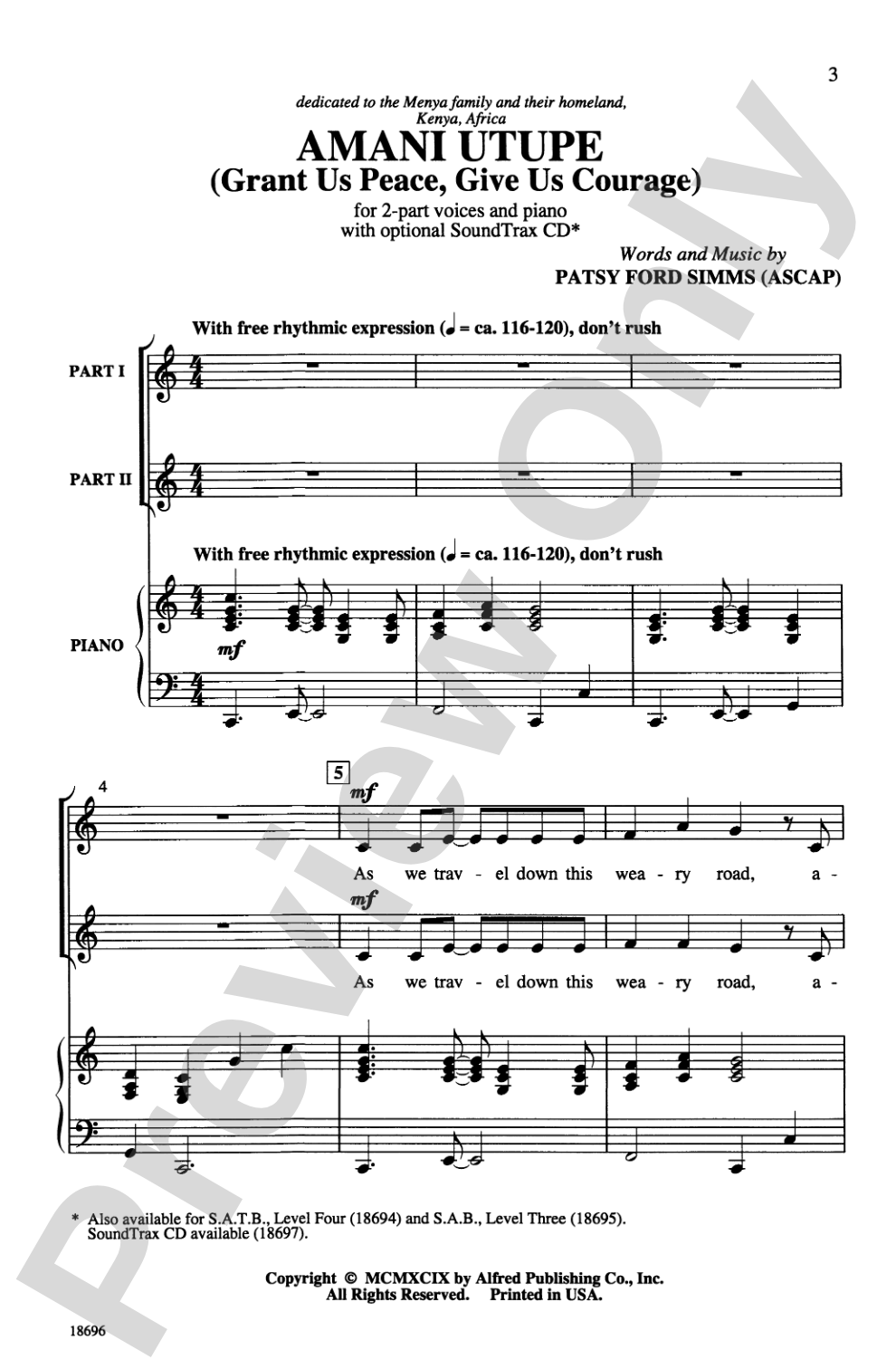
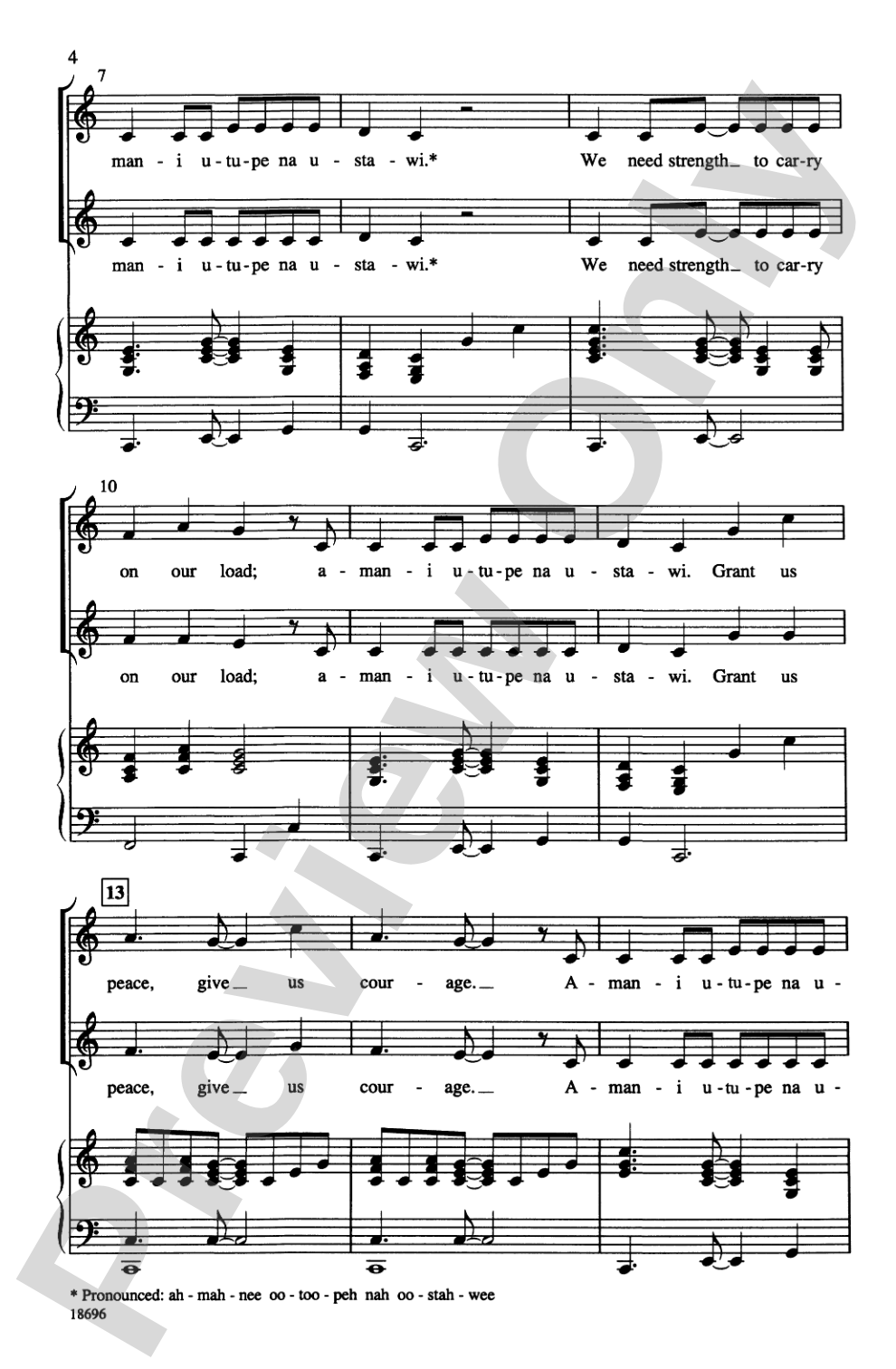

Amani Utupe (Swahili-Grant Us Peace, Give Us Courage): 2-Part Choral Octavo
(Swahili -- Grant Us Peace, Give Us Courage)
Music by Patsy Ford Simms
Item: 00-PO-0003135

$2.05
Minimum order quantity: 20 copies
Pickup currently not available
Related Items
Amani Utupe (Swahili-Grant Us Peace, Give Us Courage): SATB Choral Octavo |
$2.25
|
View | |
Amani Utupe (Swahili-Grant Us Peace, Give Us Courage): SAB Choral Octavo |
$2.05
|
View | |
Amani Utupe: SATB Choral Octavo |
$2.25
|
View | |
Amani Utupe: SAB Choral Octavo |
$2.05
|
View | |
Amani Utupe: 2-Part Choral Octavo |
$2.05
|
View | |
Amani Utupe: Choral Octavo SoundTrax CD |
$27.99
|
View |
Description
Here's an African-style piece which includes a combination of English and Swahili text: "As we travel down this weary road, amani utupe na ustawi." Outstanding SoundTrax has an African feel.


Don't just read it, hear it, play along with it, and watch your students grow with it. In MakeMusic Cloud, Amani Utupe (Swahili-Grant Us Peace, Give Us Courage): 2-Part Choral Octavo comes alive with professional accompaniment, adjustable tempo, and built-in practice tools that turn solo practice into real progress.
Open in the Player
Jump straight in and assign it today.
Start Your Free Trial
Open this title and explore the full library in minutes.
Sample Audio
1
Audio File
--:--
0:00
0:00
Sample Video
No sample videos found.
Additional Details
Series:
Alfred Choral Designs
Publisher:
Alfred Music
Page Count:
12
SKU:
00-PO-0003135
More about this title
About the Composer: Patsy Ford Simms
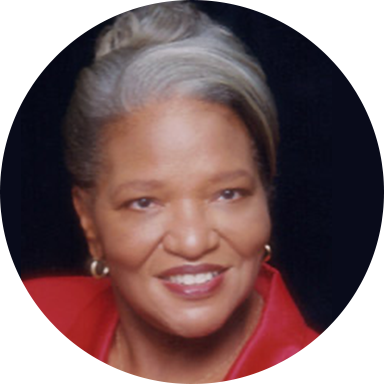
Patsy Ford Simms began composing and arranging during her early teaching years at the middle school level, driven by the scarcity of accessible choral repertoire for junior high voices. Her educational background includes a Bachelor of Science in Music Education from Knoxville College, a Master of Education from the University of Louisville, and a doctorate in Music Education from Columbia Pacific University. Over three decades in the classroom (K-12 and at the Youth Performing Arts School), she created more than 300 songs for educational and church publishers, including Shawnee Press.
Her work has earned international recognition as a clinician and presenter in Italy and Africa. Two of her compositions were selected for MENC's World's Largest Concerts, and she has received multiple ASCAP Special Music Awards. Beyond choral octavos, Simms has composed commissioned works and short musicals exploring African American history, reflecting her commitment to expanding the musical canon available to young singers.
Why we love this
Simms writes with middle schoolers in mind, and this piece proves why that matters: the two-part voicing never condescends, the text mixing English and Swahili creates genuine cultural substance without oversimplifying, and the movement and staging options give your students something meaningful to do beyond standing in formation. The African feel keeps the piece fresh while remaining singable for developing voices.
What to expect
The piece evokes a journey with both weight and hope, moving through weariness toward a request for peace and flourishing. African rhythmic and harmonic sensibilities ground the sound in authenticity while the bilingual text creates moments of reflection and connection, building toward something transcendent rather than simply decorative.
Who it's for
Middle school and junior high choirs will find this piece sits perfectly in their range and maturity level. It works equally well for high school treble choirs or any ensemble seeking substantive multicultural literature that avoids tokenism. Directors programming for festivals, contests, or assemblies on themes of peace and unity will find this accessible yet thoughtful.
How to get the most out of it
- Work the Swahili text syllable by syllable before attempting full phrases; African languages reward rhythmic precision and clear articulation more than English sometimes does.
- Use the recorded accompaniment to lock the harmonic background, then gradually reduce reliance on it as singers gain confidence with the melody and part independence.
- Plan staging choices early in rehearsal rather than as an afterthought; movement integrated from day one prevents songs from feeling static and engages singers who learn better kinesthetically.
- Balance the two languages in your interpretation: the English text sets the emotional context while the Swahili phrases anchor the cultural identity and spiritual core of the piece.
How to use it
Program this alongside other multicultural repertoire to create a cohesive concert or assembly focused on global perspectives or themes of peace. It works beautifully as a closer to a set of spirituals or world music, offering contemporary context while honoring traditions. The movement and staging elements make it ideal for a concert where you want singers actively engaged rather than stationary.
Skills your students will build
- Singing in a non-English language with rhythmic precision and cultural respect
- Sustaining two independent vocal lines with secure blend and intonation
- Integrating choreography and staging with singing
- Developing musicality in secular world music literature