
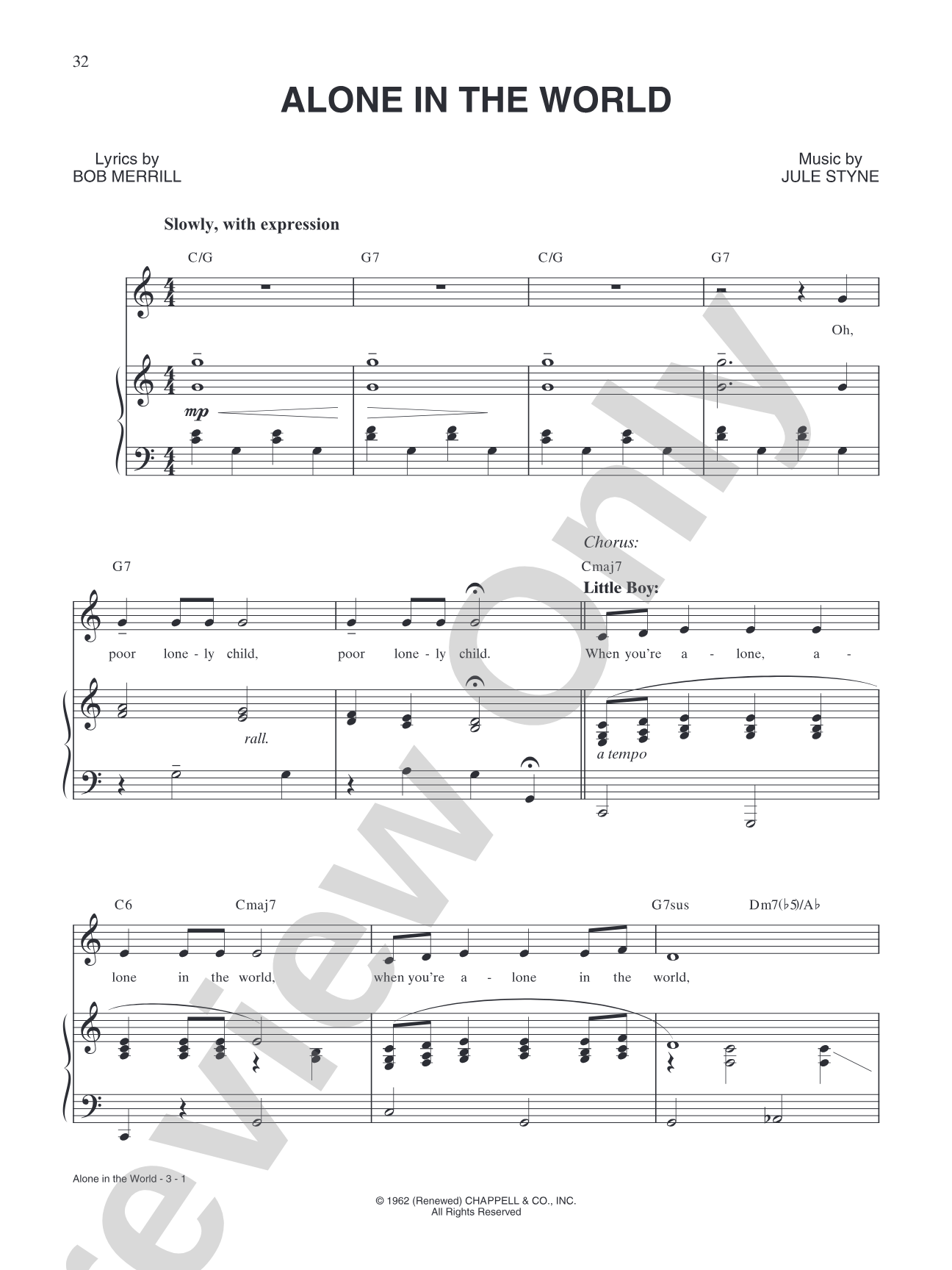

Alone In The World: Piano/Vocal/Chords
Sheet Music from the First Animated Christmas Special
Lyrics by Bob Merrill, music by Jule Styne
Item: 00-PS-0013432
$4.99
One moment…
Related Items
Ringle, Ringle: Piano/Vocal/Chords |
$4.99
|
View | |
Winter Was Warm: Piano/Vocal/Chords |
$4.99
|
View | |
The Lord's Bright Blessing (reprise): Piano/Vocal/Chords |
$4.99
|
View | |
The Lord's Bright Blessing: Piano/Vocal/Chords |
$5.99
|
View | |
We're Despicable: Piano/Vocal/Chords |
$4.99
|
View | |
It's Great To Be Back On Broadway: Piano/Vocal/Chords |
$9.99
|
View |
Description
Mr. Magoo's Christmas Carol debuted on the NBC television network on December 18, 1962, capturing the hearts of milllions with Broadway-caliber songs written by Bob Merrill and Jule Styne (Funny Girl) at the peak of their careers. Although this landmark production gradually became obscured by countless other televised Christmas specials that followed, its score remains noteworthy today for its timeless songs. Now, for the first time, this collectible songbook allows pianists and singers to explore the music and bring it to life anew. A fascinating historical foreword by animation expert Darrell Van Citters is included. Titles: * It's Great to Be Back on Broadway * Ringle, Ringle * The Lord's Bright Blessing * Alone in the World * Winter Was Warm * We're Despicable * The Lord's Bright Blessing (Reprise).


Alone In The World: Piano/Vocal/Chords isn't in MakeMusic Cloud just yet...but it could be. Let us know you'd like to see it, and you'll help shape what comes next. In the meantime, start a free trial and dive into thousands of interactive titles your students can play along with today.
Request This Title
Tell us you want it.
Start Your Free Trial
Explore everything that's ready to play right now.
Sample Audio
No sample audio found.
Sample Video
No sample videos found.
Additional Details
Publisher:
Alfred Music
Page Count:
44
SKU:
00-PS-0013432
More about this title
About the Composer: Jule Styne
Jule Styne (1905-1975) was a prolific composer whose gift for melody shaped the American musical theater. He collaborated with some of Broadway's finest lyricists, including Stephen Sondheim, Sammy Cahn, and Bob Merrill, creating scores for Gypsy, Funny Girl, and High Button Shoes. His music combined sophisticated harmonic language with unforgettable hooks, making his work accessible to audiences while satisfying musicians.
Styne's theatrical instincts extended to television and film, where he brought the same compositional rigor and emotional directness that defined his stage work. By the early 1960s, he was at the height of his creative power, capable of writing songs that felt both intimate and grand. His score for Mr. Magoo's Christmas Carol demonstrates this mastery: songs that work equally well as sung theater pieces and as standalone vocal selections.
Why we love this
This collection captures Styne at the height of his craft, paired with Bob Merrill's strong, singable lyrics. The songs sit comfortably for voices and pianists, with harmonic sophistication that keeps adult musicians engaged while remaining accessible to younger performers. Programming selections from this score allows you to draw from a television milestone that deserves rediscovery, one that stands apart from the usual holiday repertoire.
What to expect
There's a bittersweet warmth throughout this score. Even the comedic numbers carry an underlying kindness, while the ballads have a poignant quality that feels earned rather than manipulative. The harmonic language suggests the Broadway sound of the golden age without sounding dated; these melodies feel both of their time and timeless.
Who it's for
Pianists and singers who want to perform sophisticated popular song material with substance. Music teachers and directors seeking holiday selections that offer more than standard seasonal fare; these songs have genuine theatrical merit and reward careful attention to text and music.
How to get the most out of it
- Lean into the Broadway idiom. These songs were written for theatrical singers, so honor the legit singing style and clear diction that make Styne's melodies shine.
- Pay attention to the underscoring in the piano part. Styne's accompaniment shapes the emotional landscape of each song; don't reduce the piano to simple chord comping.
- Balance sentiment with restraint in the slower ballads. Songs like 'Alone in the World' have genuine tenderness, but oversinging them will undercut their effect.
- Use the chord symbols as a starting point, not a prescription. Explore how you might voice these chords on piano in ways that reflect your own musicality while staying true to the song's character.
How to use it
Use selections from this score as standalone concert pieces in holiday programming that reaches beyond Christmas carols and pop standards. A medley of two or three contrasting songs works beautifully on a vocal recital or mixed concert, or feature a single ballad like 'Alone in the World' to anchor a program around classic American songwriting. The historical foreword makes this material ripe for programming with spoken context or a brief talk-back about television's golden age of musical theater.
Skills your students will build
- Legit singing style and sustained vocal tone in the Broadway tradition
- Reading chord symbols and realizing them idiomatically on piano
- Interpreting text with emotional specificity without sentimentality
- Understanding harmonic function in the popular song tradition
- Balancing melody and accompaniment in piano-vocal performance