

Alleluia for Our Time: SAB Choral Octavo
By Jay Althouse
Item: 00-PO-0000386
$1.75
Minimum order quantity: 20 copies
Pickup currently not available
Description
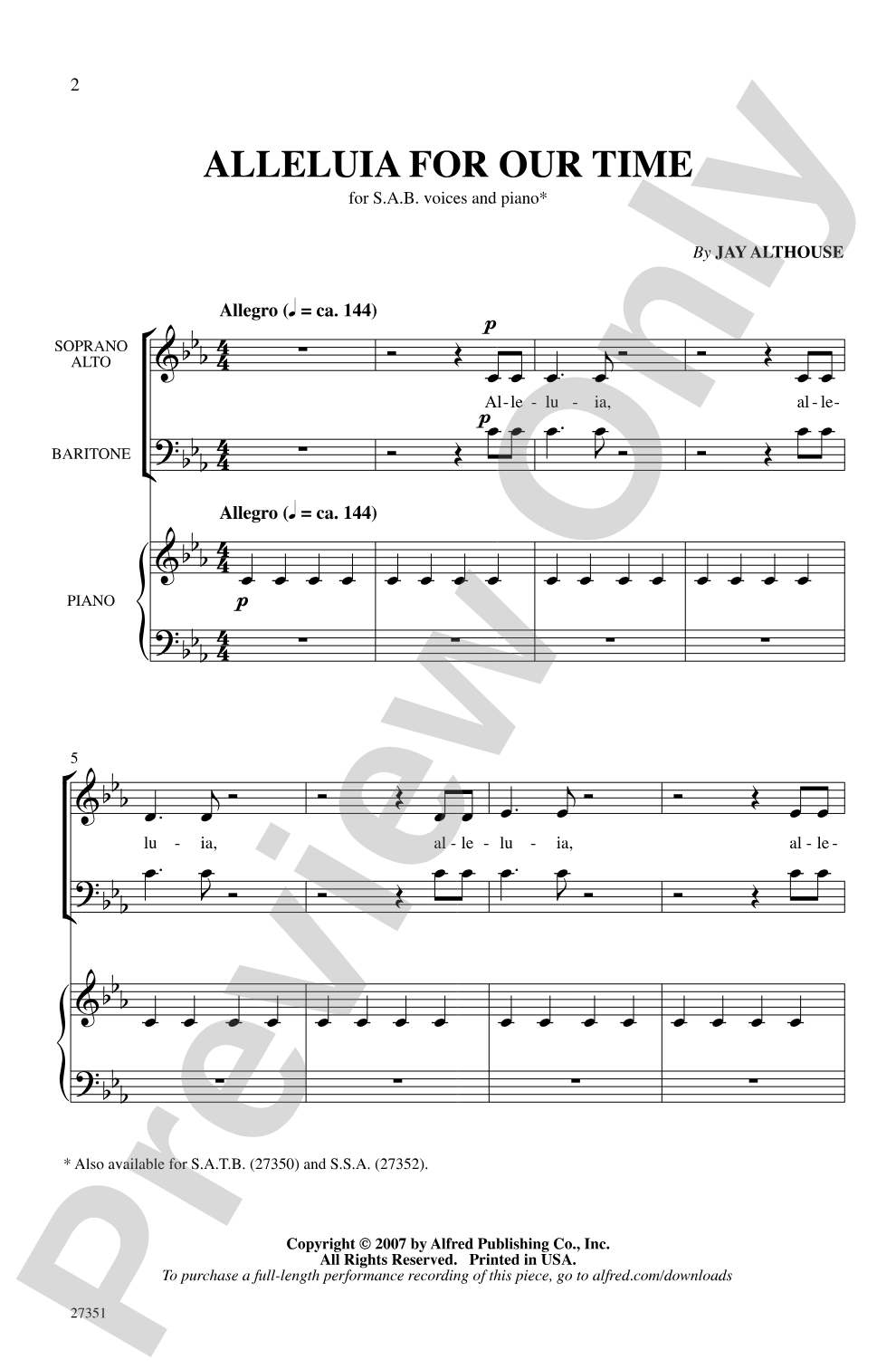
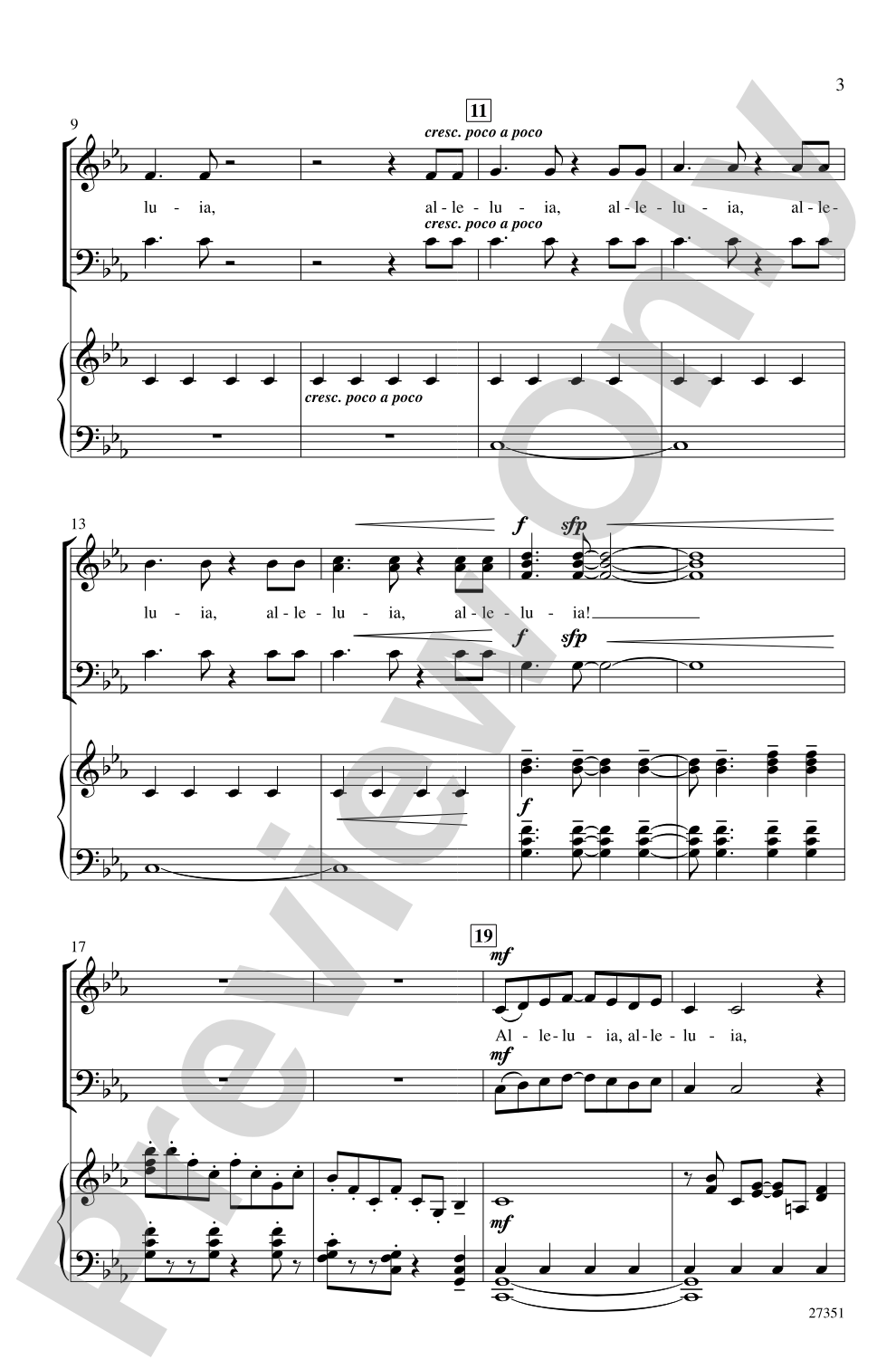
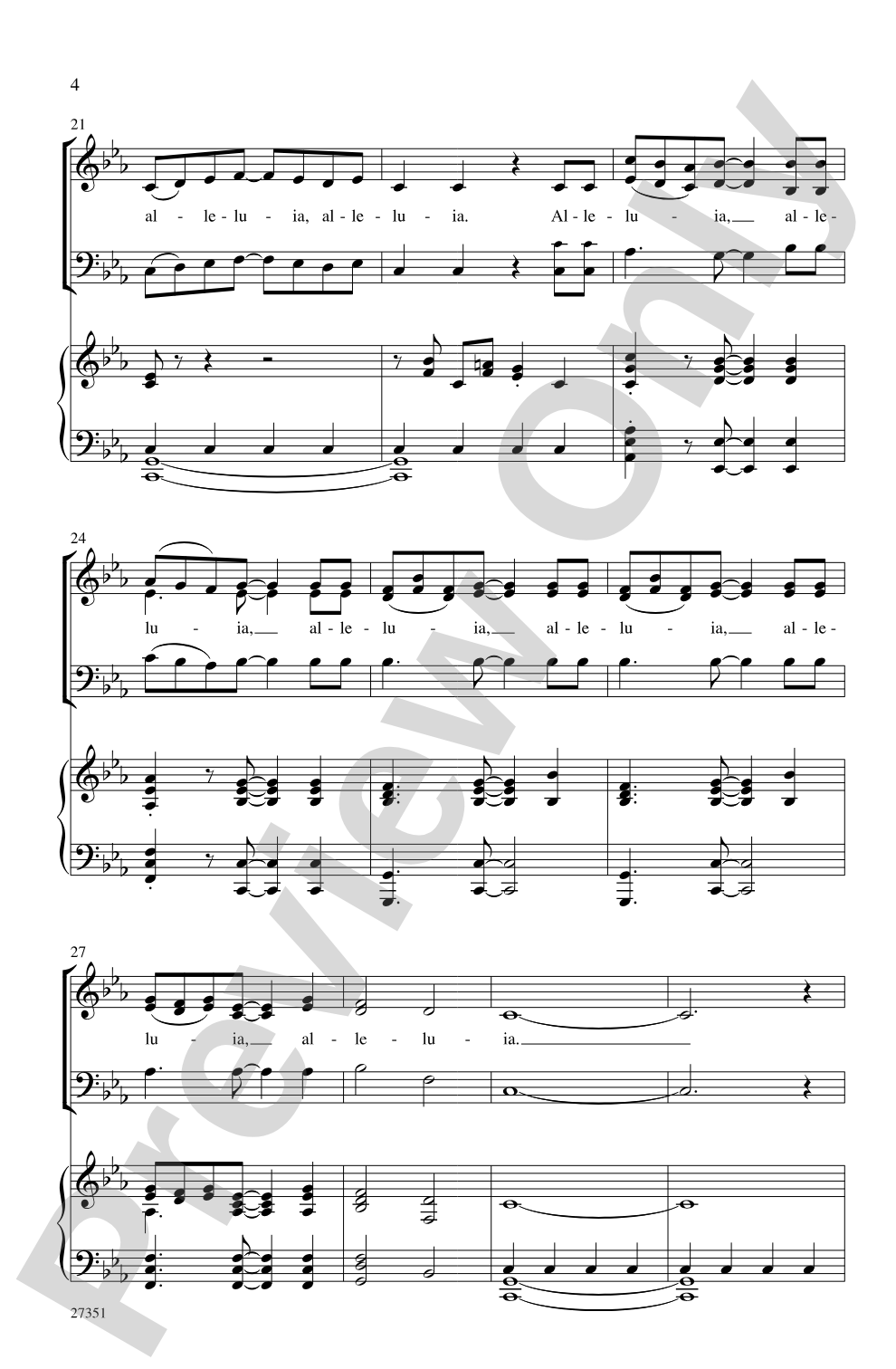
A strong choral statement that begins in C minor, builds, and finishes powerfully with a jubilant ending in E-flat major. Great contemporary writing, accessible for today's choirs. One of Jay Althouse's best works. Perfect for festivals, adjudications, and concerts, any time of year.


Alleluia for Our Time: SAB Choral Octavo isn't in MakeMusic Cloud just yet...but it could be. Let us know you'd like to see it, and you'll help shape what comes next. In the meantime, start a free trial and dive into thousands of interactive titles your students can play along with today.
Request This Title
Tell us you want it.
Start Your Free Trial
Explore everything that's ready to play right now.
Sample Audio
1
Audio File
--:--
0:00
0:00
Sample Video
No sample videos found.
Additional Details
Series:
Alfred Choral Designs
Publisher:
Alfred Music
Page Count:
12
SKU:
00-PO-0000386
More about this title
About the Composer: Jay Althouse

Jay Althouse holds degrees in Music Education and Music from Indiana University of Pennsylvania, where he was later honored as a Distinguished Alumnus. Early in his career, he spent eight years as a rights and licenses administrator for a major educational music publisher and served on the Executive Board of the Music Publishers Association of America. His compositional output spans more than 800 choral works performed widely across the English-speaking world, and he is a writer member of ASCAP with multiple Special Awards recognizing his contributions to standard choral music.
Beyond composition, Althouse has shaped music education through collaborations with his wife Sally K. Albrecht on children's musicals and vocal collections, co-authored influential texts like The Complete Choral Warm-up Book and Accent on Composers, and created classroom resources including Ready to Read Music and One-Page Composer Bios. His choral composition "I Hear America Singing," co-written with Albrecht, was performed by the San Francisco Girls and Boys Choirs at President Barack Obama's 2009 Inauguration. He has served on the boards of the North Carolina Master Chorale and the Folk Art Society of America.
Why we love this
Althouse gives you a piece with genuine dramatic arc. The journey from C minor to E-flat major unfolds naturally, never feeling forced, and the choral writing sits perfectly in the voice ranges without sacrificing intensity. Directors consistently choose this work because it sounds ambitious while remaining genuinely achievable for mixed-voice choirs working at an accessible level.
What to expect
The piece opens with restrained intensity, drawing listeners into a contemplative minor-key space. As harmonies shift and voices accumulate, the energy lifts gradually until the arrival in E-flat major breaks open with radiance and affirmation. There's both spiritual weight and genuine celebration woven into the journey.
Who it's for
Mixed-voice choirs from high school through community and church ensembles looking for a contemporary piece with substance. The SAB voicing works particularly well for groups with limited tenor depth, making it accessible without compromising musical integrity.
How to get the most out of it
- Let the minor tonality breathe in the opening sections; resist rushing the early phrases. The power of the work depends on contrast, so establish a clear dynamic floor before the build begins.
- Balance the parts during the modulation to E-flat major. The sopranos and altos need clarity without drowning out the soloistic moments in the tenor and bass lines.
- Shape the final jubilant section with articulation and breath placement. The excitement comes from precision and unified vowel sounds, not from simply singing louder.
How to use it
This works as a concert opener when you want to establish a serious musical tone, or as a powerful closing statement for services and festivals. The contemporary language and dramatic structure make it equally at home in adjudication settings or celebratory events where choirs want to leave audiences moved.
Skills your students will build
- Singing through key modulations (C minor to E-flat major)
- Balancing three-part mixed voicing with textural clarity
- Shaping dynamic arcs over longer phrases
- Ensemble tuning during harmonic transitions