
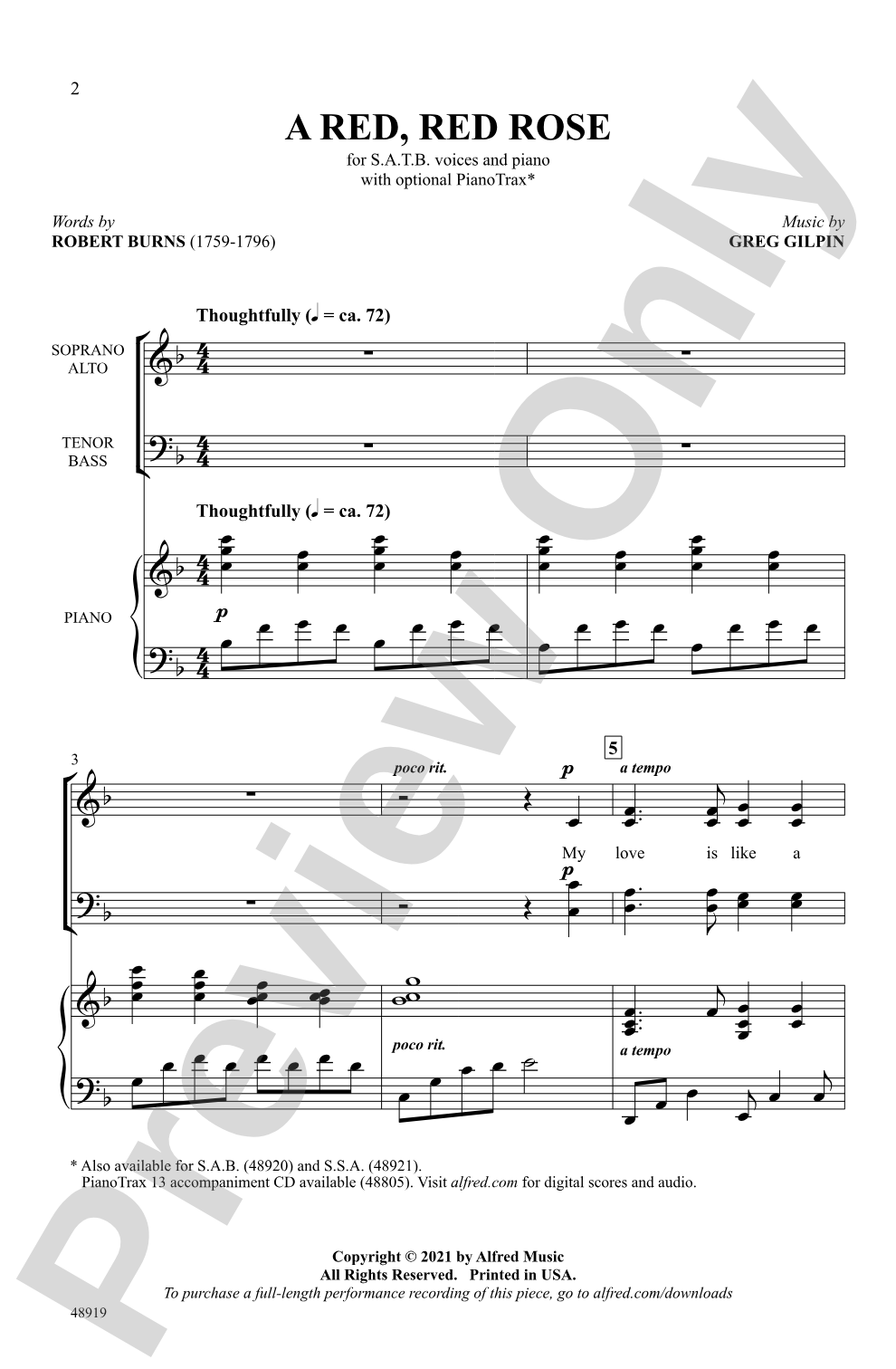

A Red, Red Rose: SATB Choral Octavo
Words by Robert Burns, music by Greg Gilpin
Item: 00-PO-0006700
$2.05
Minimum order quantity: 20 copies
Pickup currently not available
Related Items
A Red, Red Rose: PianoTrax Digital Audio Download |
$9.99
|
View | |
A Red, Red Rose: SAB Choral Octavo |
$2.05
|
View | |
A Red, Red Rose: SSA Choral Octavo |
$2.05
|
View | |
A Red, Red Rose: SATB Choral Octavo |
$2.05
|
View | |
A Red, Red Rose: SAB Choral Octavo |
$2.05
|
View | |
A Red, Red Rose: SSA Choral Octavo |
$2.05
|
View |
Description
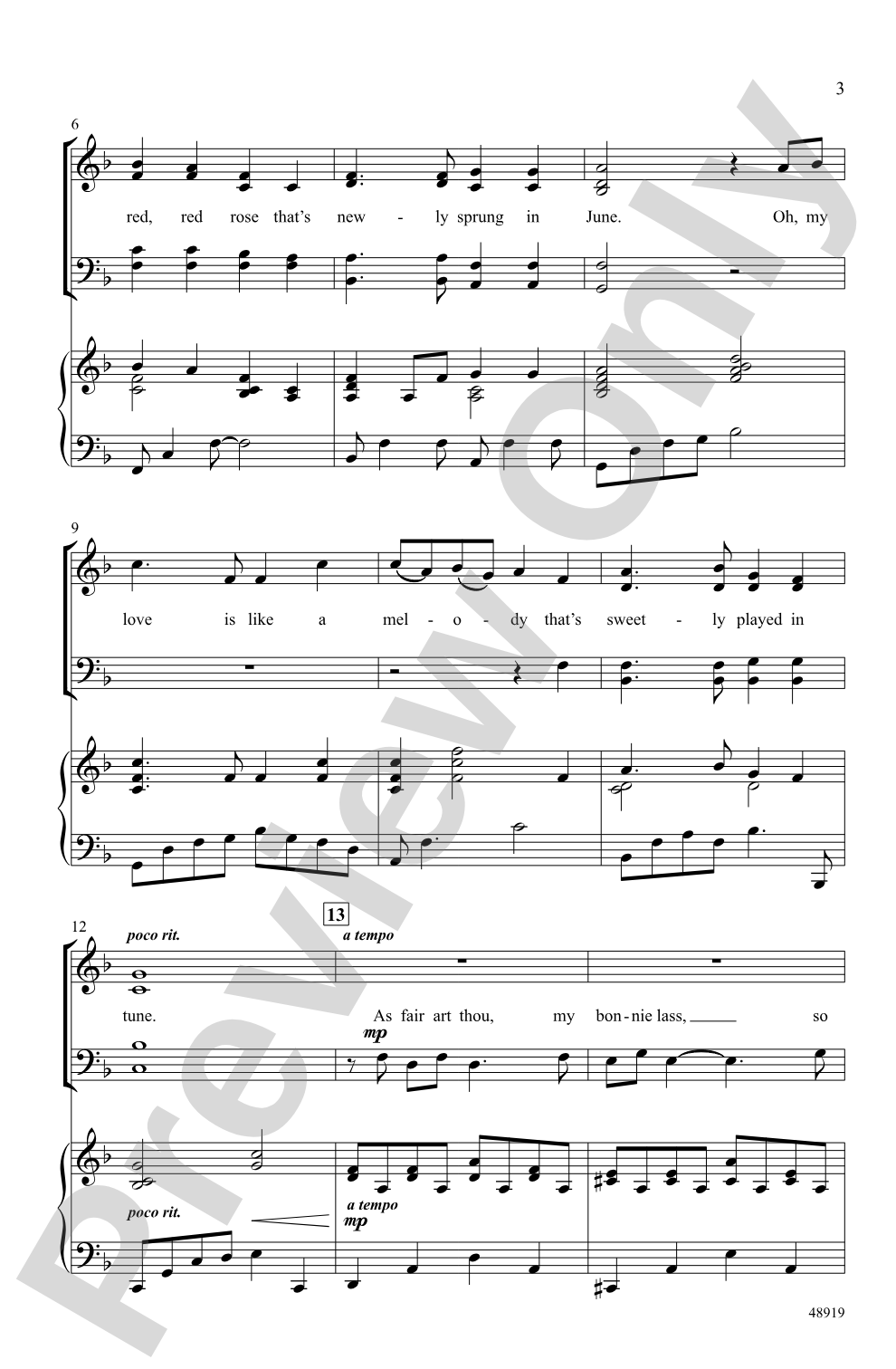
This poem has long been a favorite of singers due to its deep passion and expressive imagery, not to mention the warm vowels at the end of each line. In this artistic setting, Greg Gilpin incorporates a contemporary harmonic palette, expressive tempo nuances, and elegant dynamic shading to form a colorful garden of sound. The final chord suggests the rose/thorn quality of love, as singers sustain sweet dissonance. Give special consideration to the S.S.A. voicing---the romantic text may have great appeal to your ladies.


A Red, Red Rose: SATB Choral Octavo isn't in MakeMusic Cloud just yet...but it could be. Let us know you'd like to see it, and you'll help shape what comes next. In the meantime, start a free trial and dive into thousands of interactive titles your students can play along with today.
Request This Title
Tell us you want it.
Start Your Free Trial
Explore everything that's ready to play right now.
Sample Audio
1
Audio File
--:--
0:00
0:00
Sample Video
1 / 2
Additional Details
Series:
Alfred Choral Designs
Publisher:
Alfred Music
Page Count:
8
SKU:
00-PO-0006700
More about this title
About the Composer: Greg Gilpin

Greg Gilpin brings versatility across multiple musical roles. As a choral composer, arranger, and conductor, he has led performances at Carnegie Hall, Lincoln Center, and Ryman Auditorium, with international engagements spanning the Sydney Opera House, Royal Festival Hall in London, and Harpa Concert Hall in Reykjavik. His work has earned ASCAP recognition, and he serves as Director of Educational Choral Publications for Shawnee Press.
Beyond the concert hall, Gilpin has expanded into film scoring, composing the award-winning score for the short film "Rosie's Rescue" in 2021. He holds membership in ACDA, NAfME, and SAG-AFTRA, and remains active as a recording industry producer and musician. His involvement spans from choral artistry to collaborative projects with professional singers and orchestras.
Why we love this
Gilpin's harmonic language feels fresh without alienating singers or audiences unfamiliar with contemporary writing. The closing dissonance is a masterstroke that makes the metaphor of love's complexity audible rather than merely poetic, and the S.S.A. voicing option gives you genuine flexibility in casting while maintaining the piece's romantic core.
What to expect
Warm, introspective, and emotionally layered. Gilpin's setting honors Burns's passionate text with expressive dynamic shading and harmonic color that feels intimate even in full voice. The final sustained dissonance lingers like the bittersweet recognition that love and heartache are inseparable.
Who it's for
This octavo works beautifully for ensembles seeking concert or festival repertoire with literary substance. The optional S.S.A. voicing makes it especially useful for treble-heavy groups or programs celebrating women's voices, while the full SATB version serves mixed choirs looking for contemporary sacred or secular programming with emotional weight.
How to get the most out of it
- Shape the warm vowels at phrase endings with intentional breath support; these sustained sounds are where the piece's lyrical beauty lives.
- Let the contemporary harmonic palette breathe by giving singers time to adjust voicing in the dissonant final chord. A slight ritardando into the hold will help the harmonic tension register fully.
- Consider the emotional arc across all eight pages. This isn't a sprint to the ending; tempo nuances should reflect the poem's emotional journey from ardor to the complexity suggested by that final sonority.
- If performing the S.S.A. voicing, ensure the inner part writing remains clear so the reduced ensemble doesn't lose textural richness.
How to use it
This pairs naturally with Romantic or art song programming, offering contemporary writing alongside classical or folk arrangements. Its eight-page length makes it ideal as a centerpiece in a song cycle concert or as a sophisticated opener that establishes an emotionally engaged tone for the rest of your program.
Skills your students will build
- Singing contemporary harmonic language with security and blend
- Sustaining and balancing dissonant sonorities
- Responding to expressive dynamic and tempo markings in service of text
- Understanding metaphor through musical color and harmonic choice
- Flexible voicing between SATB and S.S.A. configurations