
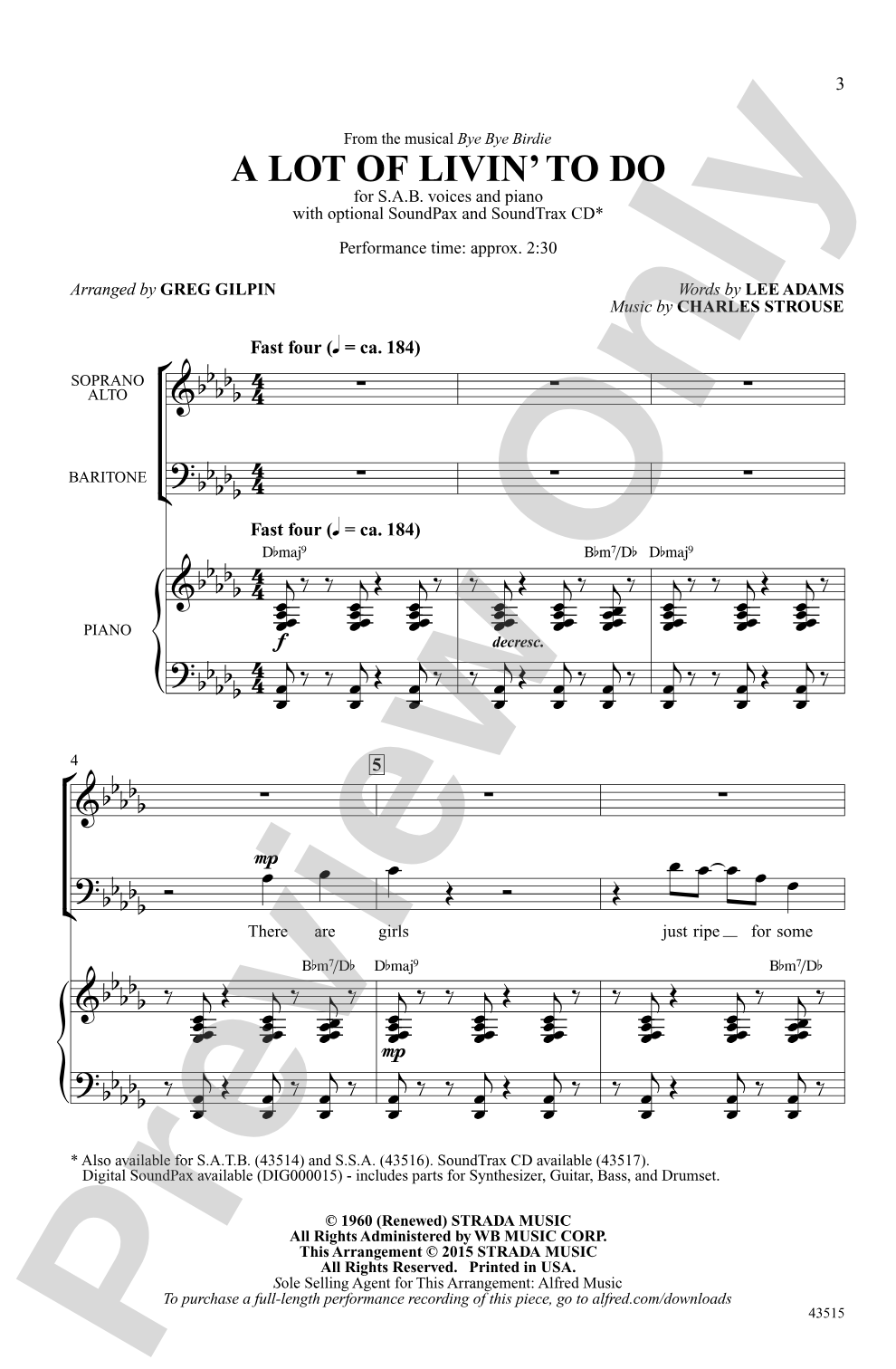
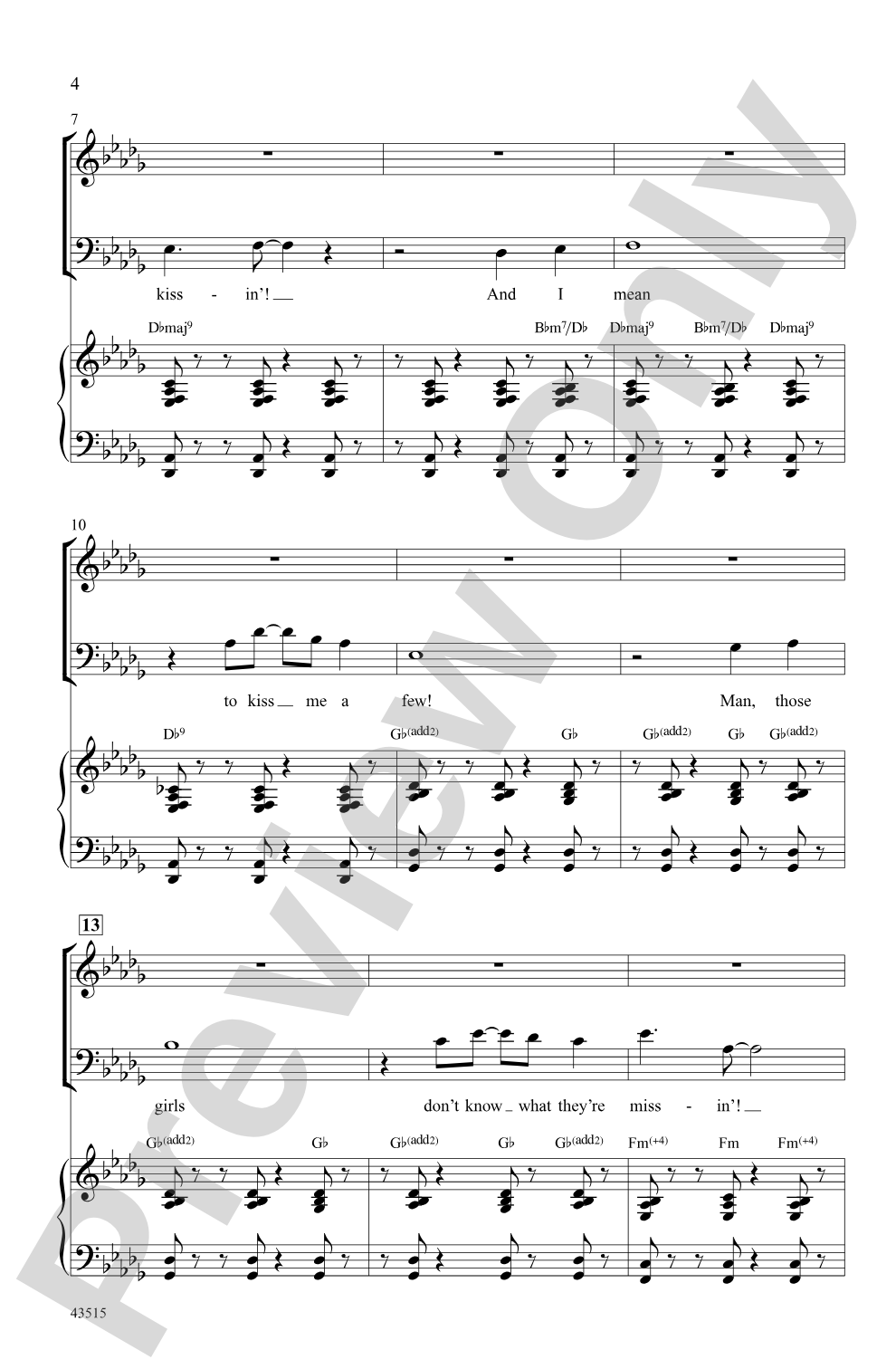

A Lot of Livin' to Do (from the musical Bye, Bye, Birdie): SAB Choral Octavo
From the Musical Bye, Bye, Birdie
Music by Charles Strouse, lyric by Lee Adams / arr. Greg Gilpin
Item: 00-PO-0003405
$2.00
Minimum order quantity: 20 copies
One moment…
Related Items
A Lot of Livin' to Do: SoundTrax Digital Audio Download |
$27.99
|
View | |
A Lot of Livin' to Do (from the musical Bye, Bye, Birdie): SATB Choral Octavo |
$2.00
|
View | |
A Lot of Livin' to Do (from the musical Bye, Bye, Birdie): SSA Choral Octavo |
$2.00
|
View | |
A Lot of Livin' To Do: Choral Octavo Digital SoundPax |
$15.00
|
View | |
A Lot of Livin' to Do: SATB Choral Octavo |
$2.00
|
View | |
A Lot of Livin' to Do: Choral Octavo SoundTrax CD |
$27.99
|
View |
Description
Show and concert choirs will both sound great singing this upbeat production number from the musical Bye, Bye, Birdie. Exciting from start to finish!


A Lot of Livin' to Do (from the musical Bye, Bye, Birdie): SAB Choral Octavo isn't in MakeMusic Cloud just yet...but it could be. Let us know you'd like to see it, and you'll help shape what comes next. In the meantime, start a free trial and dive into thousands of interactive titles your students can play along with today.
Request This Title
Tell us you want it.
Start Your Free Trial
Explore everything that's ready to play right now.
Sample Audio
1
Audio File
--:--
0:00
0:00
Sample Video
No sample videos found.
Additional Details
Series:
Alfred Pop Series
Publisher:
Alfred Music
Page Count:
12
SKU:
00-PO-0003405
More about this title
About the Composer: Charles Strouse
Charles Strouse composed some of Broadway's most enduring melodies, including the scores for Bye, Bye, Birdie, Annie, and Applause. His gift for writing memorable, singable lines that work equally well in the theater and the concert hall has made his music a staple of school and community productions for decades. Strouse understood how to write music that captures the energy of a moment while remaining accessible to student performers.
Why we love this
Greg Gilpin's SAB arrangement captures the infectious joy of this production number without sacrificing any of the song's character or momentum. The voicing sits perfectly for developing ensembles, and the part writing keeps all three sections engaged throughout without requiring soloists or excessive divisi. You get a piece that feels polished and theatrical but remains genuinely fun to teach and perform.
What to expect
Infectious optimism runs through every bar. The piece bounces with the kind of carefree energy that makes you want to move, full of the youthful exuberance that defines Bye, Bye, Birdie itself. Performing it should feel like joining a celebration, not executing a technical exercise.
Who it's for
SAB choirs at the middle school through early high school level will find this arrangement both accessible and rewarding. It works beautifully for groups seeking a Broadway number that balances showcasing their musical ability with delivering genuine entertainment value. Directors programming pops concerts, musical theater revues, or spring shows will recognize this as a crowd-pleaser that students love to perform.
How to get the most out of it
- Shape the phrases with deliberate attention to breath placement. The text naturally suggests quick breaths at punctuation marks; honor these rather than pushing through long phrases without release.
- Keep the energy steady in the accompaniment parts. The sopranos and altos carry the main melodic material, so baritones should lock into a consistent groove that supports without overwhelming.
- Approach the rhythmic figures with precision. Syncopation appears throughout, and clarity of articulation makes the difference between energetic and sloppy.
- Blend vowels carefully in the unison and near-unison passages. The SAB texture includes moments where parts align or nearly align; match these sections as tightly as possible.
How to use it
This sits naturally in a pops or musical theater concert, where it can anchor a set of Broadway numbers or stand alone as a crowd-pleasing closer. It also works well on spring concerts or variety shows where you want to balance more serious repertoire with something that reminds audiences why choral music brings joy. The twelve pages make it a substantial but not overwhelming addition to a concert program.
Skills your students will build
- Syncopated rhythm reading and execution
- Blending unison and near-unison lines across parts
- Sustaining rhythmic energy and groove in accompaniment voicing
- Accurate intonation in the upper register
- Diction clarity in text-driven, fast-moving phrases