
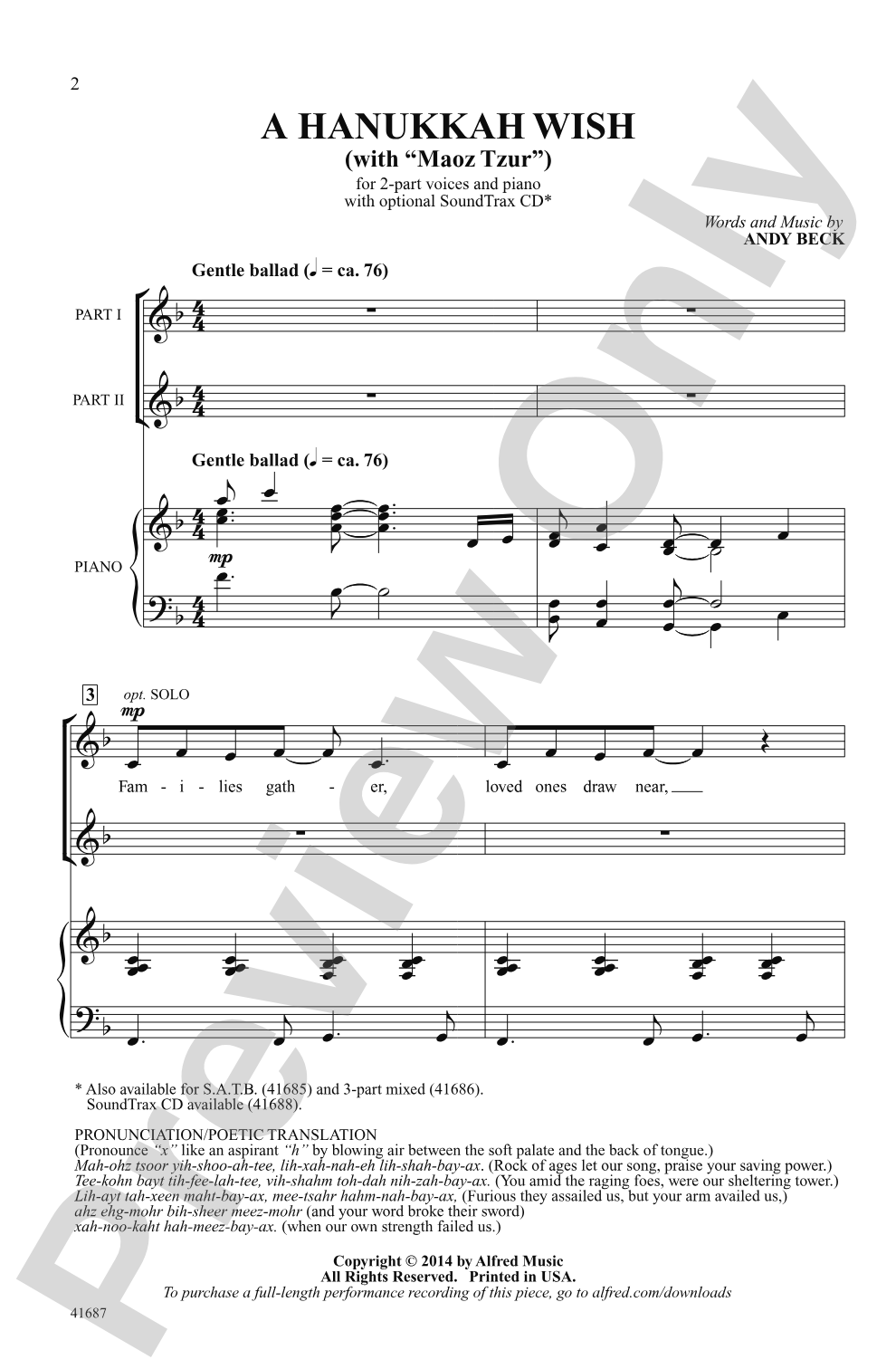
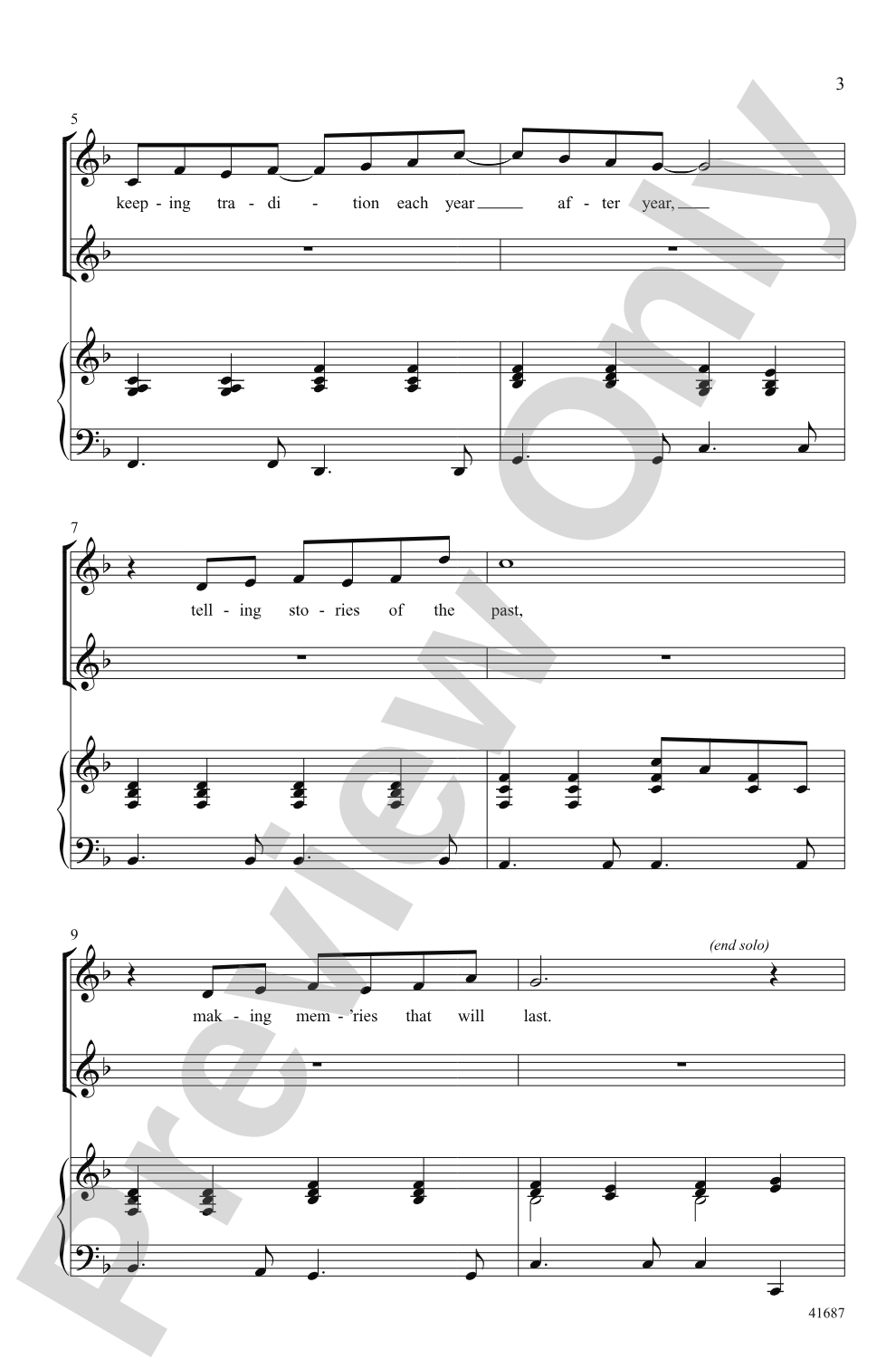

A Hanukkah Wish: 2-Part Choral Octavo
With "Maoz Tzur"
Words and music by Andy Beck
Item: 00-PO-0001875
$2.05
Minimum order quantity: 20 copies
Pickup currently not available
Related Items
A Hanukkah Wish: SATB Choral Octavo |
$2.05
|
View | |
A Hanukkah Wish: 3-Part Mixed Choral Octavo |
$1.85
|
View | |
A Hanukkah Wish: SoundTrax Digital Audio Download |
$27.99
|
View | |
A Hanukkah Wish: SATB Choral Octavo |
$2.05
|
View | |
A Hanukkah Wish: 3-Part Mixed Choral Octavo |
$1.85
|
View | |
A Hanukkah Wish: 2-Part Choral Octavo |
$2.05
|
View |
Description
How often do we find a warm ballad written especially for Hanukkah? No boom-chicks here, and no minor key either, just a tender heartfelt message of family and tradition. Incorporates a contemporary setting of the traditional Hebrew "Maoz Tzur" just before a dramatic modulation to the final refrain.


A Hanukkah Wish: 2-Part Choral Octavo isn't in MakeMusic Cloud just yet...but it could be. Let us know you'd like to see it, and you'll help shape what comes next. In the meantime, start a free trial and dive into thousands of interactive titles your students can play along with today.
Request This Title
Tell us you want it.
Start Your Free Trial
Explore everything that's ready to play right now.
Sample Audio
1
Audio File
--:--
0:00
0:00
Sample Video
No sample videos found.
Additional Details
Series:
Alfred Choral Designs
Publisher:
Alfred Music
Page Count:
12
SKU:
00-PO-0001875
More about this title
About the Composer: Andy Beck

Andy Beck directs choral publications at Alfred Music and has composed and arranged over 450 choral works for singers of all ages. His compositions span sacred music, secular repertoire, and children's musicals, and his work appears regularly on concert programs and festival recordings worldwide. Beck maintains an active career as a guest conductor, adjudicator, and clinician for honor choirs and all-state groups across the country.
A tenor and musical theatre director, Beck holds degrees in Music Education from Ithaca College and Northwest Missouri State University. He has authored influential choral resources including Sing at First Sight and Vocalize! 45 Vocal Warm-Ups That Teach Technique, and continues to balance his publication work with performances in the North Carolina Master Chorale Chamber Choir. His commitment to choral artistry and music literacy shapes both his compositions and his stewardship of Alfred's choral catalog.
Why we love this
Beck trades the expected minor-key solemnity for something more generous: a genuinely warm ballad that trusts tenderness over tradition. The integration of 'Maoz Tzur' feels earned rather than tacked on, arriving at a moment when the piece is emotionally ready for it, and the modulation that follows creates real dramatic lift without feeling forced. For directors seeking Hanukkah repertoire that speaks to family and continuity without leaning on heavy arranging tricks, this is exactly what you need.
What to expect
Intimate and unhurried, like a family gathering on a winter night. The harmonic language is contemporary but approachable, never pushing singers into uncomfortable tessituras, and the overall arc builds gently toward something transcendent without losing its quiet reverence.
Who it's for
Directors programming winter concerts or Hanukkah services who want something that resonates with both singers and audiences. This works beautifully for mixed-age choirs, school ensembles new to sacred Jewish music, and any group that values emotional honesty over complexity.
How to get the most out of it
- Balance the melody and accompaniment during the opening verses; the recorded accompaniment will help your singers hear where they sit in the overall texture.
- Shape the phrasing around the Hebrew text when it appears. Even singers unfamiliar with the language can honor the pronunciation and cadence if you mark breath points clearly in rehearsal.
- Bring out the emotional weight of the modulation by having your singers increase their dynamic intensity slightly as the key changes, creating momentum into the final refrain rather than a jarring shift.
- Mark dynamic contrasts between the main sections in your score so the shift from ballad to 'Maoz Tzur' moment feels like a conversation deepening, not an interruption.
How to use it
Open a winter concert with this if you want to establish a reflective mood before moving to other repertoire, or place it near the end of a program as a centerpiece for a Hanukkah-themed set. It also serves as a meaningful closing piece for interfaith services or secular venues celebrating the season.
Skills your students will build
- Singing in contemporary harmonic language while maintaining phrase legality
- Interpreting and pronouncing Hebrew text accurately
- Following and responding to dramatic key changes
- Balancing emotional expression with technical precision in a ballad setting
- Understanding how traditional melodies can be recontextualized in new arrangements