
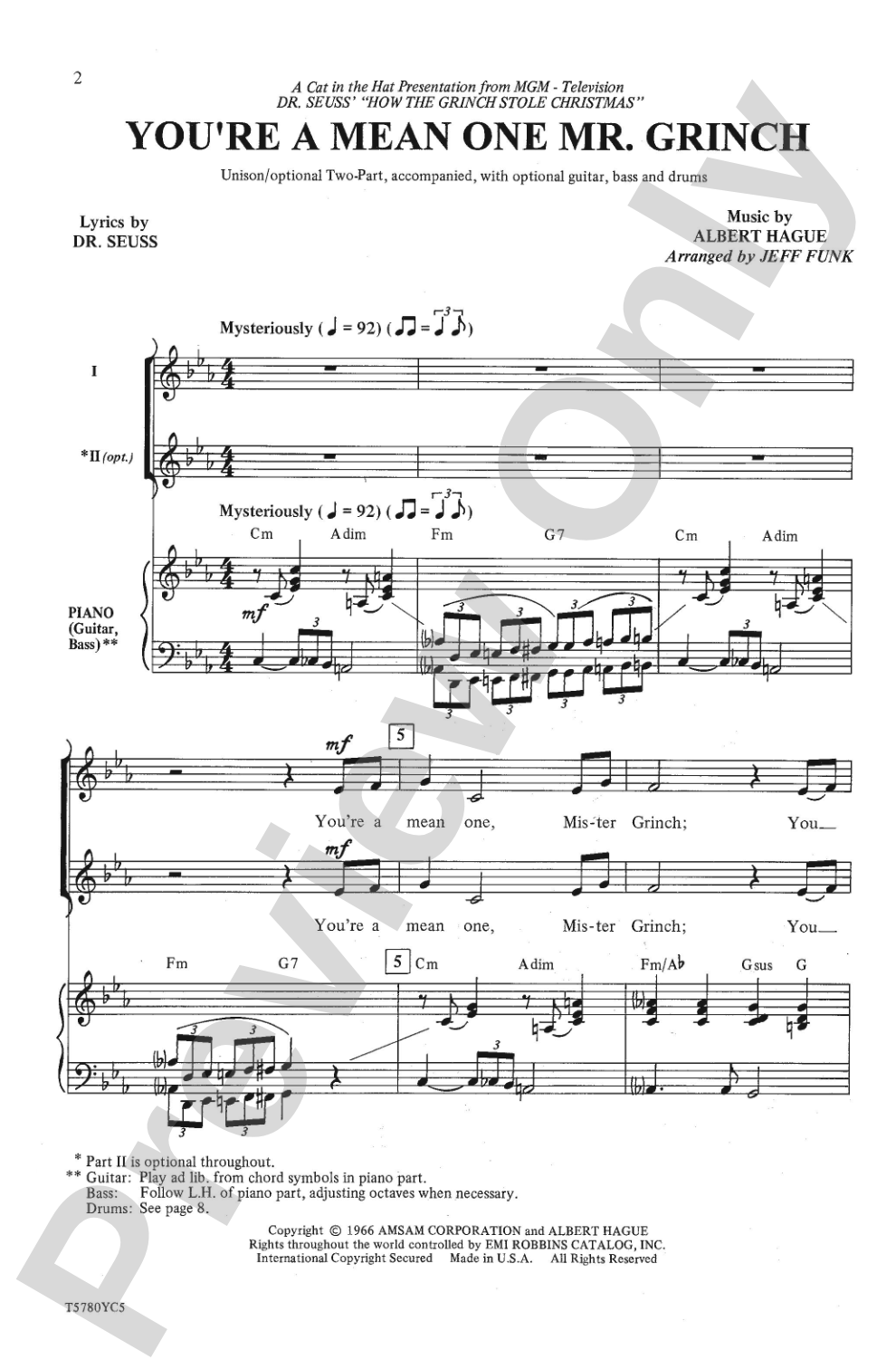
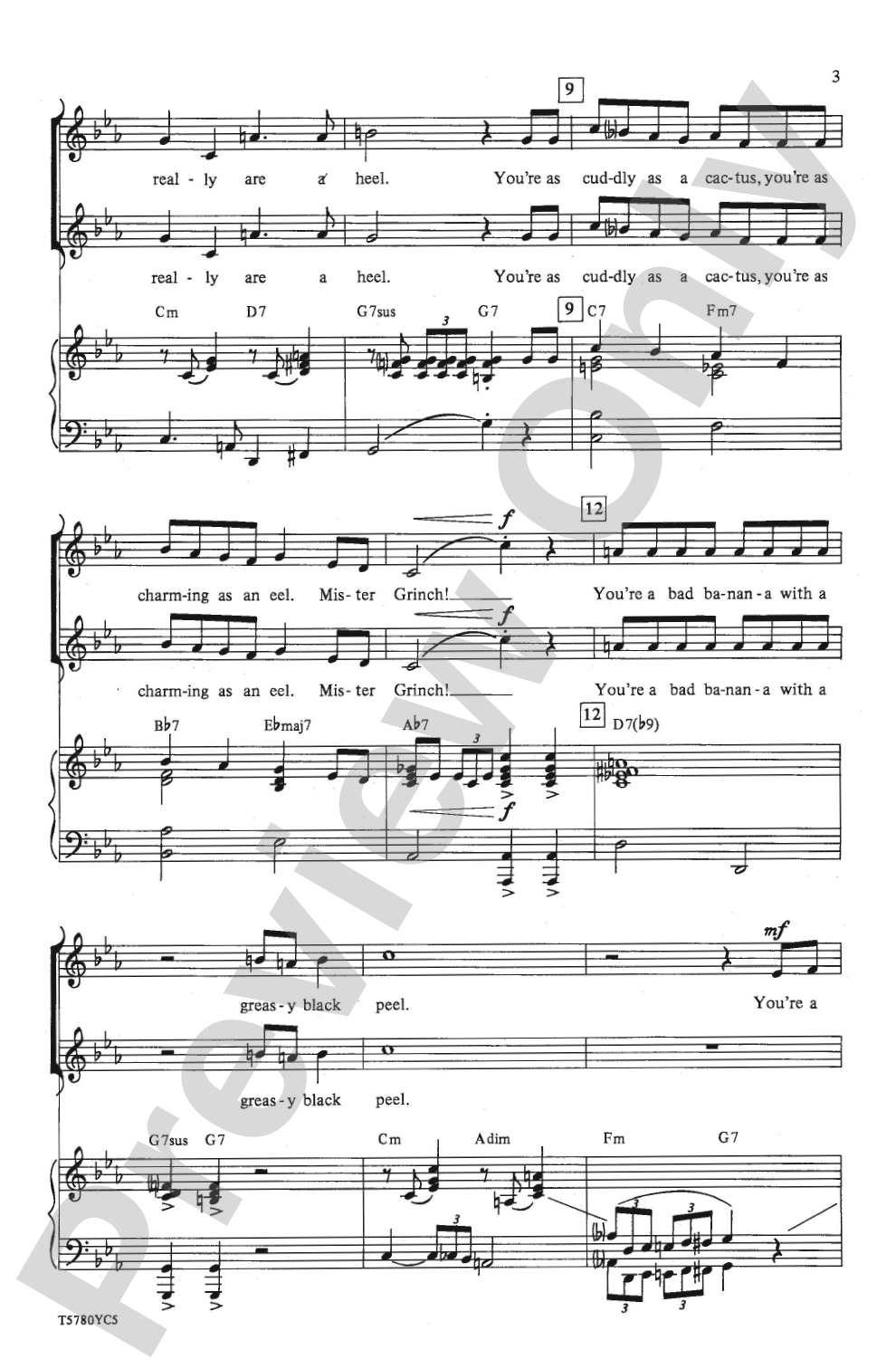

You're a Mean One, Mr. Grinch (from "How the Grinch Stole Christmas"): Unison / Opt. 2-Part Choral Octavo
From How the Grinch Stole Christmas
Lyrics by Dr. Seuss, music by Albert Hague / arr. Jeff Funk
Level: Easy
Item: 00-PO-0002801
$2.10
Minimum order quantity: 20 copies
Pickup currently not available
Related Items
You're a Mean One, Mr. Grinch (from "How the Grinch Stole Christmas"): SATB Choral Octavo |
$2.10
|
View | |
You're a Mean One, Mr. Grinch (from "How the Grinch Stole Christmas"): TBB Choral Octavo |
$2.10
|
View | |
You're a Mean One, Mr. Grinch (from "How the Grinch Stole Christmas"): 3-Part Mixed Choral Octavo |
$2.10
|
View | |
You're a Mean One, Mr. Grinch: SATB Choral Octavo |
$2.10
|
View | |
You're a Mean One, Mr. Grinch: TBB Choral Octavo |
$2.10
|
View | |
You're a Mean One, Mr. Grinch: 3-Part Mixed Choral Octavo |
$2.10
|
View | |
You're a Mean One, Mr. Grinch: Choral Octavo SoundTrax CD |
$27.99
|
View | |
You're a Mean One, Mr. Grinch: Unison / Opt. 2-Part Choral Octavo |
$2.10
|
View | |
You're a Mean One, Mr. Grinch: Choral Octavo SoundTrax CD |
$27.99
|
View |
Description
When Dr. Seuss' classic book "How the Grinch Stole Christmas" became a TV holiday special, the music helped make it a big hit! This title song is hilarious and kids of all ages will love it! Jeff has done a great job at making the lyrics and rhythm very easy to sing. A fabulous novelty addition to any holiday concert.


You're a Mean One, Mr. Grinch (from "How the Grinch Stole Christmas"): Unison / Opt. 2-Part Choral Octavo isn't in MakeMusic Cloud just yet...but it could be. Let us know you'd like to see it, and you'll help shape what comes next. In the meantime, start a free trial and dive into thousands of interactive titles your students can play along with today.
Request This Title
Tell us you want it.
Start Your Free Trial
Explore everything that's ready to play right now.
Sample Audio
1
Audio File
--:--
0:00
0:00
Sample Video
No sample videos found.
Additional Details
Series:
Alfred Pop Choral Series
Publisher:
Alfred Music
Page Count:
8
SKU:
00-PO-0002801
More about this title
About the Composer: Albert Hague
Albert Hague (1920-2001) composed music for stage, screen, and television during a career spanning five decades. He won a Tony Award for his work on the Broadway musical "Plain and Fancy" and earned an Academy Award nomination for his film scoring. Hague's gift for melody and his ability to write music that appeals to both children and adults made him a natural choice for television specials, particularly the beloved 1966 animated adaptation of Dr. Seuss' "How the Grinch Stole Christmas."
Why we love this
This arrangement captures all the mischievous humor and rhythmic snap of the original while keeping the vocal demands genuinely accessible for young singers. The optional second part gives you flexibility to include less confident singers in unison while still offering depth for choirs with stronger harmonic ability. It's a concert moment that guarantees smiles from your audience and genuine fun in rehearsal.
What to expect
Mischievous and swinging, with a rhythmic energy that makes you want to move. The melody has just enough quirk to feel distinctly "Seussian," while the lyrics deliver pointed observations about the Grinch's sourpuss disposition with delicious comedic bite.
Who it's for
Elementary and middle school choirs will find this song within immediate reach, but it works equally well for high school pop choirs and holiday community ensembles seeking accessible, crowd-pleasing repertoire. Any conductor looking for a novelty piece that requires genuine musicality rather than complexity will appreciate Funk's straightforward approach to the lyrics and rhythm.
How to get the most out of it
- Lean into the comedic timing of the lyrics. The song's humor lives in crisp, clear articulation and well-placed phrasing rather than legit singing technique.
- Balance the playfulness with forward momentum; resist the urge to drag the rhythm even when mining moments for laughs.
- If using the optional second part, spend rehearsal time on the independence of both lines so the unison singers don't get pulled off their melody.
How to use it
This is an ideal opener or closer for a holiday concert, particularly when you need a high-energy piece that engages younger audience members without sacrificing musical integrity. It pairs well with more traditional seasonal fare and gives you a programmatic counterweight to reverent selections.
Skills your students will build
- Clear articulation of rhythmic text and comedic phrasing
- Reading and singing optional harmony parts alongside unison melody
- Maintaining rhythmic precision in syncopated pop-style writing
- Balancing blend and projection in a novelty arrangement