
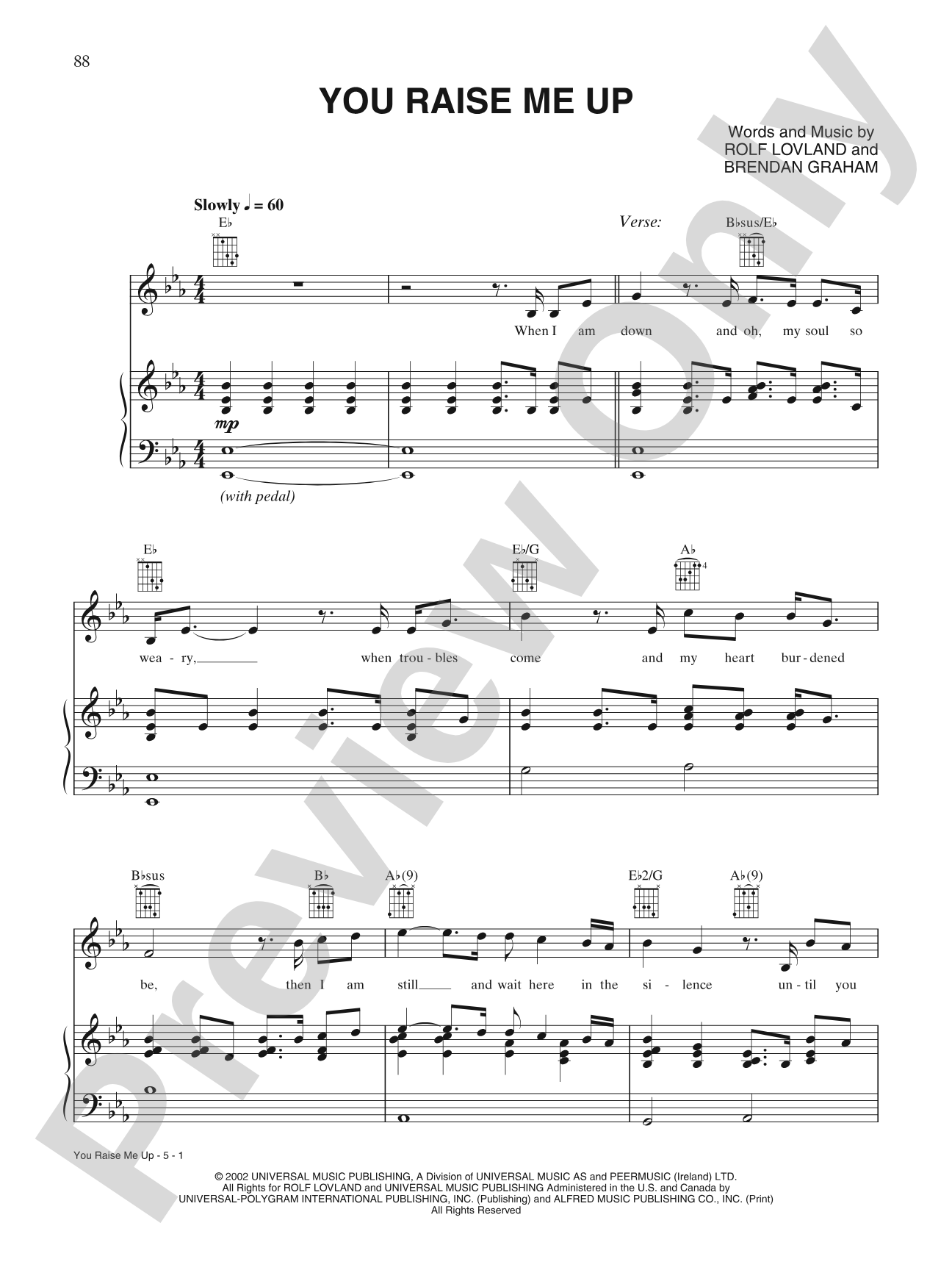

You Raise Me Up: Piano/Vocal/Chords
15 Popular Favorites in a Variety of Styles
Various
Item: 00-PS-0015557
$4.99
Pickup currently not available
Description
Music makers looking for crowd-pleasing material will love this handy songbook, which contains sheet music for 15 of the world's most popular songs in a variety of styles! In this collection, the piano parts emulate the original superstar recordings that made each song famous. Complete vocal melodies and lyrics are included, plus basic chord fingering grids for guitarists. Titles: Because of You (Kelly Clarkson) * Bridge over Troubled Water (Simon and Garfunkel) * Don't Stop Believin' (Journey) * Dynamite (Taio Cruz) * Falling Slowly (from the award-winning musical Once) * Firework (Katy Perry) * Grenade (Bruno Mars) * I Don't Want to Miss a Thing (Aerosmith) * I Have Nothing (Whitney Houston) * I'm Yours (Jason Mraz) * Kiss from a Rose (Seal) * Make You Feel My Love (Adele) * My Immortal (Evanescence) * The Prayer (Celine Dion and Andrea Bocelli) * You Raise Me Up (Josh Groban).


You Raise Me Up: Piano/Vocal/Chords isn't in MakeMusic Cloud just yet...but it could be. Let us know you'd like to see it, and you'll help shape what comes next. In the meantime, start a free trial and dive into thousands of interactive titles your students can play along with today.
Request This Title
Tell us you want it.
Start Your Free Trial
Explore everything that's ready to play right now.
Sample Audio
No sample audio found.
Sample Video
No sample videos found.
Additional Details
Series:
Top-Requested Sheet Music
Publisher:
Alfred Music
Page Count:
92
SKU:
00-PS-0015557
More about this title
About the Composer: Rolf Lovland
Rolf Lovland is a Norwegian composer whose gift for melody has made him one of the most performed songwriters in contemporary music education and performance contexts. Best known for composing "You Raise Me Up" alongside lyricist Brendan Graham, Lovland has created music that bridges classical sensibility with popular appeal, resulting in songs that resonate across age groups and vocal styles.
Lovland's work exemplifies how thoughtful composition can achieve both commercial success and artistic depth. His melodies are singable yet sophisticated, designed to showcase the human voice while remaining accessible to musicians at various skill levels. This balance makes his music particularly valuable in mixed-ability classroom and performance settings.
Why we love this
This collection captures songs that your singers actually want to perform and your audiences will enthusiastically recognize. The piano arrangements are substantial enough to stand on their own as solo pieces while supporting strong vocal performances, and the inclusion of chord grids means guitarists can participate without requiring separate transcriptions. You get versatility across pop, rock, and contemporary genres in one 92-page resource.
What to expect
These arrangements capture the emotional warmth and modern production style of the original recordings. From the intimate vulnerability of "Falling Slowly" to the exuberant energy of "Firework" and "Don't Stop Believin'," the collection offers emotional range within a cohesive popular music aesthetic. Each piece carries the signature of its original artist while remaining accessible for new interpreters.
Who it's for
This collection serves singers preparing recital material, pop and contemporary music ensembles, and music theater programs looking for supplementary repertoire with immediate appeal. It's equally suited to studio instructors building repertoire lists for voice students or pianists seeking engaging solo pieces with optional vocal collaboration.
How to get the most out of it
- Study the recorded versions of these songs before rehearsal. The piano parts are intentionally styled after the original superstar recordings, so listening gives you a sonic roadmap for dynamics, phrasing, and the energy each arrangement requires.
- Balance the vocal melody against the piano texture. Many of these songs feature rich accompaniment patterns that can overshadow the singer if voicing isn't managed carefully during rehearsal.
- Coordinate with any guitarist using the chord grids. Decide whether the guitar doubles the piano, plays a simplified rhythm pattern, or fills specific sections to avoid muddiness in the mid-range.
- Pay attention to key choices. These arrangements are voiced for popular singers' ranges, so test the transposition with your performers before committing to a key.
How to use it
Build a "songwriter's showcase" concert pairing these arrangements with spoken introductions about the composers and artists. Alternatively, use individual songs as supplementary material in a pop/contemporary music unit or as encore pieces following a more classical program. The variety of styles and tempos makes this collection natural for student recital selections or as warm-up material before tackling larger vocal repertoire.
Skills your students will build
- Reading chord grids and understanding guitar voicing notation
- Balancing vocal melody with complex piano accompaniment
- Interpreting contemporary vocal phrasing and style conventions
- Transposing and adapting popular arrangements to suit individual voice types
- Collaborating between voice, piano, and guitar in small ensemble settings