
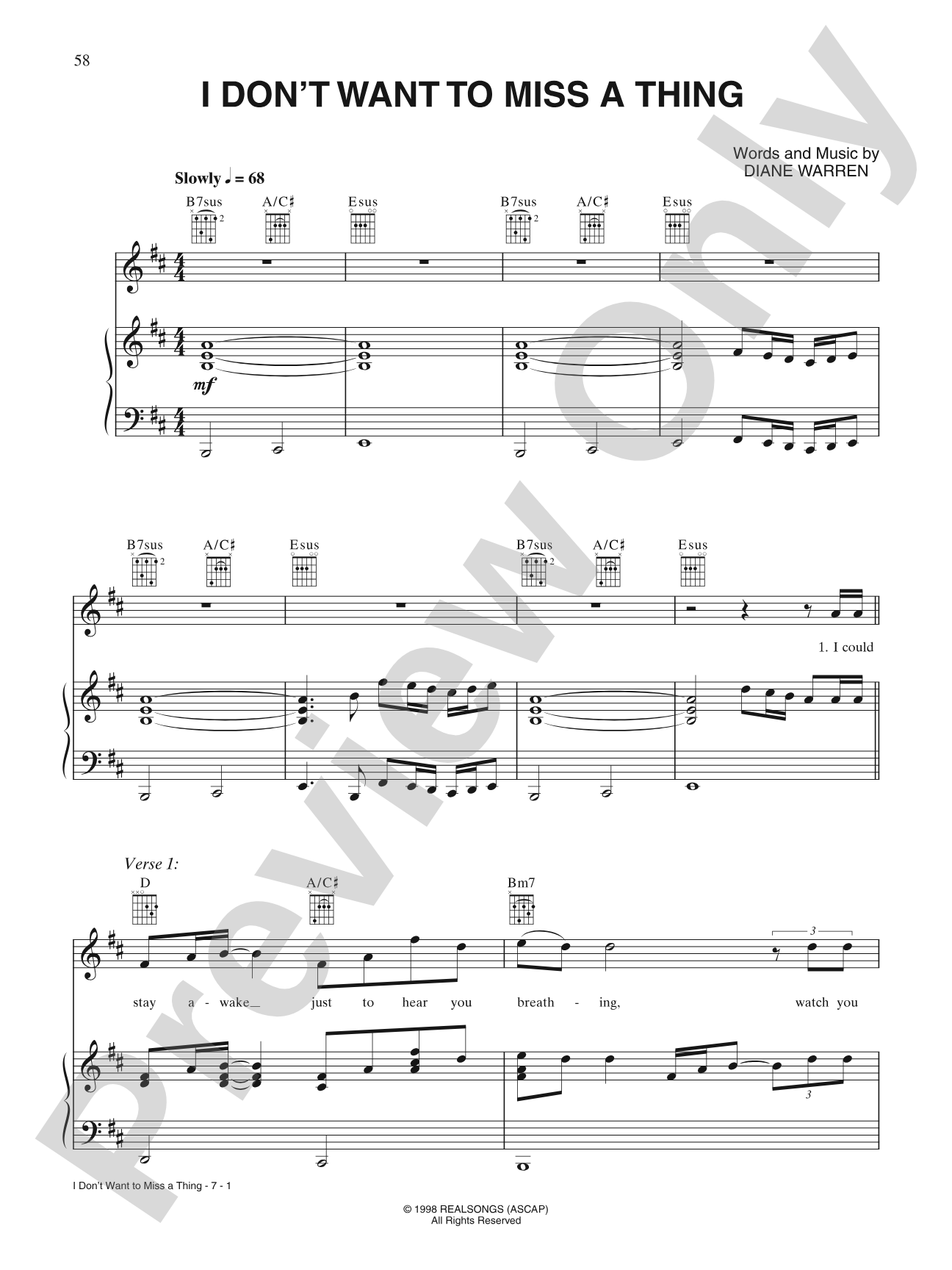
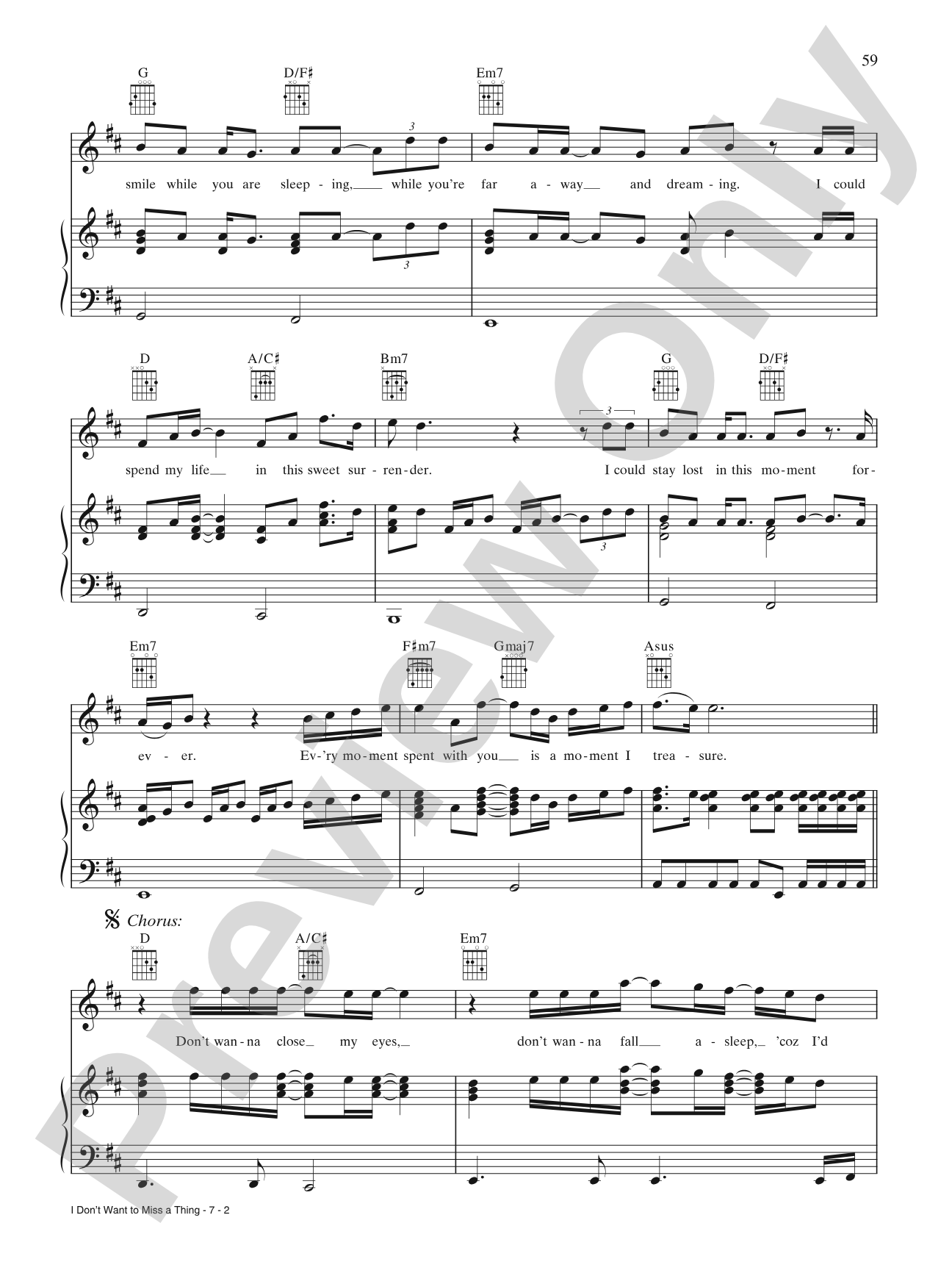

I Don't Want to Miss a Thing: Piano/Vocal/Chords
15 Popular Favorites in a Variety of Styles
Various
Item: 00-PS-0015556
$5.99
Pickup currently not available
Description
Music makers looking for crowd-pleasing material will love this handy songbook, which contains sheet music for 15 of the world's most popular songs in a variety of styles! In this collection, the piano parts emulate the original superstar recordings that made each song famous. Complete vocal melodies and lyrics are included, plus basic chord fingering grids for guitarists. Titles: Because of You (Kelly Clarkson) * Bridge over Troubled Water (Simon and Garfunkel) * Don't Stop Believin' (Journey) * Dynamite (Taio Cruz) * Falling Slowly (from the award-winning musical Once) * Firework (Katy Perry) * Grenade (Bruno Mars) * I Don't Want to Miss a Thing (Aerosmith) * I Have Nothing (Whitney Houston) * I'm Yours (Jason Mraz) * Kiss from a Rose (Seal) * Make You Feel My Love (Adele) * My Immortal (Evanescence) * The Prayer (Celine Dion and Andrea Bocelli) * You Raise Me Up (Josh Groban).


I Don't Want to Miss a Thing: Piano/Vocal/Chords isn't in MakeMusic Cloud just yet...but it could be. Let us know you'd like to see it, and you'll help shape what comes next. In the meantime, start a free trial and dive into thousands of interactive titles your students can play along with today.
Request This Title
Tell us you want it.
Start Your Free Trial
Explore everything that's ready to play right now.
Sample Audio
No sample audio found.
Sample Video
No sample videos found.
Additional Details
Series:
Top-Requested Sheet Music
Publisher:
Alfred Music
Page Count:
92
SKU:
00-PS-0015556
More about this title
About the Composer: Diane Warren
Diane Warren is one of the most prolific songwriters in contemporary music, with a catalog spanning multiple decades and genres. Her compositions have earned Grammy nominations, Academy Award recognition, and chart success across pop, rock, R&B, and film soundtrack categories. Warren's gift for crafting emotionally resonant melodies with memorable hooks has made her songs essential repertoire for vocalists and musicians seeking material with genuine emotional depth and commercial appeal.
Why we love this
This collection assembles genuine crowd-pleasers that audiences recognize instantly, which means your performers get the psychological boost of playing music people actually want to hear. The piano arrangements capture the essence of the original recordings without oversimplifying, giving pianists real work to do while singers connect with familiar vocal lines. Whether you're building a recital program, filling a coffeehouse gig, or giving advanced students contemporary material with substance, these 15 songs deliver impact across skill levels.
What to expect
These arrangements capture the DNA of their original recordings, delivering that satisfying moment when a listener recognizes the first few piano notes. The collection ranges from intimate, stripped-down moments like "Falling Slowly" to full-energy rock and pop anthems, creating variety that keeps both performers and audiences invested across a full performance.
Who it's for
This book serves singers and pianists working together in coffeehouse settings, community theater contexts, or recital performances who want immediate audience engagement. Guitarists will find chord grids useful for transposing or adapting arrangements to different keys. Advanced high school vocalists and college-level music students benefit from performing contemporary material with genuine emotional texture.
How to get the most out of it
- Balance the vocal melody against the piano part by treating the accompaniment as atmospheric support rather than competition. Let the singer's voice remain the focal point while the keys provide harmonic and rhythmic context.
- Study the original recordings to understand the emotional arc of each song. Your interpretation doesn't need to replicate them exactly, but knowing whether a track builds energy, pulls back introspectively, or maintains consistent intensity will guide your phrasing choices.
- Coordinate with guitarists using the chord grids by establishing clear dynamic shapes together. These arrangements work best when piano and guitar lock into the same rhythmic pocket rather than layering independently.
- Pay attention to tempo stability in uptempo tracks like "Don't Stop Believin'" and "Dynamite." The grooves in these songs depend on rock-solid timing to feel authentic rather than precious.
How to use it
Program these songs as a cohesive set within a larger recital or concert, or select individual titles to complement classical or theater repertoire and give audiences a bridge to contemporary music. The genre variety means you can build a thematic program around emotional storytelling ("Bridge over Troubled Water," "I Have Nothing," "Make You Feel My Love") or mix energetic pop-rock numbers with quieter reflective pieces for pacing.
Skills your students will build
- Balancing vocal melody against piano accompaniment in contemporary arrangements
- Interpreting songs with emotional subtext and dynamic shape
- Reading chord symbols and understanding harmonic function in pop and rock contexts
- Coordinating between singer, pianist, and guitarist in small ensemble settings
- Transposing and adapting arrangements to accommodate different vocal ranges