
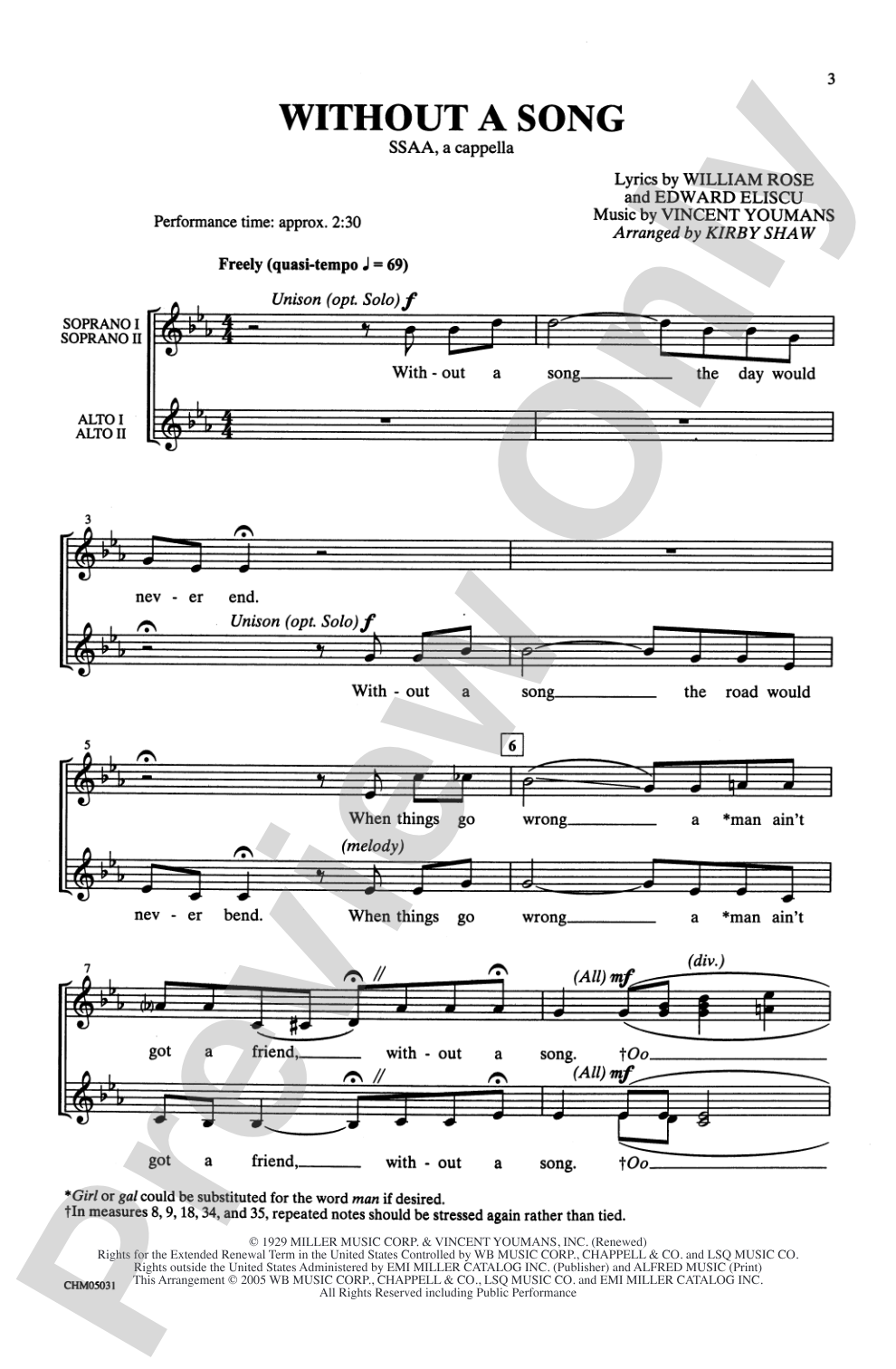

Without a Song: SSAA, a cappella Choral Octavo
Lyrics by William Rose and Edward Eliscu, music by Vincent Youmans / arr. Kirby Shaw
Level: Moderately Difficult
Item: 00-PO-0004849
$2.25
Minimum order quantity: 20 copies
One moment…
Description
The classic Vincent Youman song has delighted audiences for decades and has been recorded by artists of every genre. Kirby Shaw has added his superior arranging talent to provide us with a truly wonderful new arrangement.


Without a Song: SSAA, a cappella Choral Octavo isn't in MakeMusic Cloud just yet...but it could be. Let us know you'd like to see it, and you'll help shape what comes next. In the meantime, start a free trial and dive into thousands of interactive titles your students can play along with today.
Request This Title
Tell us you want it.
Start Your Free Trial
Explore everything that's ready to play right now.
Sample Audio
1
Audio File
--:--
0:00
0:00
Sample Video
No sample videos found.
Additional Details
Series:
Alfred Archive Edition: Alfred Pop Choral Series
Publisher:
Alfred Music
Page Count:
8
SKU:
00-PO-0004849
More about this title
About the Composer: Vincent Youmans
Vincent Youmans (1898-1946) was an American composer who brought sophistication and memorable melody to the Broadway musical theater of the 1920s and 1930s. His gift for writing songs that capture both emotional depth and popular appeal made him one of the most performed composers of the Great American Songbook, and his work continues to anchor the standard repertoire across vocal genres.
Youmans composed for stage and screen during the golden age of musical theater, creating scores that balanced contemporary style with enduring musical substance. His melodies have proven resilient across decades and across wildly different performance contexts, from jazz interpretations to classical arrangements, a testament to their inherent strength and flexibility.
Why we love this
Kirby Shaw's arrangement respects the harmonic sophistication of Youmans' original melody while tailoring it for the SSAA ensemble, making it accessible to choirs that might otherwise struggle with a standard four-part setting. The piece sits at exactly the right level of difficulty for Grade 4 choirs, presenting real arranging craft and voicing challenges without overwhelming singers who are still building blend and independence. Directors get a piece that sounds polished and substantial in performance while remaining genuinely teachable in rehearsal.
What to expect
The piece carries the warmth of a mid-century popular standard with a reflective, almost intimate quality enhanced by the a cappella setting. Without instrumental accompaniment, the voices create a conversational space around Youmans' elegant melody, and the SSAA voicing gives the sound a unified, cohesive character that feels both classic and contemporary.
Who it's for
This arrangement fits solidly into the repertoire for intermediate treble choirs, particularly those with some experience singing a cappella. Directors seeking a Youmans standard that doesn't require a tenor section will find this a straightforward choice for concert programming or festival performance.
How to get the most out of it
- Balance the melody across the soprano section, particularly in passages where it passes between Soprano I and Soprano II; the arrangement depends on both parts having equal presence.
- Find the song's conversational tone during rehearsal. While a cappella requires precision, avoid the trap of making it sound mechanically perfect. This is a standard that lives in popular and jazz idioms, so allow natural phrasing and breath points.
- Lock in the harmonic foundation through the alto parts early in rehearsal. Without instrumental support, altos anchor the tuning, so make sure they hear their voice as essential structural work, not accompaniment.
- Shape the dynamic arc around the lyrical content. The emotional weight of the text should guide your volume and tempo choices, preventing the piece from becoming either monotonous or overwrought.
How to use it
Pair this with other standards from the American Songbook to build a concert set exploring twentieth-century popular composition, or use it as a lighter contrasting piece in a mixed-repertoire program. It works equally well as a standalone recital choice or as part of a pops concert celebrating Broadway and classic song.
Skills your students will build
- Singing a cappella with secure tuning and blend across four voices
- Maintaining vocal independence while supporting the harmonic structure
- Performing with stylistic awareness of the American popular song tradition
- Shaping phrasing and dynamics to reflect lyrical meaning and emotional arc
- Reading and executing contemporary choral arranging voicing