
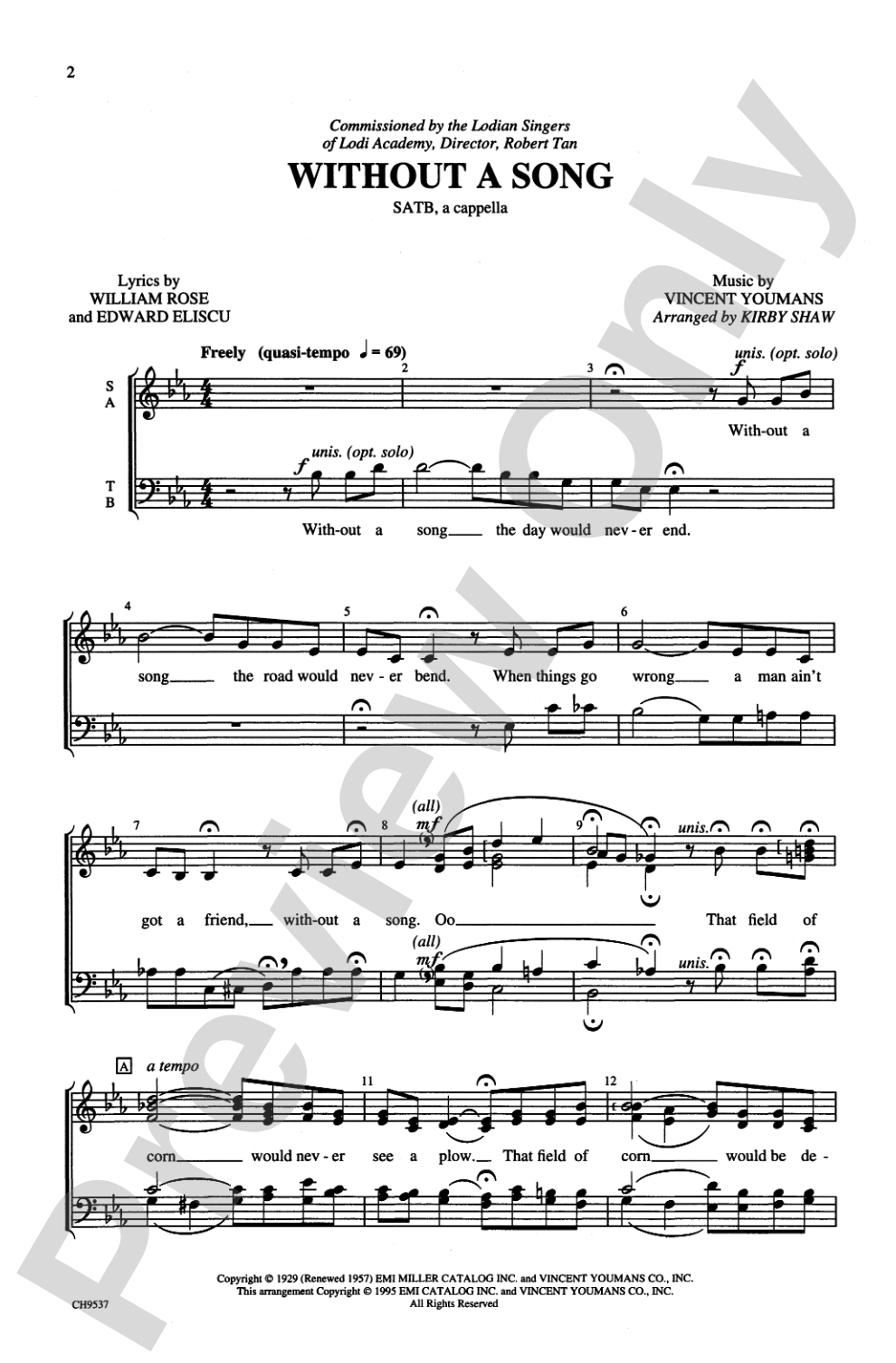

Without a Song: SATB, a cappella Choral Octavo
Lyrics by William Rose and Edward Eliscu, music by Vincent Youmans / arr. Kirby Shaw
Level: Moderately Difficult
Item: 00-PO-0002953
$2.25
Minimum order quantity: 20 copies
One moment…
Description
The classic Vincent Youman song has delighted audiences for decades and has been recorded by artists of every genre. Kirby Shaw has added his superior arranging talent to provide us with a truly wonderful new arrangement.


Without a Song: SATB, a cappella Choral Octavo isn't in MakeMusic Cloud just yet...but it could be. Let us know you'd like to see it, and you'll help shape what comes next. In the meantime, start a free trial and dive into thousands of interactive titles your students can play along with today.
Request This Title
Tell us you want it.
Start Your Free Trial
Explore everything that's ready to play right now.
Sample Audio
No sample audio found.
Sample Video
No sample videos found.
Additional Details
Series:
Alfred Archive Edition: Alfred Pop Choral Series
Publisher:
Alfred Music
Page Count:
4
SKU:
00-PO-0002953
More about this title
About the Composer: Vincent Youmans
Vincent Youmans (1898–1946) was one of the most prolific American musical theater composers of the 1920s and early 1930s. His gift for crafting memorable, singable melodies made him a natural fit for Broadway, where he composed the scores for productions including No, No, Nanette and Hit the Deck. Youmans wrote music that balanced sophistication with accessibility, creating songs that have endured far beyond their original theatrical contexts.
His compositions reveal a deep understanding of the human voice. Whether writing for trained singers or popular recording artists, Youmans constructed melodies that sit naturally in the voice, have clear narrative or emotional arc, and reward both careful interpretation and straightforward enjoyment. "Without a Song" exemplifies this quality, blending melodic richness with emotional directness.
Why we love this
Kirby Shaw's arrangement takes a melody that's already proven its staying power and recasts it for ensemble voices with genuine sophistication. The challenge level lands exactly where it should for a Grade 4 choir: demanding enough to push singers' blend and phrasing skills, accessible enough that the beauty of the song emerges quickly. This is a selection that will sound impressive in concert without requiring months of rehearsal.
What to expect
The piece carries the warmth of classic American songwriting, with harmonic language that feels both familiar and rich. There's a reflective quality underlying the melody, inviting singers and listeners into something genuinely human rather than merely entertaining. The a cappella setting puts the spotlight entirely on the singers' voices and the emotional content of the music.
Who it's for
This octavo serves intermediate to advanced choral programs seeking a beautiful standard with proven audience appeal. It works equally well for show choirs, concert choirs, and community singing groups that want to program a song with genuine musical substance and emotional presence.
How to get the most out of it
- Shape the melody with long phrase arcs rather than breaking it into small sections. The song's emotional weight comes from sustained musical lines, so encourage singers to breathe strategically rather than at every comfortable spot.
- Establish a clear vowel concept before learning notes. Since the group sings a cappella, consistent vowel shaping across all sections directly impacts blend and resonance.
- Balance the harmony parts by ear rather than relying on part dominance. Without instrumental support, each voice layer needs to serve the overall harmonic color, not stand out individually.
- Explore the lyrical content with your singers. Understanding what the text conveys about resilience and finding meaning will inform the tonal quality and phrasing choices they make.
How to use it
Program this as a centerpiece of a concert section devoted to American standards or song catalog. It pairs well with other Shaw arrangements of classic material and provides a meaningful contrast to contemporary selections. The piece also makes an excellent encore option when you want something polished, moving, and immediately accessible to diverse audiences.
Skills your students will build
- Sustaining long phrase lines without intermediate breaths
- Achieving blend in a cappella harmonic voicing
- Shaping vowels consistently across four-part harmony
- Balancing accompaniment voices to support melody
- Interpreting lyrics to inform musical expression