
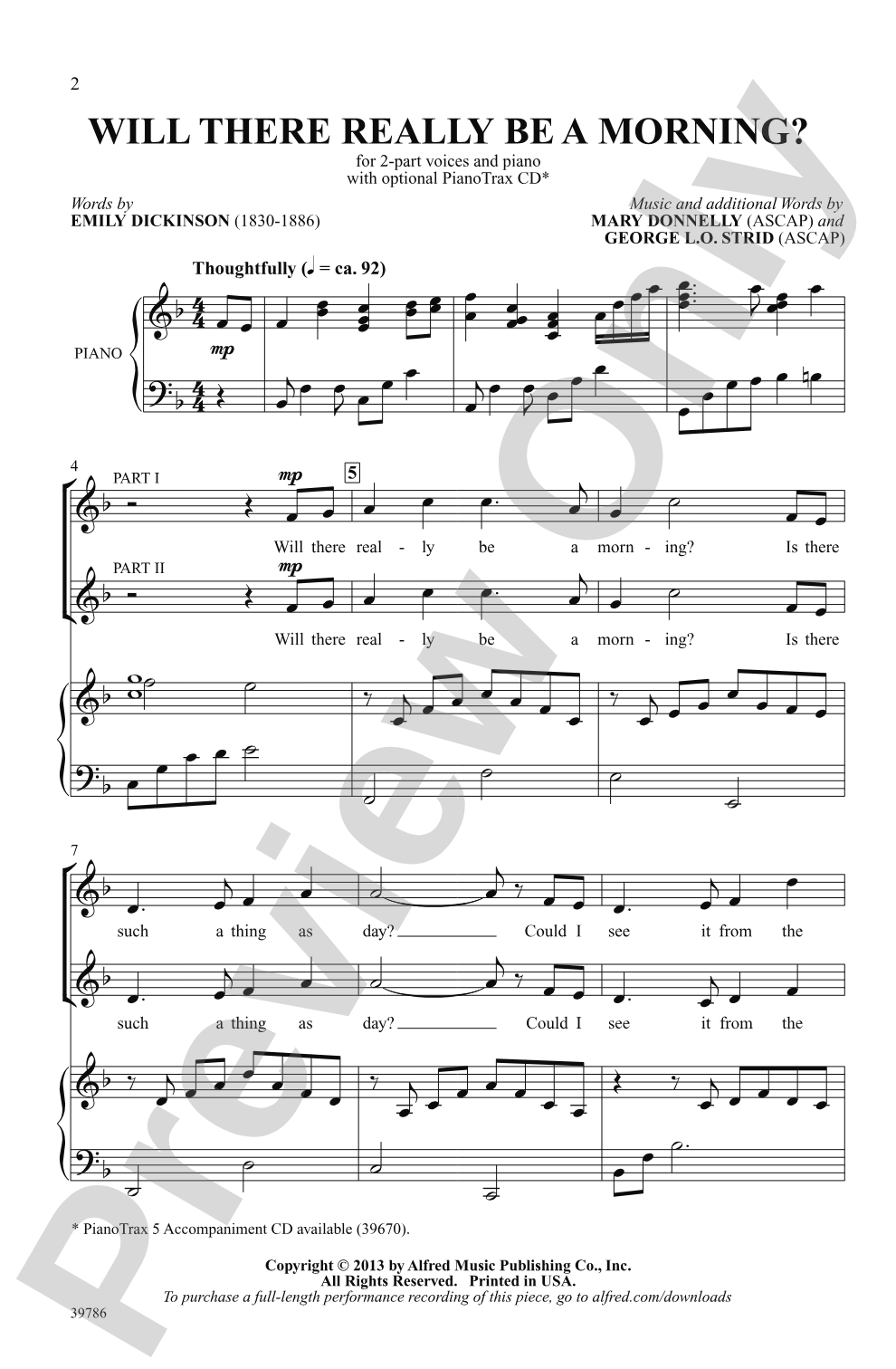
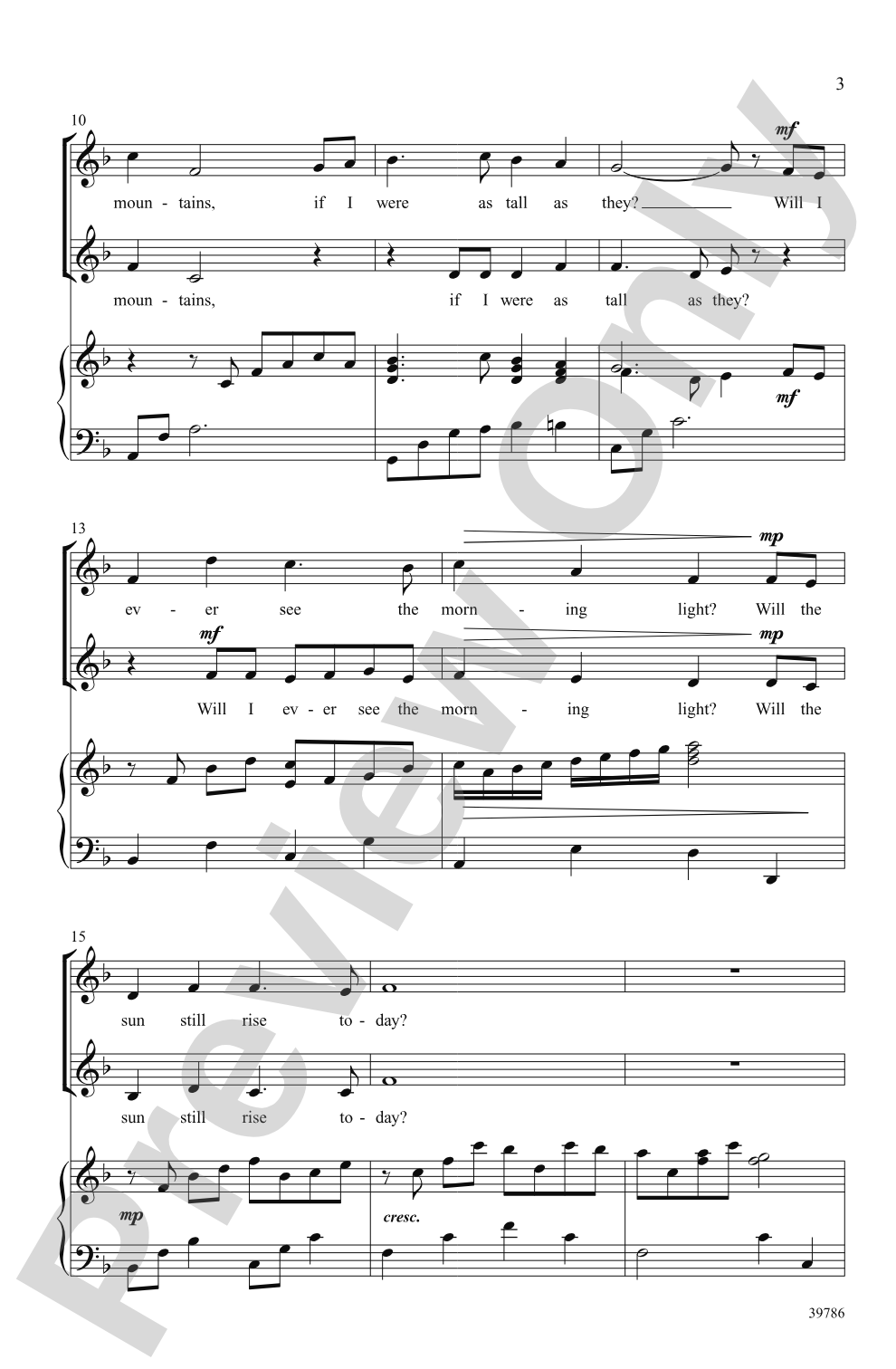

Will There Really Be a Morning?: 2-Part Choral Octavo
Words by Emily Dickinson, music and additional words by Mary Donnelly and George L. O. Strid
Item: 00-PO-0001606
$2.05
Minimum order quantity: 20 copies
Pickup currently not available
Description
A tuneful melody floats above the arpeggiated piano part in this delightful choral for treble voices. The setting is free from musical roadblocks, with success woven into the fabric, making it a perfect choice for developing choirs.


Will There Really Be a Morning?: 2-Part Choral Octavo isn't in MakeMusic Cloud just yet...but it could be. Let us know you'd like to see it, and you'll help shape what comes next. In the meantime, start a free trial and dive into thousands of interactive titles your students can play along with today.
Request This Title
Tell us you want it.
Start Your Free Trial
Explore everything that's ready to play right now.
Sample Audio
1
Audio File
--:--
0:00
0:00
Sample Video
No sample videos found.
Additional Details
Series:
Alfred Choral Designs
Publisher:
Alfred Music
Page Count:
8
SKU:
00-PO-0001606
More about this title
About the Composer: Mary Donnelly
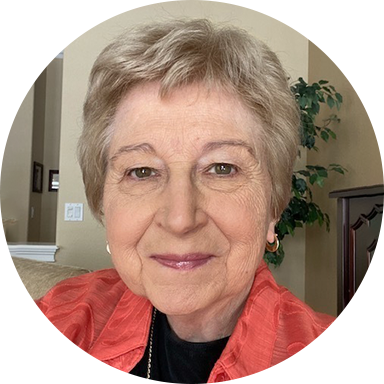
Mary Donnelly grew up in Reno, Nevada, and studied English and French at the University of Nevada before discovering her calling in music education. While still an undergraduate, she founded two children's choruses, an experience that prompted her to pursue formal music training. She earned a Master's Degree in Education from Lesley College in Cambridge, Massachusetts, where she focused on arts integration across the curriculum.
Donnelly spent thirty years teaching general music and choir in the Washoe County School District, retiring after a career deeply rooted in classroom practice. In 1985, she began collaborating with George Strid when they were asked to write a musical for a Reading Week project at their school. That partnership has since produced more than two hundred songs and twenty-five musicals. She holds memberships in ACDA, NEA, and ASCAP.
Why we love this
Donnelly and Strid know what developing choirs need: a melody that sits beautifully in the voice, accompaniment that supports rather than complicates, and a text worth singing. The arpeggiated piano writing creates elegance without technical demands, allowing singers to focus on ensemble blend and musicality rather than negotiating awkward ranges or rhythmic complications.
What to expect
A gentle, tuneful piece that feels contemporary yet rooted in song craft. The melody floats naturally while the arpeggiated accompaniment creates a sense of calm forward motion, making this an accessible but never simplistic choice for treble voices.
Who it's for
This octavo serves developing choirs that benefit from literature without technical obstacles. It suits middle school choirs, church youth groups, and elementary school singers transitioning to part-singing, where success builds confidence and musicianship grows from rewarding repertoire.
How to get the most out of it
- Shape the treble melody with a gentle legato line; the simplicity of the writing invites singers to find warmth and connection in sustained vowels.
- Balance the voice parts by listening for the piano's arpeggios to support rather than overshadow the choir, keeping the texture transparent.
- Let the poetic text guide phrasing naturally; avoid over-conducting small sections and trust the singability of the melody to speak for itself.
How to use it
Program this as a concert opener or as part of a spring concert celebrating accessible yet artful choral writing. It also works well in a diverse program where you want a moment of clarity and beauty between more complex works, or as a festival piece for choirs seeking literature that demonstrates musical maturity at an introductory level.
Skills your students will build
- Sustaining legit tone in 2-part treble voicing
- Singing arpeggiated harmonic movement in tune
- Interpreting poetic text with musical intention
- Blending voices while maintaining individual line integrity