
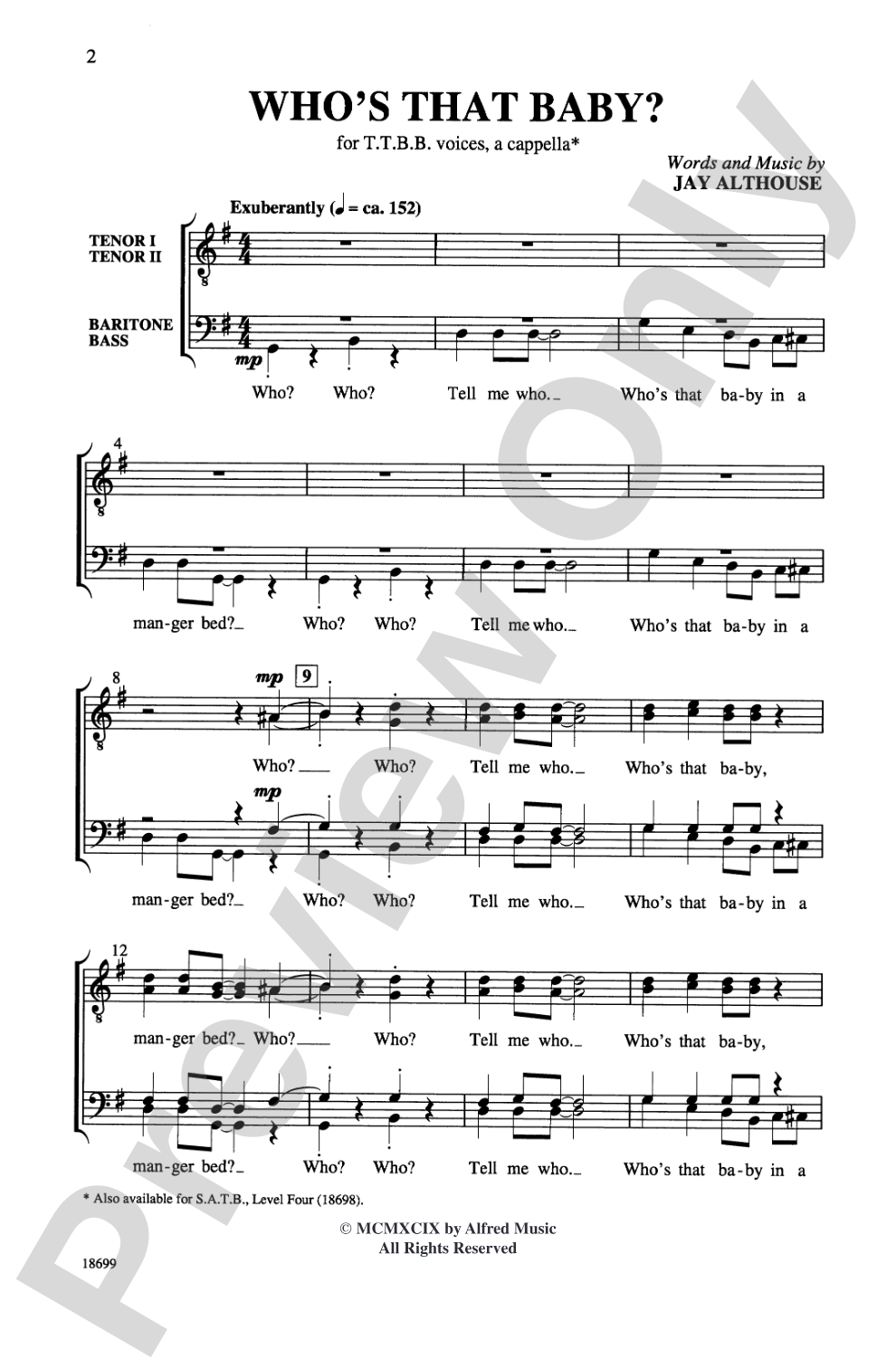
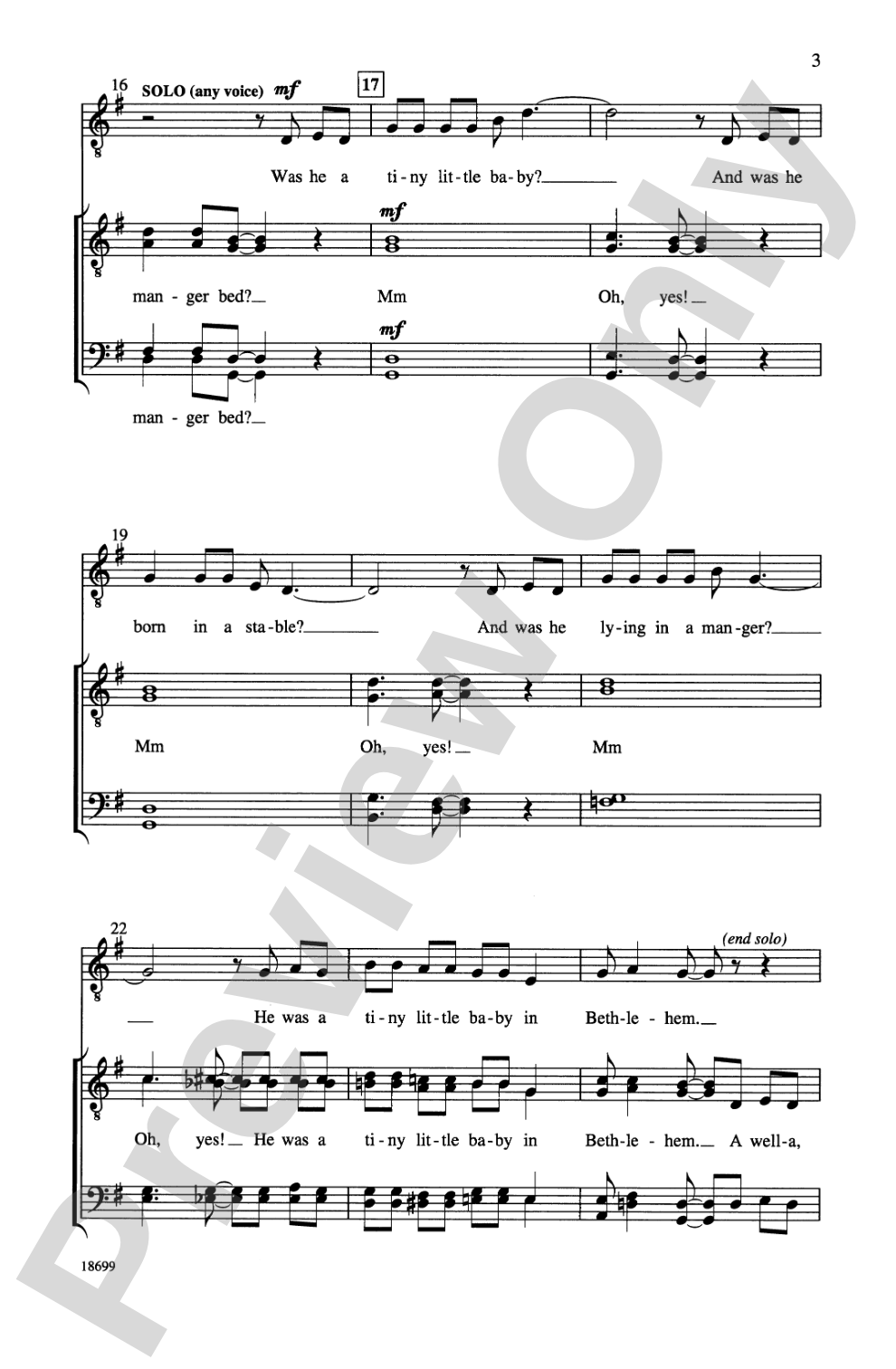

Who's That Baby?: TTBB, a cappella Choral Octavo
Music by Jay Althouse
Item: 00-PO-0004088
$2.25
Minimum order quantity: 20 copies
Pickup currently not available
Description
This may be the most exciting Christmas sprirtual Jay Althouse has ever written. It opens with the basses asking, in a hushed, rhythmic melody, "Who's that baby in a manger bed?" The text is classic spiritual style, but the music is anything but . . . t's fresh, new, and alive!


Who's That Baby?: TTBB, a cappella Choral Octavo isn't in MakeMusic Cloud just yet...but it could be. Let us know you'd like to see it, and you'll help shape what comes next. In the meantime, start a free trial and dive into thousands of interactive titles your students can play along with today.
Request This Title
Tell us you want it.
Start Your Free Trial
Explore everything that's ready to play right now.
Sample Audio
1
Audio File
--:--
0:00
0:00
Sample Video
No sample videos found.
Additional Details
Series:
Alfred Archive Edition: Alfred Choral Designs
Publisher:
Alfred Music
Page Count:
8
SKU:
00-PO-0004088
More about this title
About the Composer: Jay Althouse

Jay Althouse holds degrees in Music Education and Music from Indiana University of Pennsylvania, where he later received the Distinguished Alumni award. His career spans roles as a rights and licenses administrator for a major educational music publisher and service on the Executive Board of the Music Publishers Association of America. As a composer, he has over 800 choral works in print and is a writer member of ASCAP, a regular recipient of the ASCAP Special Award for compositions in standard music.
Beyond composition, Althouse has co-written children's musicals with Sally K. Albrecht, compiled respected vocal solo collections including Folk Songs for Solo Singers, and authored or co-authored numerous educational resources such as The Complete Choral Warm-up Book, Accent on Composers, and Ready to Read Music. His collaborative work I Hear America Singing was performed by the San Francisco Girls and Boys Choirs at President Barack Obama's inauguration in 2009. He has contributed articles to the Folk Art Messenger and served on boards including the North Carolina Master Chorale and the National Advisory Board of the Folk Art Society of America.
Why we love this
Althouse brings genuine spirituality to what could easily become a predictable seasonal text. The opening bass melody in hushed rhythm immediately draws listeners in, and the modern harmonic language keeps the piece from feeling nostalgic or reverential in a tired way. For TTBB ensembles looking to program something with real bite alongside traditional carols, this delivers both accessibility and musical substance.
What to expect
This piece radiates wonder without sentimentality. The opening is intimate and rhythmically alive, drawing listeners into a question that feels genuinely asked rather than recited. As it unfolds, the music breathes with the energy of a spiritual that has something fresh to say, even as it honors its tradition.
Who it's for
TTBB ensembles at intermediate levels and beyond will find this accessible yet musically engaging. Directors seeking a Christmas spiritual that sounds contemporary without abandoning the genre's warmth and authenticity will recognize Althouse's gift for keeping both elements in balance.
How to get the most out of it
- Start with that opening bass line at a conversational dynamic. The question "Who's that baby in a manger bed?" needs to feel intimate and curious, not declamatory.
- Lock the rhythmic precision among all four parts early in rehearsal. Without accompaniment, any rhythmic wavering becomes immediately apparent, and the freshness of the writing depends on clean ensemble.
- Shape the text as you would a spoken narrative. Christmas spirituals invite call-and-response energy and conversational phrasing; avoid a purely choral tone.
How to use it
Program this alongside traditional Christmas spirituals to demonstrate the genre's living, evolving tradition rather than its museum piece quality. It works particularly well in December concerts where you want to honor sacred music but also show your choir's range and contemporary sensibility. The a cappella format makes it flexible for both full concert settings and more intimate holiday performances.
Skills your students will build
- Maintaining rhythmic precision and ensemble cohesion without instrumental support
- Balancing dynamic control in a cappella singing to create shape and narrative
- Understanding spiritual convention while interpreting modern harmonic language
- Connecting emotional intention to text within a four-part male voicing