
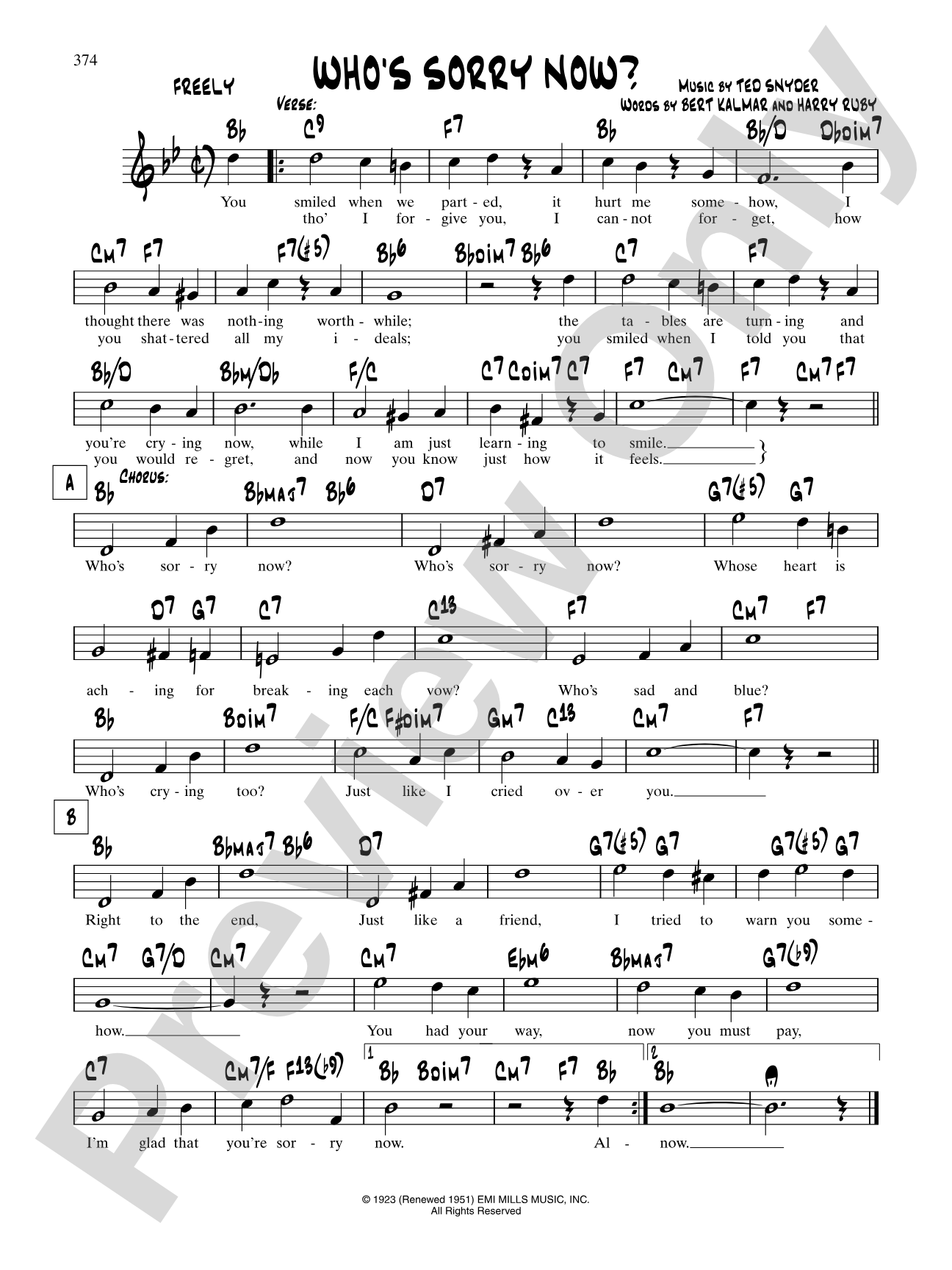

Who's Sorry Now: Lead Sheet
Thomas "Fats" Waller
Level: Intermediate / Advanced
Item: 00-PSL-000313
$4.99
Pickup currently not available
Description
The artist's own piano arrangements of titles he made famous. Pianists will find no better "Fats" selection. Twenty titles include: All That Meat and No Potatoes * Margie * I'm Sitting on Top of the World * Who's Sorry Now * I'm Nobody's Baby and a special bonus section of selected songs from the Broadway musical Ain't Misbehavin'.


Who's Sorry Now: Lead Sheet isn't in MakeMusic Cloud just yet...but it could be. Let us know you'd like to see it, and you'll help shape what comes next. In the meantime, start a free trial and dive into thousands of interactive titles your students can play along with today.
Request This Title
Tell us you want it.
Start Your Free Trial
Explore everything that's ready to play right now.
Sample Audio
No sample audio found.
Sample Video
No sample videos found.
Additional Details
Publisher:
Alfred Music
Page Count:
52
SKU:
00-PSL-000313
More about this title
About the Artist: Thomas "Fats" Waller
Thomas "Fats" Waller (1904-1943) was a pianist, organist, composer, and entertainer whose virtuosity and wit defined stride piano and early jazz. Born in New York, he mastered the keyboard by his teens and became famous not only for his technical brilliance but also for his irreverent humor and ability to captivate audiences across vaudeville, radio, and film. His catalog includes hundreds of compositions, many co-written with lyricist Andy Razaf, and his influence on jazz piano and American popular music remains foundational to the art form.
Waller's genius lay in making complex music sound joyful and accessible. His arrangements blend ragtime foundations with jazz harmonies and swing rhythms, creating pieces that are both musically substantial and deeply entertaining. For pianists, his work offers a master class in stride technique, voicing, and the art of making an audience smile while executing sophisticated music.
Why we love this
These are Waller's own piano arrangements of the songs that made him legendary, which means you're learning jazz piano from someone who lived and shaped the language. The collection balances accessibility with real musical meat: stride bass lines, jazz voicings, and the rhythmic sophistication that defined his era. The bonus material from Ain't Misbehavin' adds theatrical flair and extends the repertoire for recitals and performance classes.
What to expect
Swinging, witty, and unapologetically joyful. These pieces have the energy of a Harlem nightclub in the 1930s: rhythmically buoyant, harmonically rich, and full of personality. Playing them feels like joining a conversation between an old friend and a packed house, where technical skill and warmth go hand in hand.
Who it's for
Intermediate and advanced pianists seeking authentic jazz repertoire with strong technical grounding and personality. This book suits students ready to move beyond classical or pop-influenced styles into the stride, swing, and blues-inflected traditions of early American jazz. It's also valuable for music educators introducing jazz history and composition through the work of a legendary practitioner.
How to get the most out of it
- Anchor the stride left hand with confidence. The bass line drives the groove; let your listeners feel the pulse through it rather than playing it lightly or defensively.
- Experiment with the rhythmic flexibility Waller embedded in these arrangements. Jazz piano thrives on subtle rubato and swing; the written notes are a blueprint, not a straitjacket.
- Balance the melody's character against the harmonic sophistication underneath. Waller often wrote witty, simple-sounding top lines over complex chords; clarity in the right hand lets both shine.
- Explore the humor in these pieces. Many titles hint at Waller's personality and playfulness; let that attitude inform your touch and phrasing without undermining the musicianship.
How to use it
Feature individual selections in jazz recitals, piano performance classes, or concert programs that need genuine swing and historical weight. The Ain't Misbehavin' section works well in revue-style productions or cabaret programs. Assign selections to advanced students studying jazz history or stride piano technique as repertoire-based learning rather than supplementary material.
Skills your students will build
- Stride piano technique and left-hand independence
- Jazz harmony voicing and reharmonization
- Swing rhythms and jazz phrasing in written music
- Stylistic interpretation of early jazz and theatrical jazz standards
- Melodic clarity over complex harmonic backgrounds