
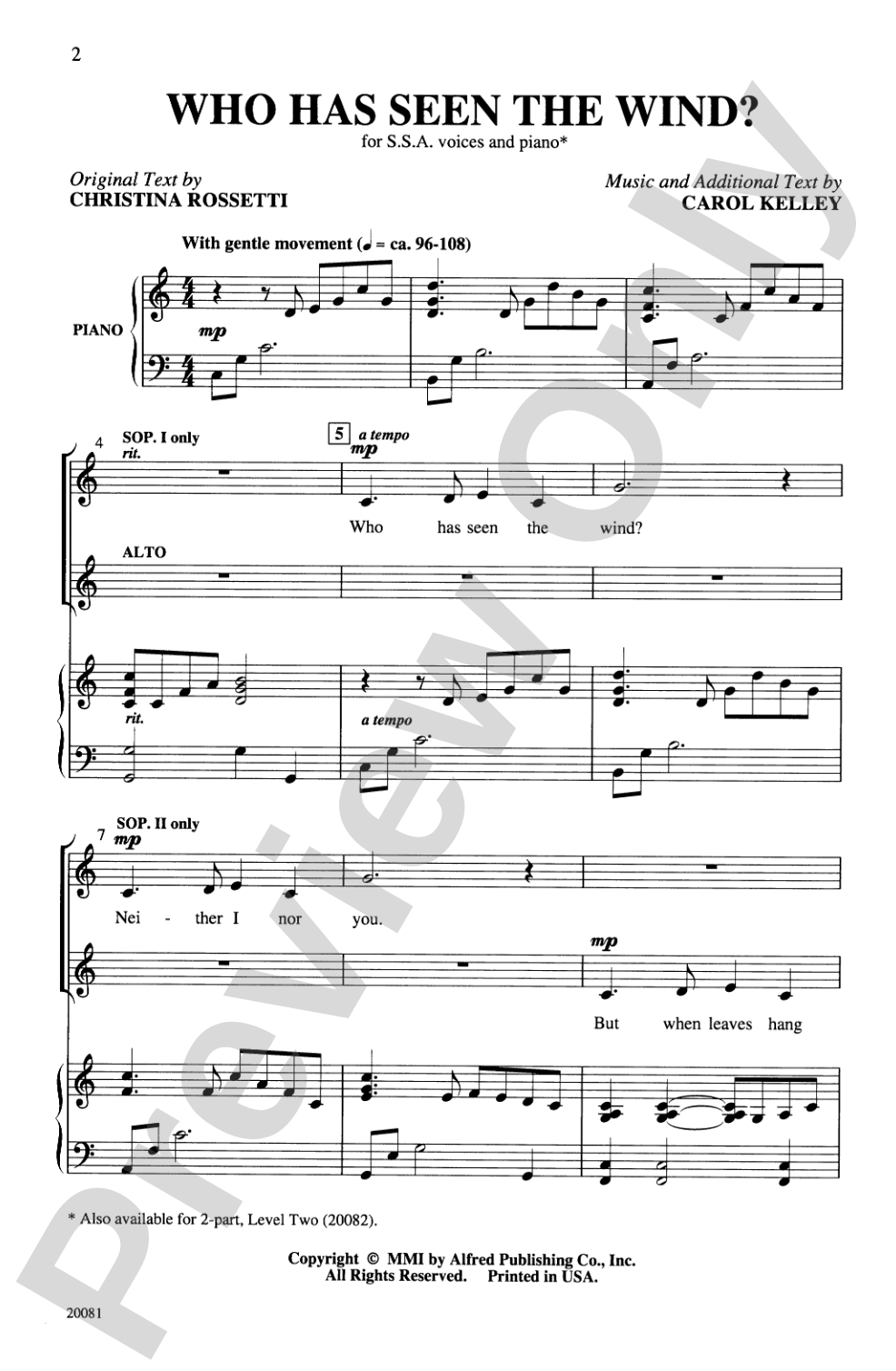

Who Has Seen the Wind?: SSA Choral Octavo
Music by Christina Rossetti / arr. Carol Kelley
Item: 00-PO-0004199
$2.25
Minimum order quantity: 20 copies
Pickup currently not available
Description
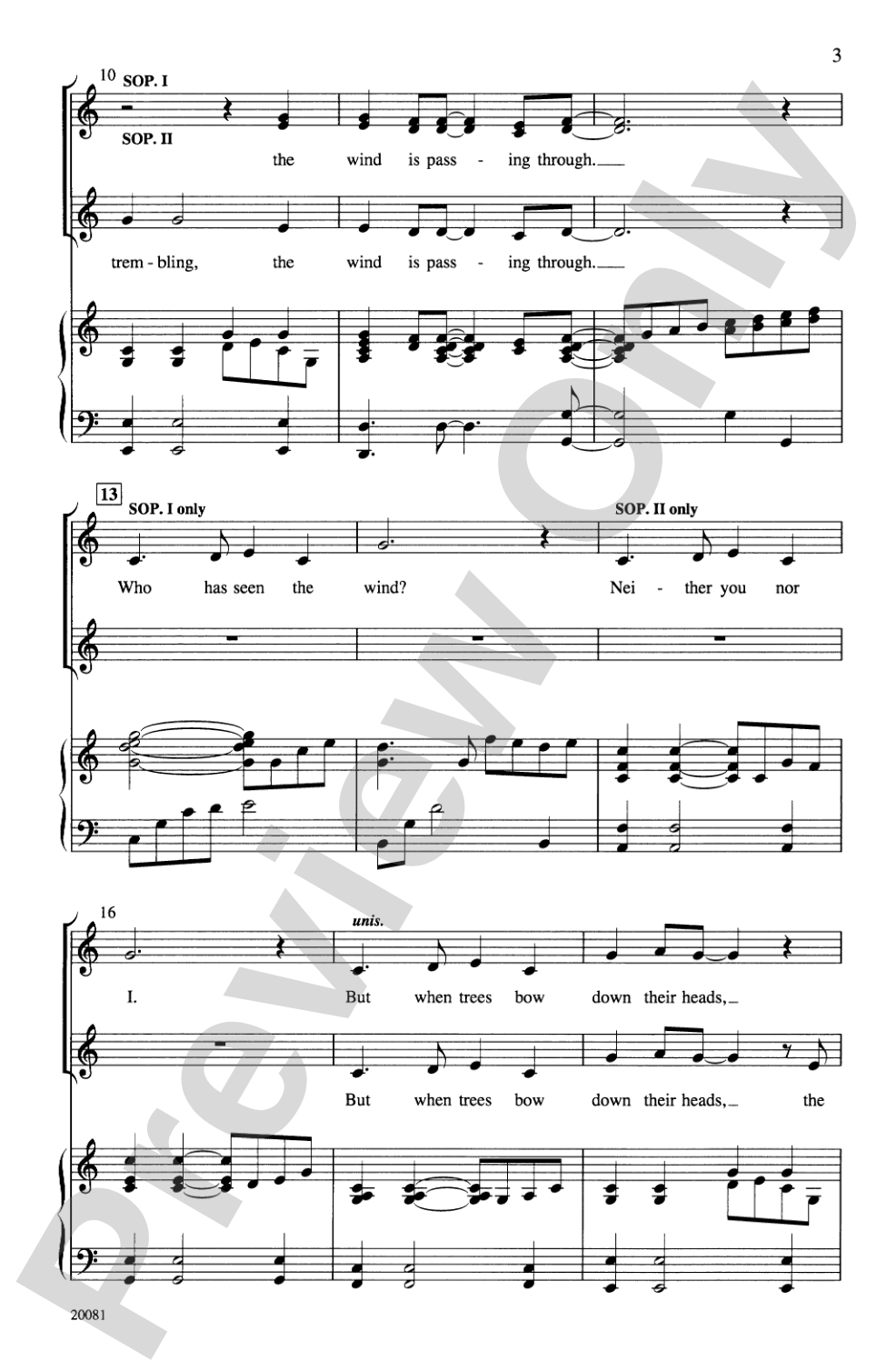
A lovely Christina Rossetti text is the foundation for this pensive new choral work for treble voices by Carol Kelley. It's a thought provoking question that can never be answered: "Who has seen the wind? Neither you nor I." The fluid piano accompaniment highlights the flowing opening melody which contrasts with the more homophonic "B" section. Who Has Seen the Wind? will show off your treble choirs at concerts, festivals, and adjudications.


Who Has Seen the Wind?: SSA Choral Octavo isn't in MakeMusic Cloud just yet...but it could be. Let us know you'd like to see it, and you'll help shape what comes next. In the meantime, start a free trial and dive into thousands of interactive titles your students can play along with today.
Request This Title
Tell us you want it.
Start Your Free Trial
Explore everything that's ready to play right now.
Sample Audio
1
Audio File
--:--
0:00
0:00
Sample Video
No sample videos found.
Additional Details
Series:
Alfred Archive Edition: Alfred Choral Designs
Publisher:
Alfred Music
Page Count:
8
SKU:
00-PO-0004199
More about this title
About the Composer: Christina Rossetti
Christina Rossetti (1830-1894) was a British poet whose literary legacy extends far beyond the page. Her imagery is precise, her questions linger, and her work has inspired composers across centuries to set her words to music. Rossetti's ability to embed profound philosophical inquiry within deceptively simple language makes her texts ideal for musical interpretation; a single line can sustain an entire harmonic arc.
Why we love this
Carol Kelley's setting trusts the text completely. Rather than overshadowing Rossetti's meditation on the invisible, the music creates space for the words to resonate. The contrast between the fluid opening and the grounded homophonic section gives your treble choir a genuine interpretive challenge without requiring virtuosic vocal technique.
What to expect
Contemplative and ethereal, with a gentle questioning at its heart. The music inhabits the space between mystery and acceptance, never rushing to answer the unanswerable. There is quiet beauty in simply asking the question well.
Who it's for
This octavo suits treble choirs seeking concert and festival repertoire that balances accessibility with artistic substance. It works equally well for established high school treble choirs and high-level middle school groups comfortable with sustained singing and textual interpretation.
How to get the most out of it
- Shape the opening melody with gentle direction through the flowing piano accompaniment; resist the urge to sing it too heavily or with too much vibrato, which can obscure the delicate text.
- Treat the shift to the 'B' section as a philosophical deepening rather than a dramatic change; the homophonic writing creates opportunity for clearer text projection and unified ensemble sound.
- Listen carefully to the piano part during rehearsals. It anchors harmonic movement and provides crucial support for intonation, especially in passages where voices divide.
How to use it
Program this as a centerpiece for a concert exploring poetry and music, where it can stand alongside other literary settings. It also serves well as a closer that leaves audiences in reflection rather than in applause, making it particularly effective at the end of a concert set.
Skills your students will build
- Sustaining long phrases with consistent tone and breath control
- Maintaining independent voice parts in divided passages while blending as an ensemble
- Interpreting text through musical phrasing and dynamics
- Responding to accompaniment texture and harmonic rhythm