
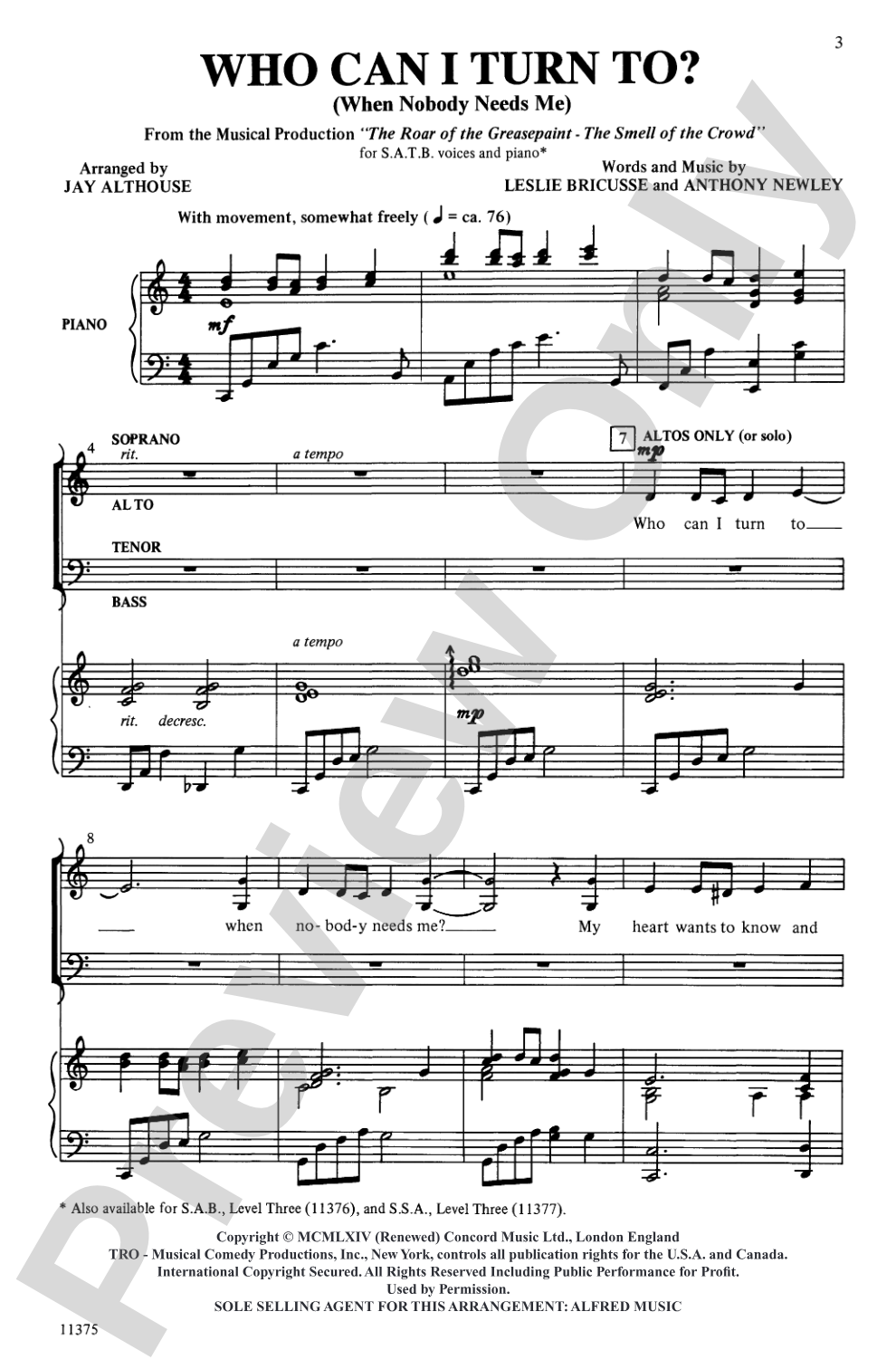

Who Can I Turn To?: SATB Choral Octavo
Music by Leslie Bricusse and Anthony Newley / arr. Jay Althouse
Item: 00-PO-0006487
$2.25
Minimum order quantity: 20 copies
Pickup currently not available
Description
This lovely ballad translates beautifully to the choral medium. Jay Althouse's sensitive arrangement opens with a beautiful eight measure alto line which may be sung by a soloist or the section. From there it builds gradually to a climactic finish. This is a show tune with a powerful text which will speak to your students.


Who Can I Turn To?: SATB Choral Octavo isn't in MakeMusic Cloud just yet...but it could be. Let us know you'd like to see it, and you'll help shape what comes next. In the meantime, start a free trial and dive into thousands of interactive titles your students can play along with today.
Request This Title
Tell us you want it.
Start Your Free Trial
Explore everything that's ready to play right now.
Sample Audio
No sample audio found.
Sample Video
No sample videos found.
Additional Details
Series:
Alfred Archive Edition: Alfred Choral Designs
Publisher:
Alfred Music
Page Count:
8
SKU:
00-PO-0006487
More about this title
About the Composer: Leslie Bricusse
Leslie Bricusse is a British composer, lyricist, and screenwriter whose work spans musical theatre, film, and television. His songs have appeared in major motion pictures and stage productions, often combining memorable melodies with emotionally direct lyrics that resonate across audiences. His collaborations with Anthony Newley produced some of the most enduring popular songs of the mid-twentieth century, including material that has since become standards in choral and vocal repertoires.
Bricusse's gift for accessible, singable melody and clear emotional content makes his work particularly valuable in educational settings. His songs translate readily to ensemble singing because they balance individual expression with cohesive group performance, allowing students to connect with sophisticated popular music while developing their vocal and interpretive skills.
Why we love this
Jay Althouse's arrangement gives this classic show tune real architectural shape, building from that striking alto solo entrance through carefully controlled dynamics to a satisfying climax. Your singers will appreciate material with genuine emotional substance, and the text's directness about vulnerability and human connection gives even young choirs something authentic to perform. The eight-page length is practical for concert programming without demanding extensive rehearsal time.
What to expect
The piece opens with vulnerability and grows into quiet intensity rather than bombast. There's a conversational intimacy in the alto solo that gradually expands into fuller harmony, creating a sense of building emotional clarity. The musical language is contemporary enough to feel relatable to singers, yet sophisticated enough to challenge them interpretively.
Who it's for
This arrangement works for intermediate to advanced high school choirs and adult ensembles comfortable with secular popular material. Singers need solid intonation and the ability to maintain a line while other parts build around them, but no extreme ranges or technical demands will discourage participation.
How to get the most out of it
- Shape the opening alto solo with careful attention to phrasing and breath placement. Whether sung by a soloist or the section, this line sets the emotional tone for everything that follows.
- Mark the dynamic journey clearly in your score. The gradual build Althouse creates only works when each section understands the overall arc and their role in it.
- Balance the entrance of additional voices as they layer in. Clarity matters more than volume during the build section, so blend rather than blast.
- Find the natural song phrasing in your text. Popular song typically breathes differently than classical choral music, so work against a tendency to stop at bar lines.
How to use it
Consider this for a concert moment that balances technical show pieces with human connection. It pairs well on a program with other popular or contemporary choral work, or as a bridge between classical repertoire and more modern vocal literature. The moderate length makes it suitable for a fall concert or evening where you want material that lands emotionally without competing with your most ambitious programming.
Skills your students will build
- Layering voices while maintaining individual line clarity
- Managing dynamic growth across an extended section
- Interpreting popular music text with appropriate phrasing and breath
- Blending alto solo entrance with section support
- Building harmonic texture from a single melodic line