
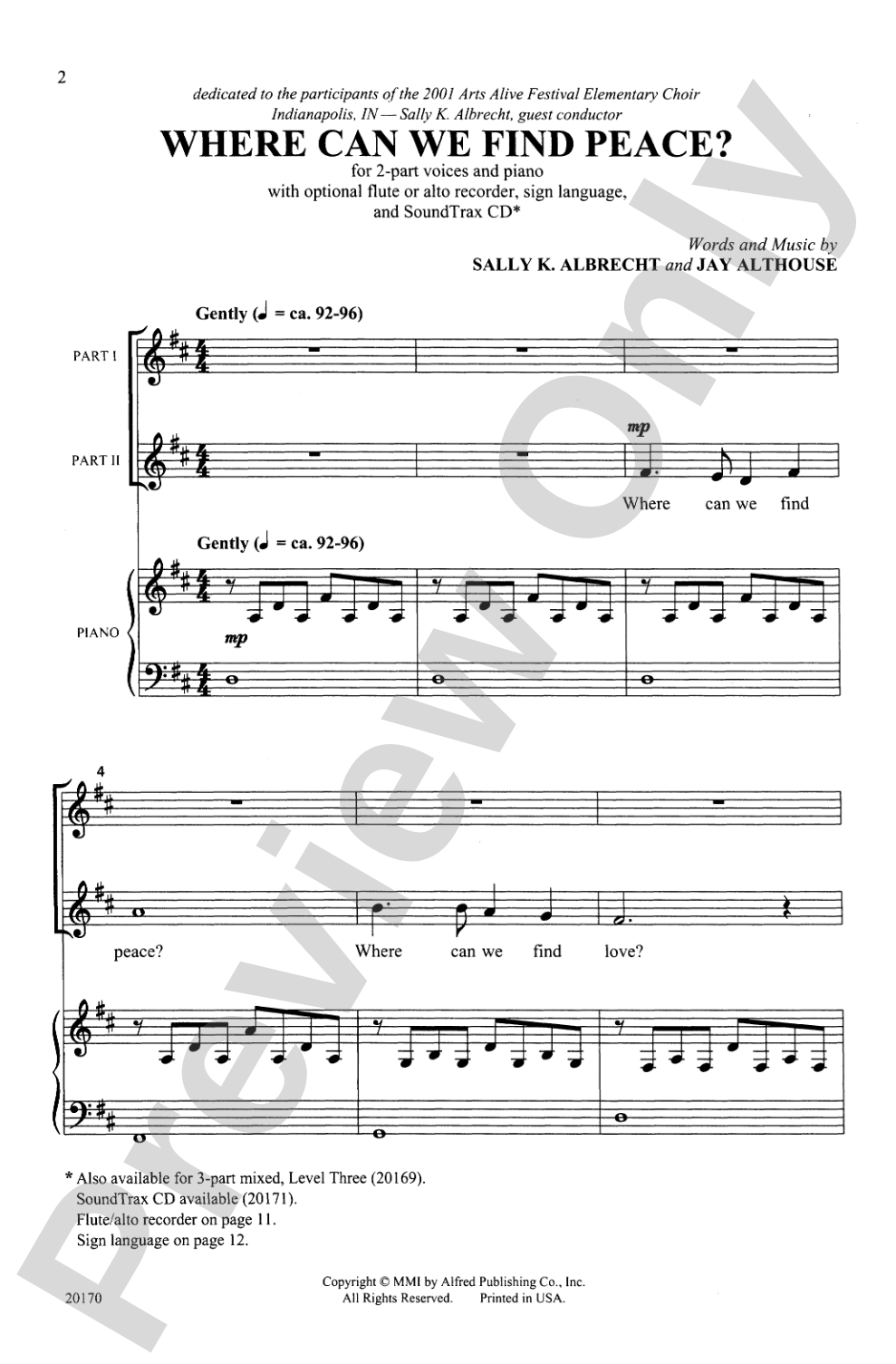
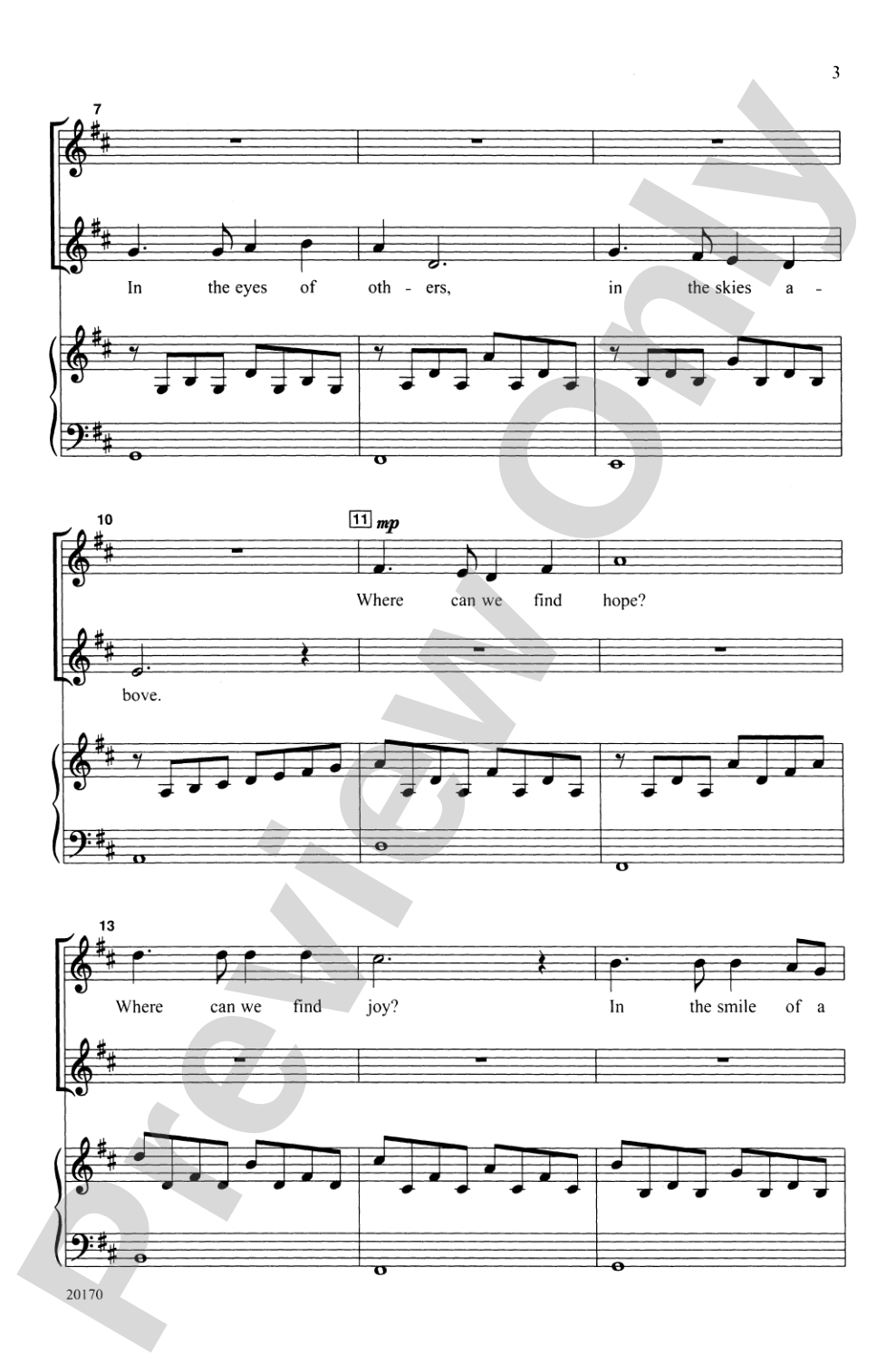
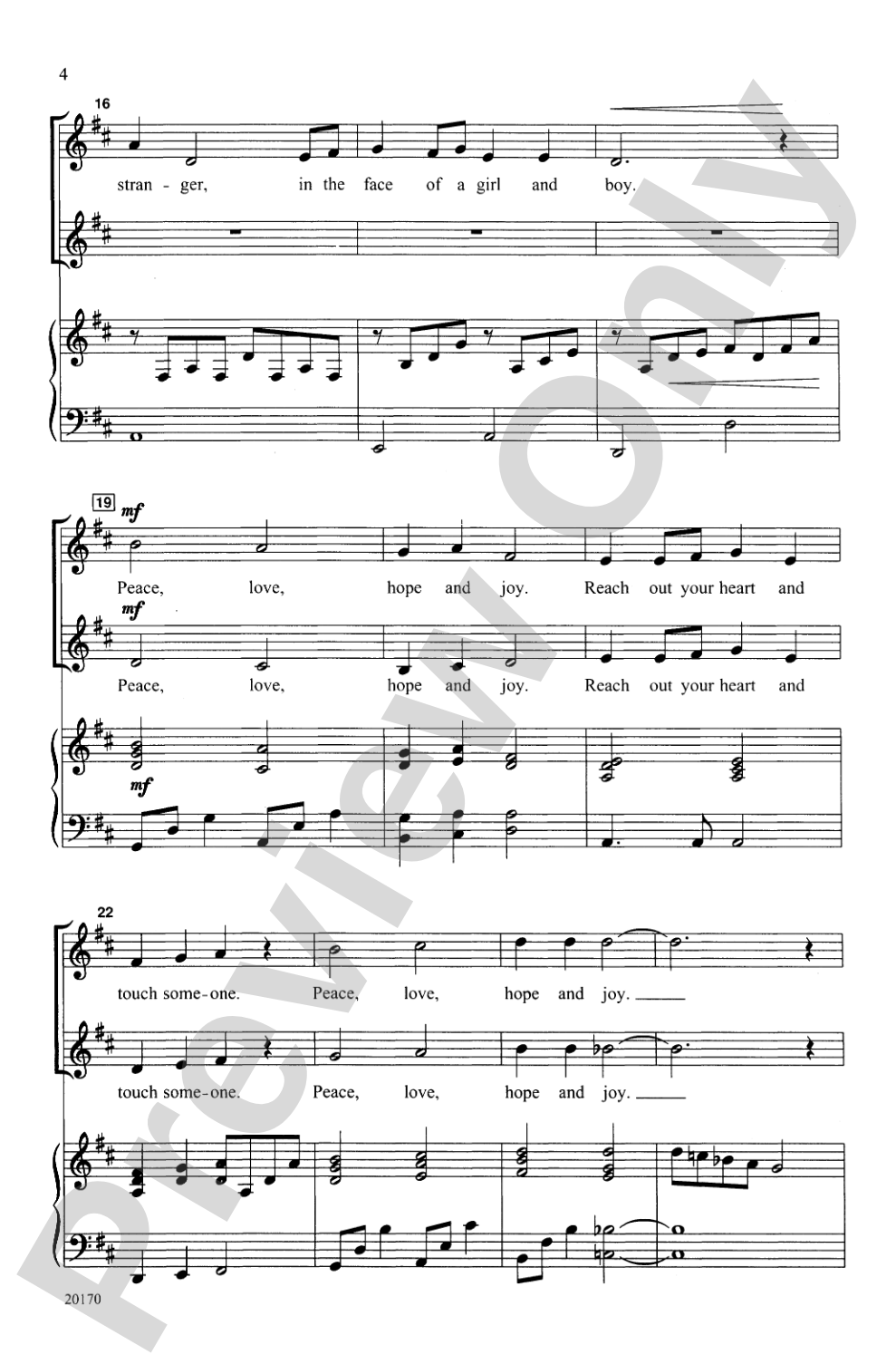

Where Can We Find Peace?: 2-Part (with Opt. Sign Language) Choral Octavo
Music by Sally K. Albrecht and Jay Althouse
Item: 00-PO-0002883
$2.25
Minimum order quantity: 20 copies
Pickup currently not available
Description
The beautiful melody could certainly stand alone, but when the optional flute or recorder enters, playing Amazing Grace in counterpoint to the melody, well, it's the icing on the cake. And the text is profound in its grace: we find peace and joy "in the smile of a stranger, in the face of a girl and boy." Simple and touching, this choral work will allow your choir to make music, not just sing the notes. Add the sign language (included in the publication) and the SoundTrax CD for a truly moving performance. Included on "Put On a Show!" DVD #27433.


Where Can We Find Peace?: 2-Part (with Opt. Sign Language) Choral Octavo isn't in MakeMusic Cloud just yet...but it could be. Let us know you'd like to see it, and you'll help shape what comes next. In the meantime, start a free trial and dive into thousands of interactive titles your students can play along with today.
Request This Title
Tell us you want it.
Start Your Free Trial
Explore everything that's ready to play right now.
Sample Audio
1
Audio File
--:--
0:00
0:00
Sample Video
No sample videos found.
Additional Details
Series:
Alfred Archive Edition: Alfred Choral Designs
Publisher:
Alfred Music
Page Count:
12
SKU:
00-PO-0002883
More about this title
About the Composer: Sally K. Albrecht
Sally K. Albrecht has shaped American choral music for over three decades as a composer, conductor, and vocal music publisher. Her catalog of more than 600 choral works and 75 larger musicals and songbooks reflects her deep commitment to accessible, meaningful repertoire for school and community choirs. An ASCAP award recipient since 1987, she has conducted honor choirs at prestigious venues including Lincoln Center, Carnegie Hall, and The Kennedy Center, and served as Director of School Choral and Vocal Publications for major educational publishers, including Alfred Music.
Albrecht holds degrees from Rollins College (B.A. in Music and Theater, 1976), the University of Miami (M.A. in Drama, 1977; M.M. in Accompanying, 1979), and has taught at Oakland University, Jersey City State College, and Meredith College. She is a Distinguished Alumna of both the University of Miami Frost School of Music and Rollins College, where she serves on the Board of Trustees. She currently resides in North Carolina with her husband, composer and arranger Jay Althouse.
Why we love this
This piece layers profound simplicity with musical sophistication. The counterpoint between your choir's melody and the optional flute or recorder playing Amazing Grace creates an unexpected depth that lifts the work beyond its accessible 2-part voicing, while the text's focus on finding peace in ordinary human moments feels both timeless and urgently needed in today's choral repertoire.
What to expect
Quiet and reflective, with an underlying warmth that builds gently as the recorder or flute enters with its familiar countermelody. The piece carries a sense of discovery, revealing connection and comfort in simple human encounters. There's a grace here that feels earned rather than imposed, settling into the listener with stillness and hope.
Who it's for
Choirs at the middle school level and above who want repertoire that speaks to universal human values without sacrificing musical interest. This works equally well for concert programming, peace-themed services, and community or festival performances where meaningful content matters as much as accessibility.
How to get the most out of it
- Balance the choir's melody against the recorder or flute counterpoint by rehearsing the two lines separately first, then bringing them together at half volume to establish clarity before moving to performance dynamic.
- If incorporating sign language, introduce it early in rehearsals so singers can internalize both the vocal line and the gesture work without compromise to either.
- The SoundTrax CD provides harmonic support; use it in early rehearsals to establish pitch security, then gradually reduce reliance on it as the choir gains independence with their part.
- Shape the text naturally through conversational phrasing rather than strict metric pulse, allowing words like "stranger" and "joy" to breathe and land with emotional weight.
How to use it
Position this as a centerpiece for a peace-themed concert set or as a reflective moment in a holiday service following more energetic selections. Its 2-part voicing and optional instrumental layer make it flexible enough to anchor a program celebrating community and inclusion without requiring large ensemble resources.
Skills your students will build
- Balancing independent melodic lines while maintaining harmonic support
- Singing with text-based expression and conversational phrasing
- Coordinating vocal and instrumental counterpoint
- Integrating movement (sign language) with vocal technique and musical interpretation