

When the Day Comes: SATB Choral Octavo
Music by Sally K. Albrecht and Jay Althouse
Item: 00-PO-0006515
$1.50
Minimum order quantity: 20 copies
Pickup currently not available
Related Items
When the Day Comes: SATB Choral Octavo |
$1.50
|
View |
Description
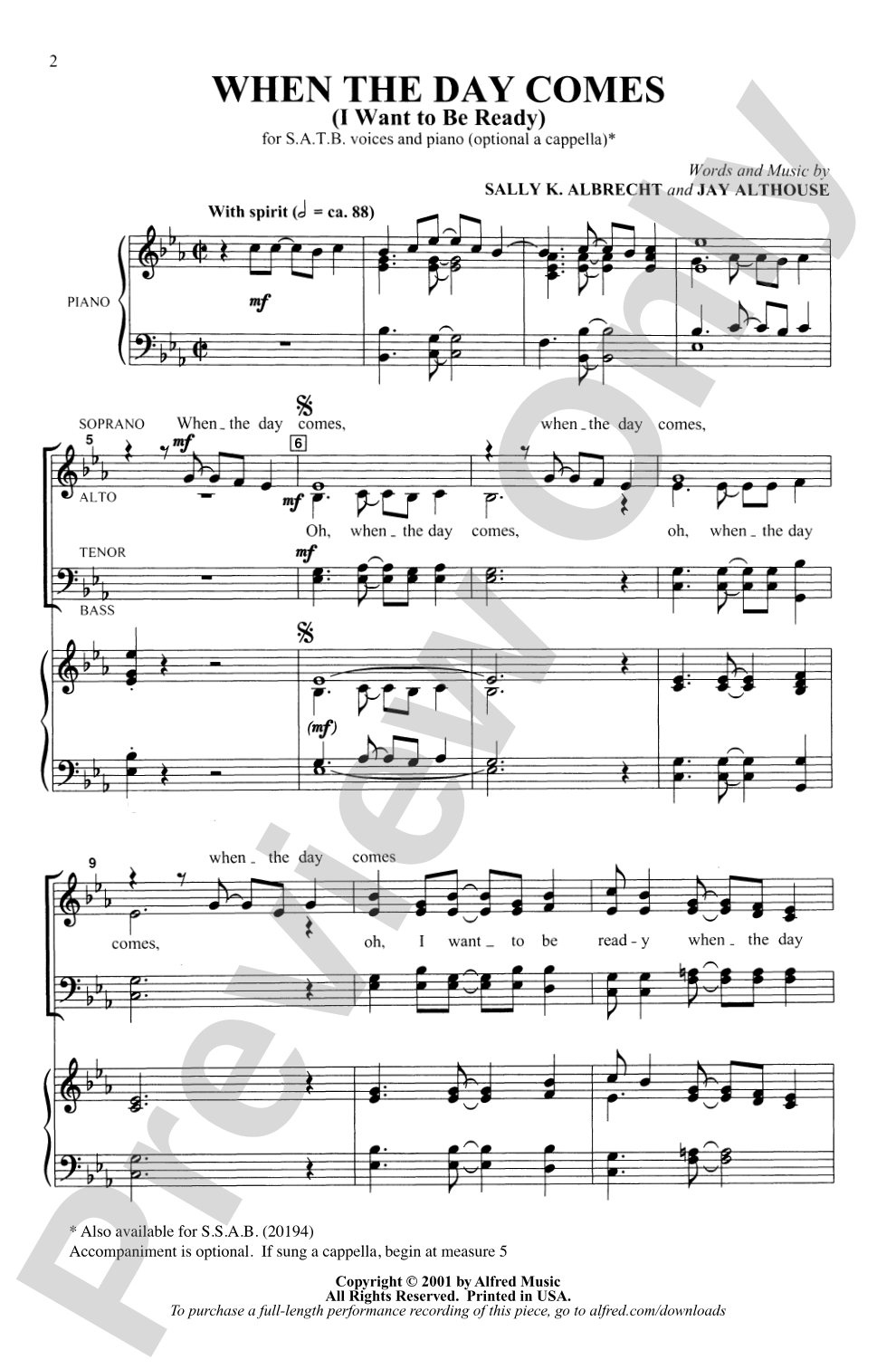
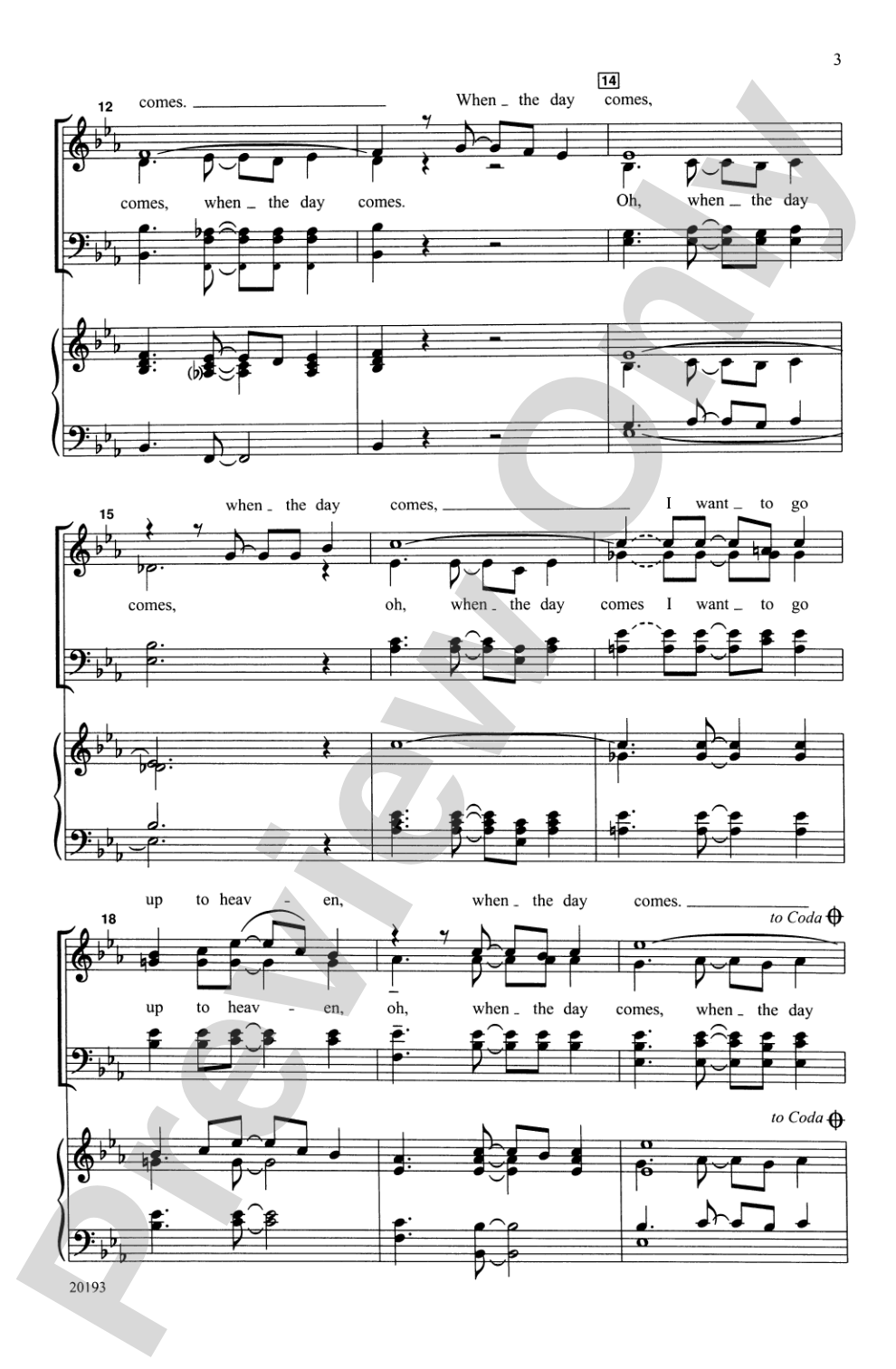
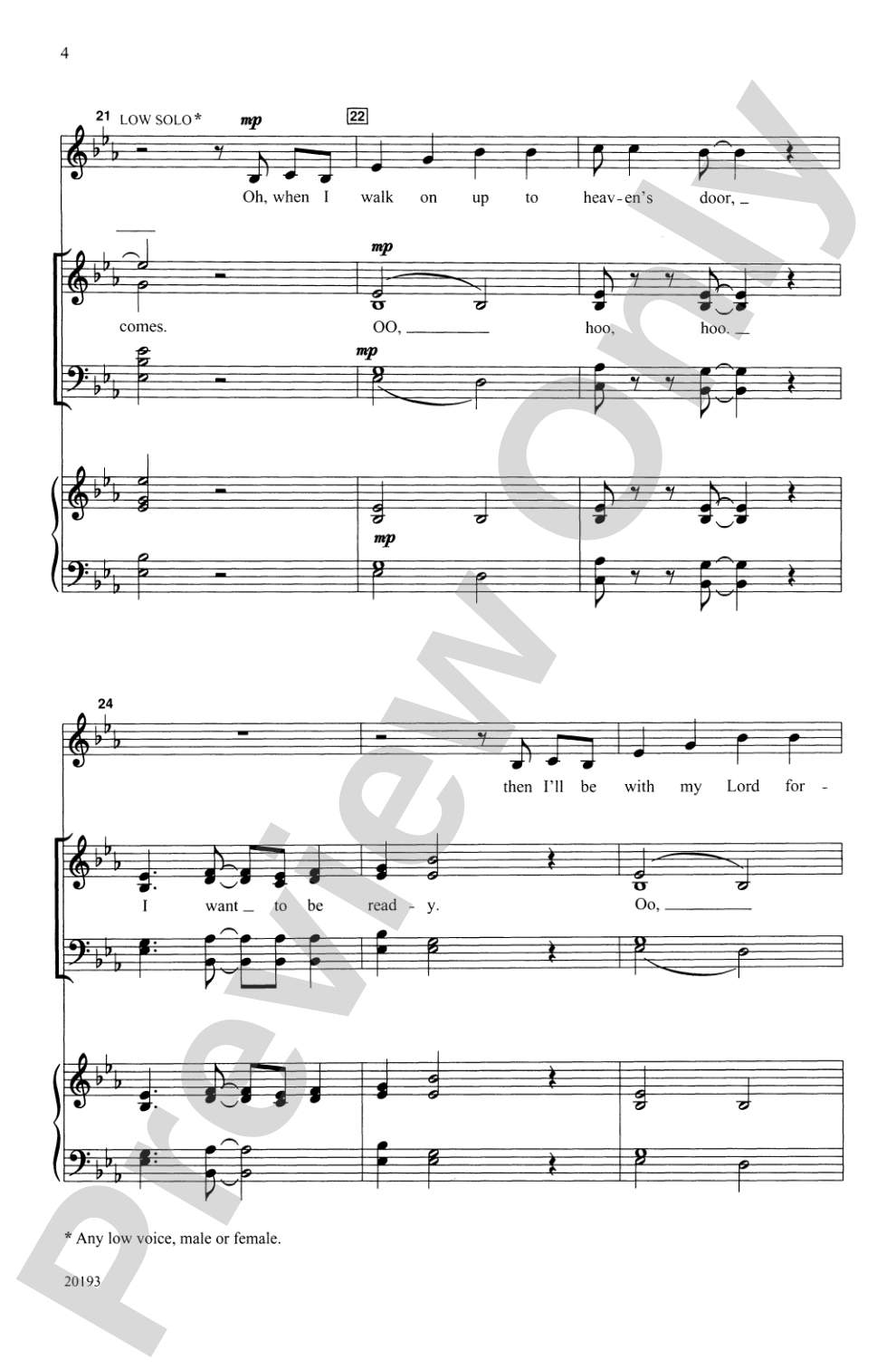
It's an original spiritual with a touch of the traditional I Want to Be Ready. It's fresh and singable, with solid part writing. And just when you think the exciting original melody is about to end, the arrangement kicks into high gear with an a cappella section featuring the basses and lots of handclaps and, finally, a double-time section which drives to a brilliant finish. Includes two 8-measure solos, one for low voice and one for high voice. Great for showing off your group in contests and adjudications.


When the Day Comes: SATB Choral Octavo isn't in MakeMusic Cloud just yet...but it could be. Let us know you'd like to see it, and you'll help shape what comes next. In the meantime, start a free trial and dive into thousands of interactive titles your students can play along with today.
Request This Title
Tell us you want it.
Start Your Free Trial
Explore everything that's ready to play right now.
Sample Audio
1
Audio File
--:--
0:00
0:00
Sample Video
No sample videos found.
Additional Details
Series:
Alfred Choral Designs
Publisher:
Alfred Music
Page Count:
12
SKU:
00-PO-0006515
More about this title
About the Composer: Sally K. Albrecht
Sally K. Albrecht has shaped American choral music for decades as a composer, conductor, and clinician with particular expertise in choral movement. Since 1987, she has received annual ASCAP Special Music Awards and maintains over 600 published choral works alongside 75 full-length musicals and songbooks. She has led honor choirs at major venues including Lincoln Center, Carnegie Hall, and The Kennedy Center, and spent more than thirty years directing choral, vocal, and elementary publications for major educational music publishers, most recently Alfred Music.
Albrecht holds degrees from Rollins College (B.A., Music and Theater, 1976), the University of Miami (M.A. in Drama, 1977; M.M. in Accompanying, 1979), and has taught at Oakland University, Jersey City State College, and Meredith College. A Cleveland native, she currently resides in North Carolina with her husband, composer and arranger Jay Althouse. She is a recipient of the Omicron Delta Kappa "Pillar of Leadership" award and earned Distinguished Alumna recognition from both the University of Miami Frost School of Music and Rollins College in 2021.
Why we love this
Albrecht and Althouse strike an uncommon balance here: the piece opens with a fresh, singable melody rooted in spiritual tradition, yet refuses to settle for conventional. The a cappella bass moment with handclaps and the explosive double-time finale transform what could be a straightforward spiritual into a genuine crowd-pleaser. Two separate solo opportunities mean you can feature your strongest singers without leaving anyone out.
What to expect
The piece unfolds like a conversation between tradition and innovation. It begins warm and grounded in spiritual language, then builds into an irresistible surge of energy, complete with the physicality of handclaps and the propulsion of double-time sections. By the end, your choir feels like it has traveled somewhere meaningful together.
Who it's for
SATB choirs looking for a spiritual arrangement that combines accessibility with genuine excitement. Works especially well for groups preparing for competitions or adjudications where you need a piece that sounds confident and cohesive while still showcasing individual singers.
How to get the most out of it
- Build the dynamic trajectory from the opening statement through the traditional section so the a cappella bass entrance lands with real impact; this pivot is the piece's turning point.
- Establish a clear rhythmic pocket in the handclap section before the double-time section begins; lock the ensemble's sense of pulse so the acceleration feels controlled rather than chaotic.
- Balance the solos so each voice type gets full resonance; the low voice solo and high voice solo are distinct moments, so give singers space to breathe and project without pushing.
- Shape the final double-time section with building intensity in the accompaniment parts; this is your brilliant finish, so let the sopranos shine while the lower voices drive underneath.
How to use it
Program this as your statement piece in a festival or adjudication setting where you want to demonstrate both musicianship and ensemble confidence. It also works as a powerful closer to a concert program featuring sacred music, providing a high-energy send-off that leaves the audience energized. The solo features give you flexibility to showcase singers at different points in your rehearsal calendar.
Skills your students will build
- Balancing traditional spiritual style with contemporary arrangement techniques
- Sustaining focus through contrasting sections (lyrical opening, a cappella interlude, accelerated finale)
- Executing rhythmic precision in handclap-driven passages
- Managing tempo relationships, particularly the transition into and through double-time material
- Blending solo and ensemble writing across all voice parts