

Weep You No More, Sad Fountains: 3-Part Mixed Choral Octavo
Words and music by John Dowland / ed. Russell Robinson
Item: 00-PO-0000508
$1.75
Minimum order quantity: 20 copies
Pickup currently not available
Description
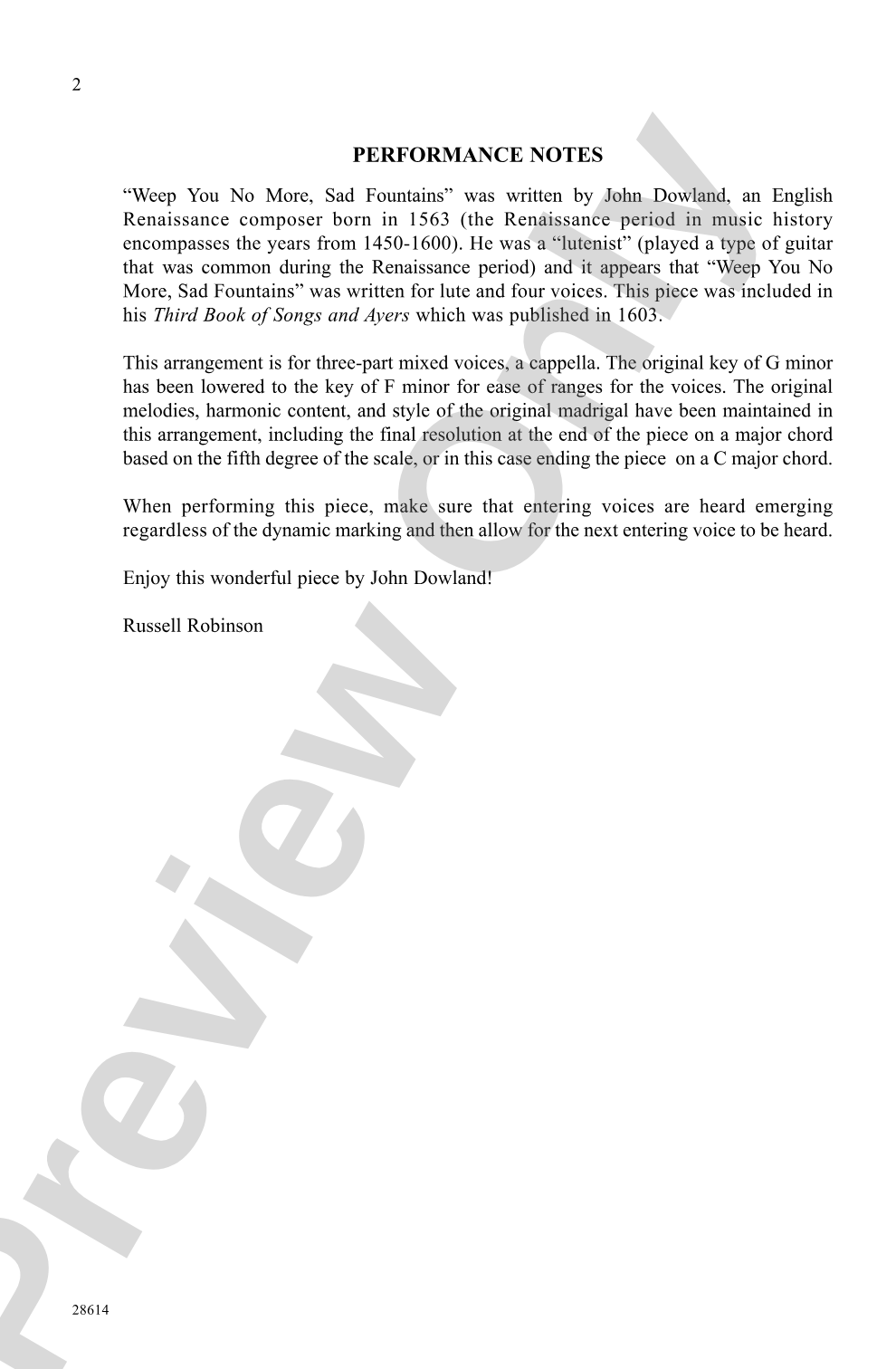
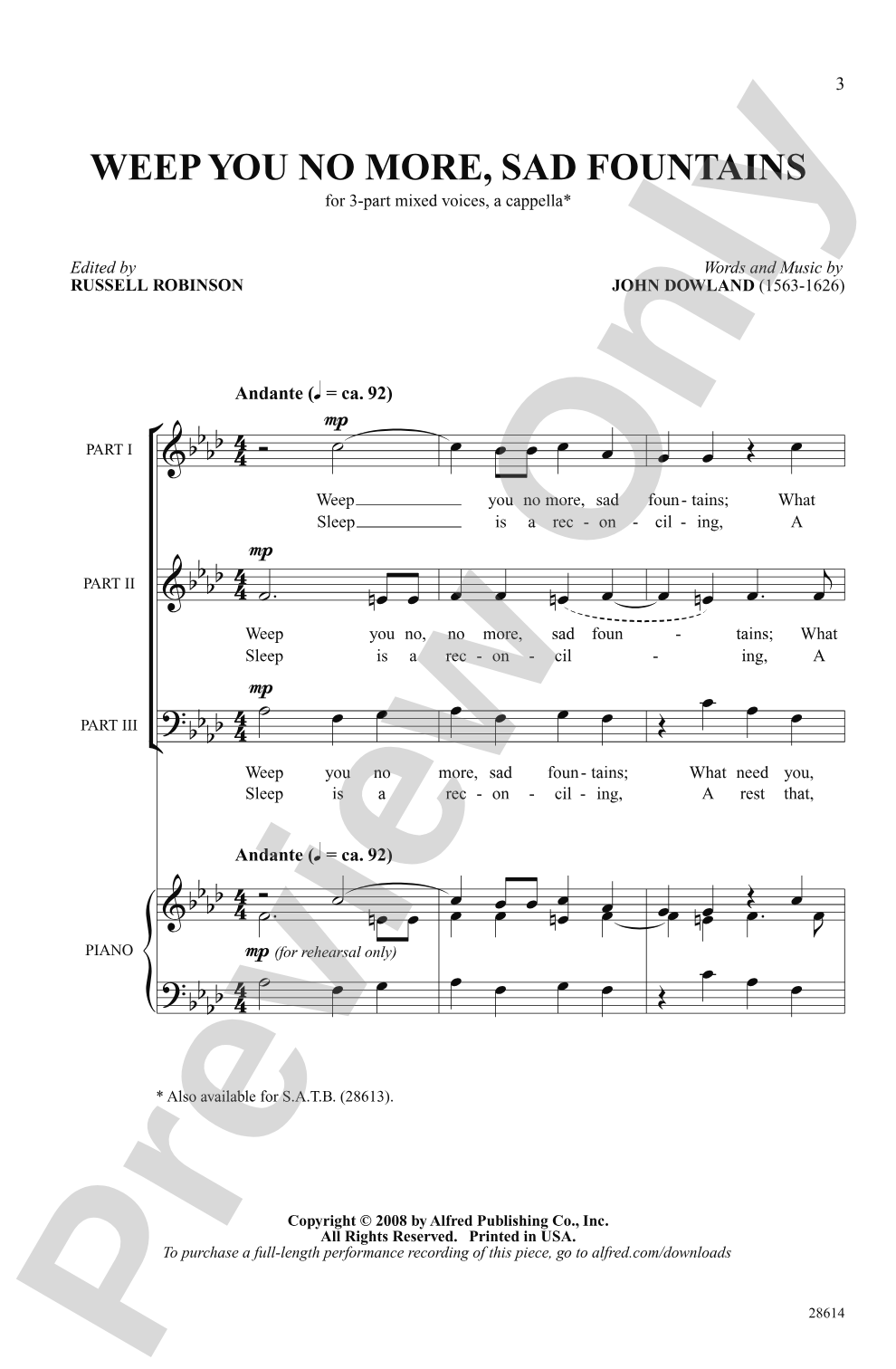
First published in 1603, this quintessential John Dowland madrigal has been newly edited by Russell Robinson. SATB and 3-part mixed choirs will enjoy the lush texture and rich harmonic structure, which exemplifies music of the Renaissance era, and appreciate the high quality of Dr. Robinson's tidy edition. Solid choral repertoire.


Weep You No More, Sad Fountains: 3-Part Mixed Choral Octavo isn't in MakeMusic Cloud just yet...but it could be. Let us know you'd like to see it, and you'll help shape what comes next. In the meantime, start a free trial and dive into thousands of interactive titles your students can play along with today.
Request This Title
Tell us you want it.
Start Your Free Trial
Explore everything that's ready to play right now.
Sample Audio
1
Audio File
--:--
0:00
0:00
Sample Video
No sample videos found.
Additional Details
Series:
Alfred Choral Designs
Publisher:
Alfred Music
Page Count:
8
SKU:
00-PO-0000508
More about this title
About the Composer: John Dowland
John Dowland (1562-1626) stands as one of the Renaissance's finest composers of vocal music and lute works. His career took him across Europe's major musical centers, including Italy, France, Germany, and Denmark, where he absorbed and synthesized the sophisticated harmonic language that distinguishes his madrigals and songs. Dowland's gift for text painting and emotional depth made him one of the most published composers of his era, and his works remain central to understanding how the madrigal developed in Northern Europe.
For choral directors, Dowland's music offers an accessible entry point into Renaissance polyphony without sacrificing harmonic richness or expressive power. His melodic lines sing naturally, and his harmonic progressions reward singers who listen carefully to one another.
Why we love this
This piece showcases the madrigal at its most accessible without becoming simplistic. Robinson's editing strips away editorial excess while preserving Dowland's voice, making rehearsal efficient and the music itself the focus. The harmonic language feels immediate and modern to singers, yet unmistakably Renaissance in character, creating a satisfying bridge between periods for mixed choirs.
What to expect
The piece unfolds with the intimate quality characteristic of the madrigal, where close attention to text and harmony creates emotional resonance rather than grandeur. Dowland's setting of this melancholic poem captures vulnerability and consolation in equal measure, with voices moving in gentle counterpoint that feels conversational rather than ceremonial.
Who it's for
Choirs with secure musicianship and a willingness to engage with Renaissance harmonic language will find this piece both rewarding and achievable. It works well for intermediate to advanced mixed choirs seeking repertoire beyond the familiar, and for singers developing their understanding of madrigal style and period-appropriate phrasing.
How to get the most out of it
- Shape each phrase as a complete thought rather than rushing to cadences. The text will guide your phrasing naturally if you let it.
- Balance the part writing carefully during ensemble sections so that no single voice overwhelms the others. The beauty lies in how voices interlock.
- Take time with any held notes or suspensions to let the harmonic tension speak before resolution. These moments anchor the emotional arc.
- Encourage singers to hear the text painting Dowland embedded in the music, particularly around key words. This awareness deepens interpretation without requiring stylistic affectation.
How to use it
Program this alongside other Renaissance secular music to create a cohesive concert section, or pair it with contemporary settings of similar texts to explore how composers approach the same emotional terrain. Its modest scale makes it suitable for a recital that emphasizes vocal color and textual clarity rather than spectacle.
Skills your students will build
- Interpreting text in Renaissance harmonic contexts
- Balancing multiple vocal lines in close counterpoint
- Responding to harmonic tension and resolution through singing
- Maintaining independence within mixed ensembles while listening actively to surrounding voices
- Sustaining long phrases with natural phrasing architecture rather than written breath marks