
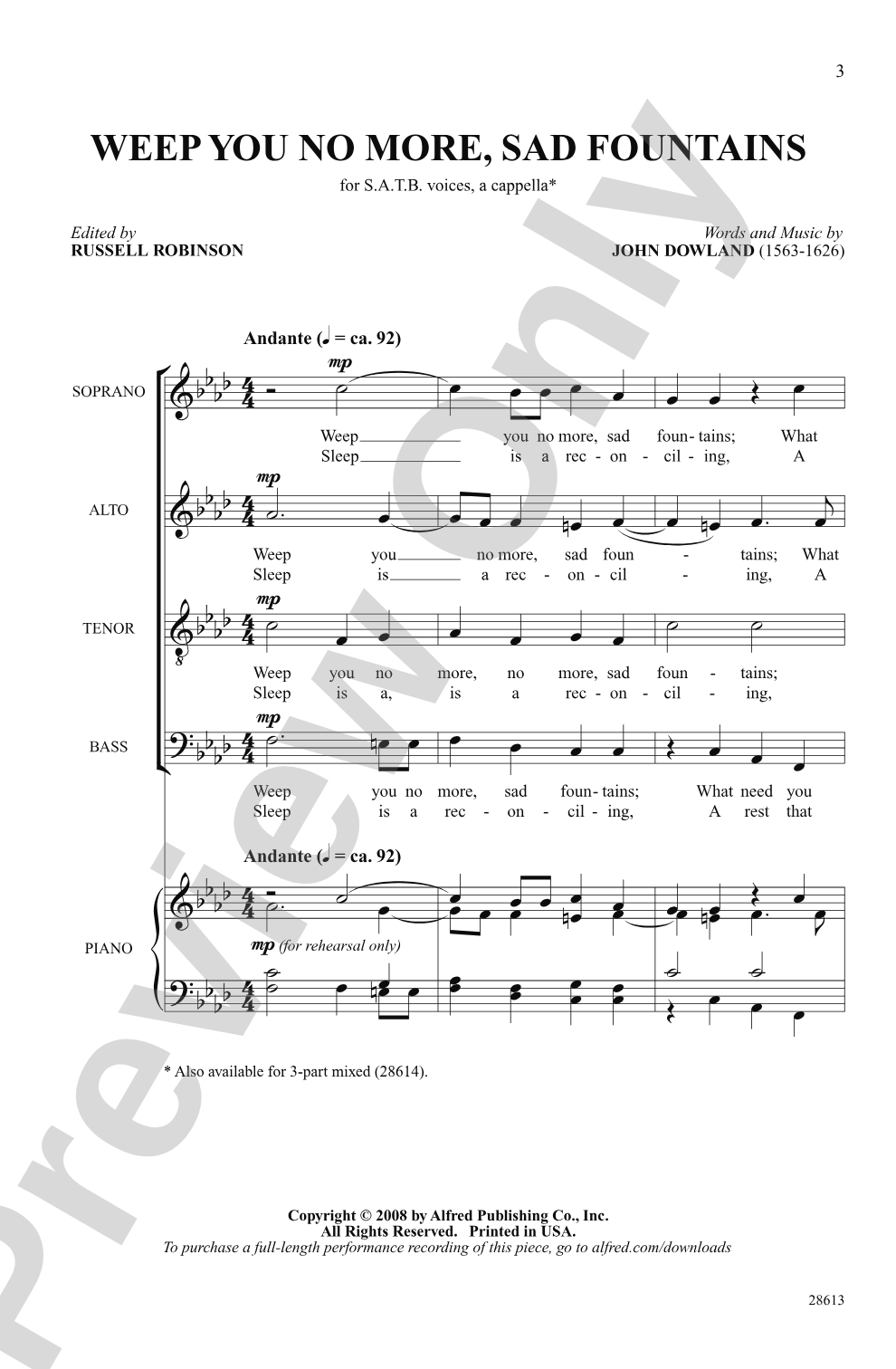

Weep You No More, Sad Fountains: SATB Choral Octavo
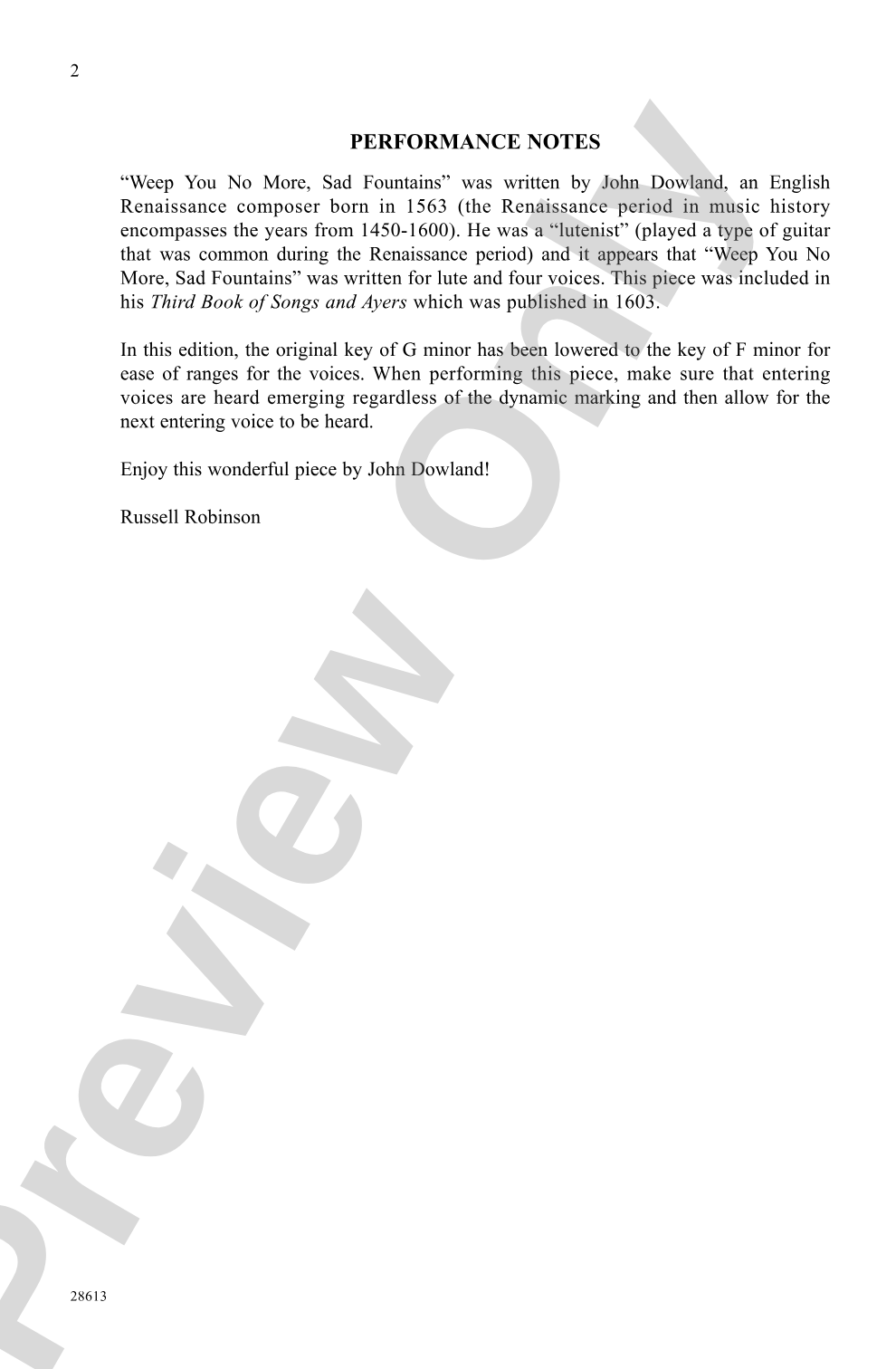
Words and music by John Dowland / ed. Russell Robinson
Item: 00-PO-0000507
$1.75
Minimum order quantity: 20 copies
Pickup currently not available
Description
First published in 1603, this quintessential John Dowland madrigal has been newly edited by Russell Robinson. SATB and 3-part mixed choirs will enjoy the lush texture and rich harmonic structure, which exemplifies music of the Renaissance era, and appreciate the high quality of Dr. Robinson's tidy edition. Solid choral repertoire.


Weep You No More, Sad Fountains: SATB Choral Octavo isn't in MakeMusic Cloud just yet...but it could be. Let us know you'd like to see it, and you'll help shape what comes next. In the meantime, start a free trial and dive into thousands of interactive titles your students can play along with today.
Request This Title
Tell us you want it.
Start Your Free Trial
Explore everything that's ready to play right now.
Sample Audio
1
Audio File
--:--
0:00
0:00
Sample Video
No sample videos found.
Additional Details
Series:
Alfred Choral Designs
Publisher:
Alfred Music
Page Count:
8
SKU:
00-PO-0000507
More about this title
About the Composer: John Dowland
John Dowland (1563-1626) stands as one of the Renaissance's most celebrated lutenists and composers. His output spans instrumental works for the lute alongside vocal music that reveals his gift for expressive melody and harmonic sophistication. Though he spent much of his career abroad seeking stable patronage, Dowland's influence on English musical culture proved lasting and profound.
For choral directors, Dowland matters because his madrigals occupy a crucial position in the repertoire: they bridge the intricate polyphony of earlier Renaissance masters and the more homophonic textures that would define Baroque music. His secular vocal works remain wonderfully singable while demanding genuine musicianship from performers.
Why we love this
Russell Robinson's edition brings clarity and accessibility to one of Dowland's most affecting madrigals without flattening its character. The harmonic language feels modern enough to engage contemporary choirs while remaining thoroughly authentic to the period, making this an ideal entry point for singers discovering Renaissance secular music.
What to expect
Dowland's setting opens into a world of melancholy beauty and gentle resignation. The text paints an image of weeping fountains, and the music responds with sinuous counterpoint and unexpected harmonic turns that seem to capture sorrow not through agitation but through a kind of resigned, eloquent acceptance.
Who it's for
This octavo suits SATB choirs and mixed ensembles at the intermediate level and above. Singers need secure musicianship and comfort with Renaissance notation and harmonic language, making it ideal for high school advanced choirs, college ensembles, and adult community choirs.
How to get the most out of it
- Shape the text carefully across the extended melismas. Let the words breathe and inform your phrasing rather than rushing through passage work.
- Balance the four voices so that no single line dominates; the real artistry emerges in how the parts interweave and support one another.
- Approach the piece with restraint in dynamics. Renaissance madrigals gain expressive power through subtle shaping and careful voice leading rather than dramatic contrasts.
- Give attention to the underlay and consonant placement. Robinson's edition marks these clearly, and honoring them keeps the text intelligible across the entire choir.
How to use it
Program this as a thoughtful centerpiece for a concert devoted to Renaissance secular music, or pair it with other Dowland madrigals to showcase the composer's range. The piece also works exceptionally well in themed programs exploring grief, loss, or the evolution of English vocal music across the centuries.
Skills your students will build
- Reading and performing Renaissance clefs and notation
- Balancing four-part polyphony with equal clarity across all voices
- Interpreting text underlay and making interpretive choices about consonant placement
- Singing with accurate intonation in complex harmonic contexts
- Shaping longer melodic lines and managing text across melismatic passages