
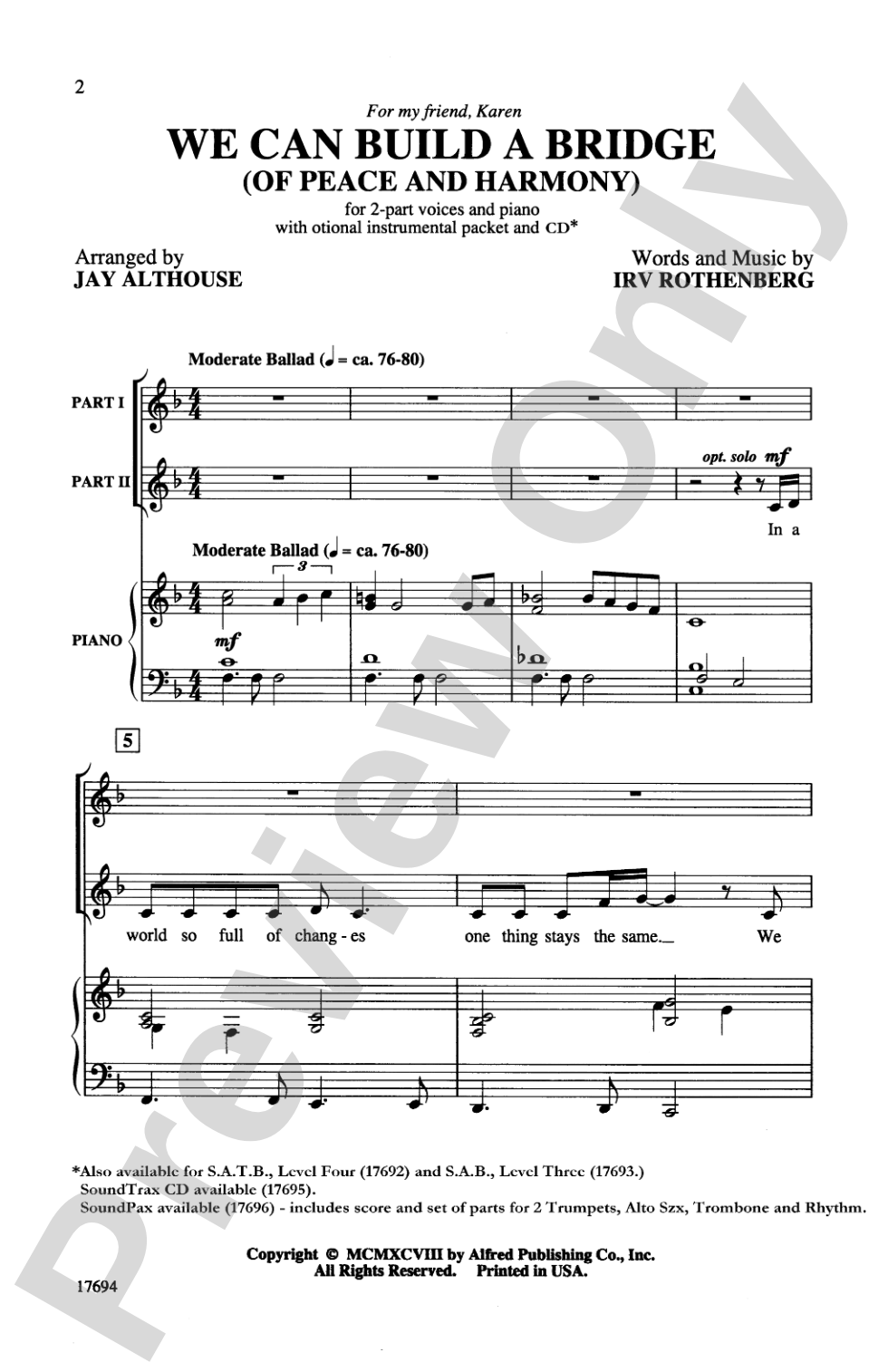
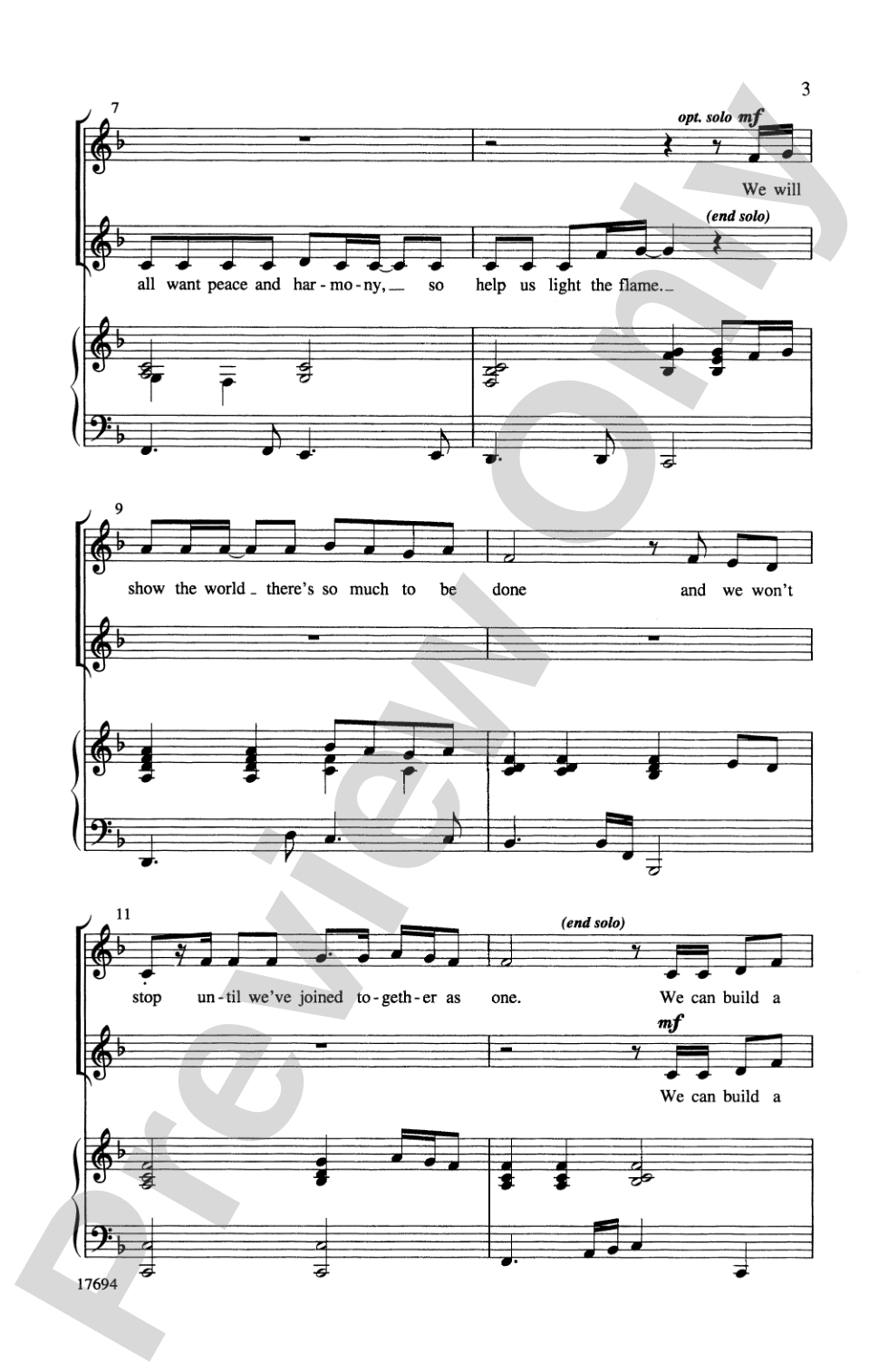

We Can Build a Bridge (of Peace and Harmony): 2-Part Choral Octavo
Music by Jay Althouse and Irv Rothenberg
Item: 00-PO-0002858
$2.25
Minimum order quantity: 20 copies
Pickup currently not available
Description
Outstanding ballad of peace and brotherhood: if we all work together we can build a bridge of peace and harmony. A quick-learn piece for general use, graduation.


We Can Build a Bridge (of Peace and Harmony): 2-Part Choral Octavo isn't in MakeMusic Cloud just yet...but it could be. Let us know you'd like to see it, and you'll help shape what comes next. In the meantime, start a free trial and dive into thousands of interactive titles your students can play along with today.
Request This Title
Tell us you want it.
Start Your Free Trial
Explore everything that's ready to play right now.
Sample Audio
1
Audio File
--:--
0:00
0:00
Sample Video
No sample videos found.
Additional Details
Series:
Alfred Archive Edition: Alfred Choral Designs
Publisher:
Alfred Music
Page Count:
12
SKU:
00-PO-0002858
More about this title
About the Composer: Jay Althouse

Jay Althouse studied music education and music at Indiana University of Pennsylvania, where he later received the Distinguished Alumni award. His background in educational music publishing informed eight years of work administering rights and licenses for a major publisher, during which he served on the Executive Board of the Music Publishers Association of America.
As a composer, Althouse has created more than 800 choral works performed across the English-speaking world. He is an ASCAP member and regular recipient of the ASCAP Special Award. His output spans children's musicals (co-written with Sally K. Albrecht), curated vocal collections including Folk Songs for Solo Singers, pedagogical books such as The Complete Choral Warm-up Book and Accent on Composers, and classroom resources like Ready to Read Music and One-Page Composer Bios. Althouse co-wrote I Hear America Singing, performed by the San Francisco Girls and Boys Choirs at President Obama's 2009 Inauguration, and has served on the boards of the North Carolina Master Chorale and the Folk Art Society of America.
Why we love this
This piece delivers a message of unity and collective action without sacrificing musicality or sophistication. The two-part voicing makes it accessible for developing choirs while the emotional weight of the text and melody ensures it lands powerfully in performance, making it equally at home at a graduation ceremony or a community service project.
What to expect
Hopeful and affirming, with a straightforward melody that sits naturally in the voice. The piece builds quietly toward a message of shared responsibility and common purpose, creating a moment of genuine connection between singers and audience.
Who it's for
Choirs at all levels, especially those preparing for graduation ceremonies or peace-themed concerts. The quick-learn arrangement makes it ideal for spring performances when rehearsal time is compressed, and the straightforward two-part writing welcomes developing singers without talking down to more experienced ensembles.
How to get the most out of it
- Balance the harmonic movement between parts by asking singers to listen across rather than into their own line; this creates the sense of dialogue the text suggests.
- Shape the melody through the bridge sections with careful attention to breath placement so the arc of the message comes through clearly.
- Use the recorded accompaniment during rehearsals to establish the harmonic context early, then gradually reduce dependence on it as sectional confidence builds.
- Encourage singers to connect emotionally with the imagery of bridge-building; this internal engagement will translate to genuine expression rather than performance mechanics.
How to use it
Anchor a graduation concert finale with this piece, positioning it as a send-off that speaks to the year's themes of cooperation and growth. It also fits naturally into Earth Day or community service programming, or as a bridge between more dramatic or complex repertoire to create an accessible moment of reflection.
Skills your students will build
- Singing sustained harmonic progressions with clear intonation
- Phrasing a simple melody to support textual meaning
- Blending two-part voices in balance
- Connecting emotional intent to vocal expression