
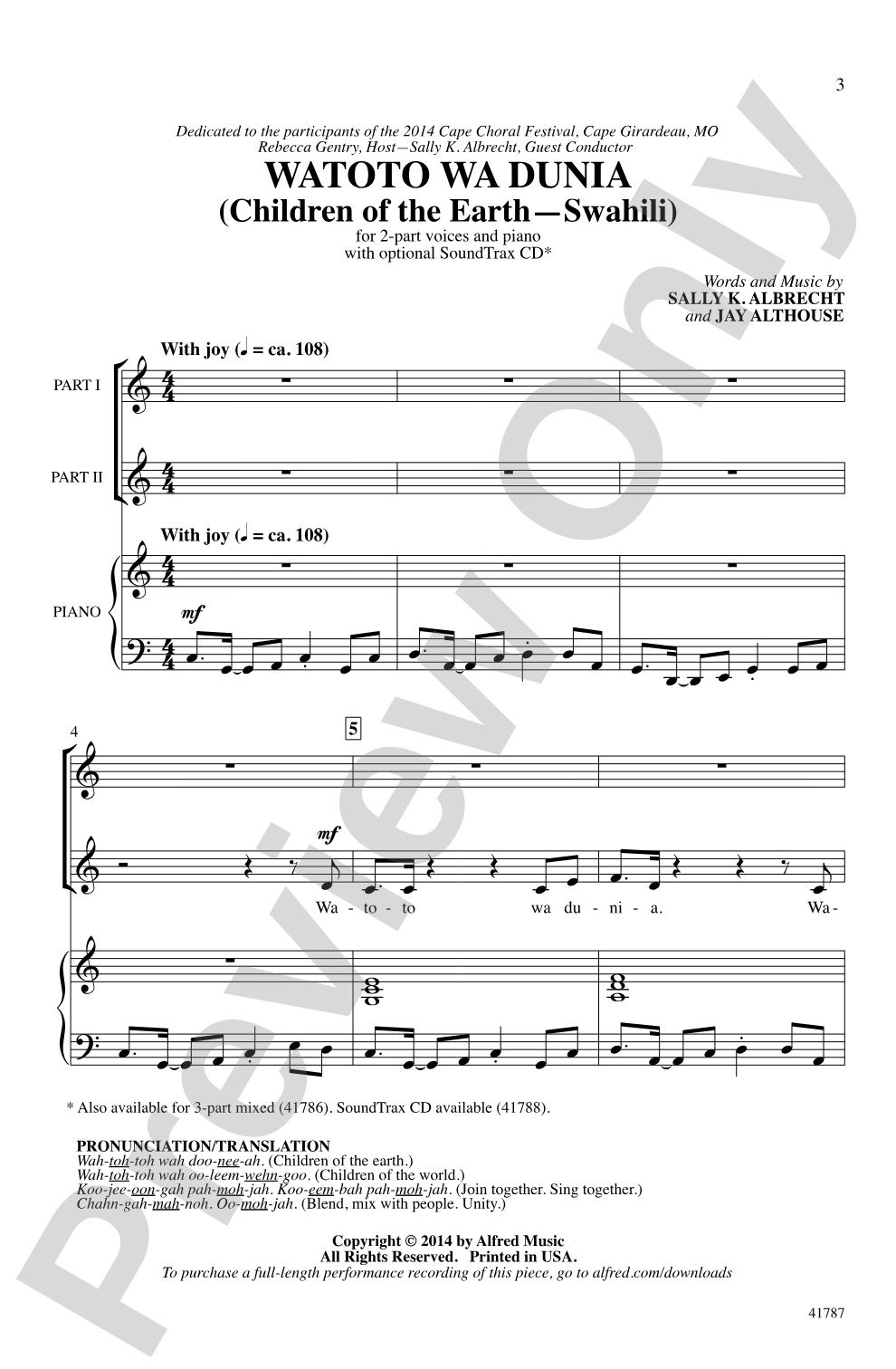
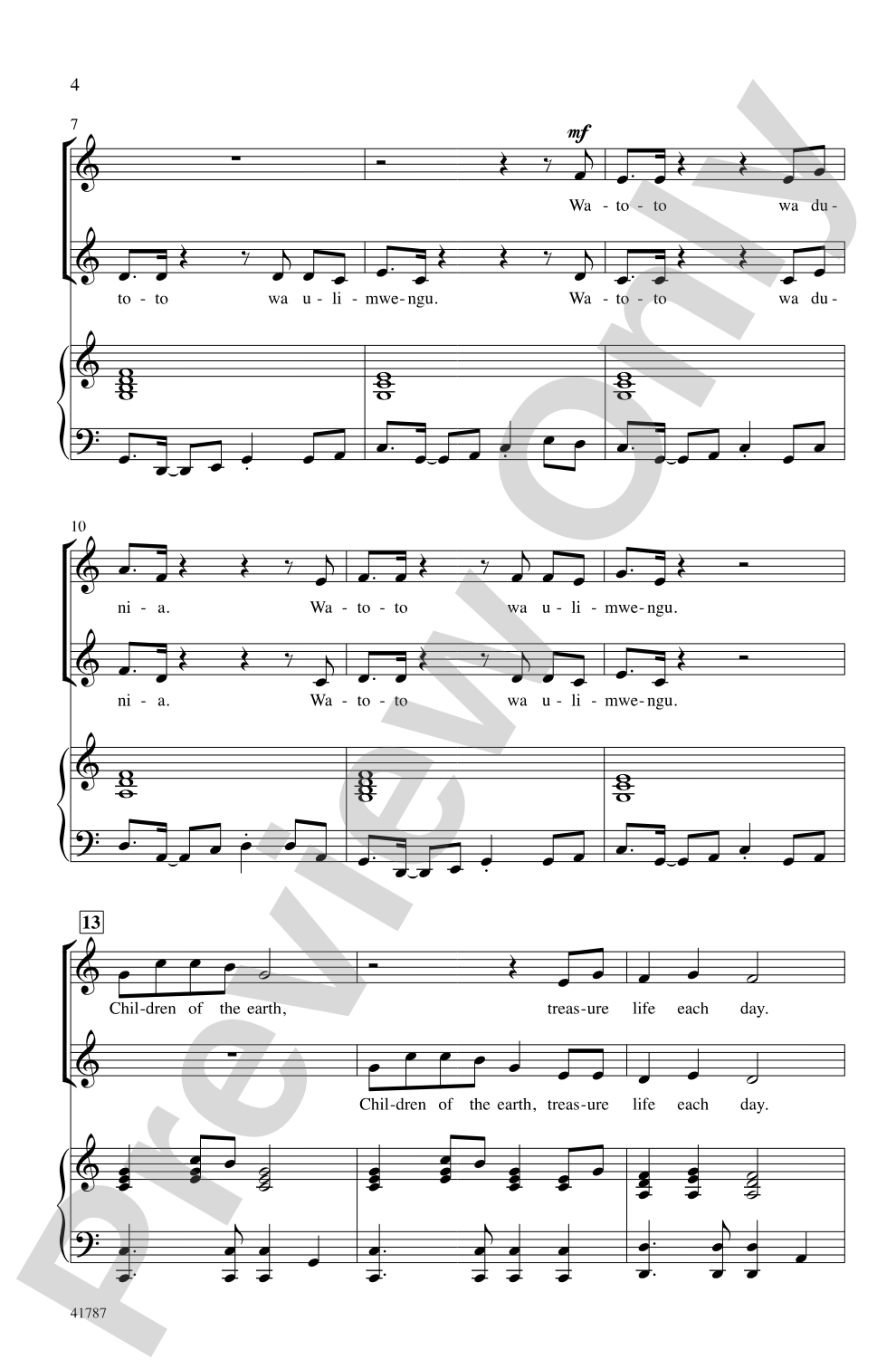

Watoto Wa Dunia (Children of the Earth -- Swahili): 2-Part Choral Octavo
(Children of the Earth -- Swahili)
Words and music by Sally K. Albrecht and Jay Althouse
Item: 00-PO-0001907
$1.85
Minimum order quantity: 20 copies
Pickup currently not available
Related Items
Watoto Wa Dunia: SoundTrax Digital Audio Download |
$27.99
|
View | |
Watoto Wa Dunia (Children of the Earth -- Swahili): 3-Part Mixed Choral Octavo |
$1.85
|
View | |
Watoto Wa Dunia: 3-Part Mixed Choral Octavo |
$1.85
|
View | |
Watoto Wa Dunia: 2-Part Choral Octavo |
$1.85
|
View | |
Watoto Wa Dunia: Choral Octavo SoundTrax CD |
$27.99
|
View |
Description
This fun feature for 2- and 3-part choirs includes Swahili and English lyrics, rhythmic chanting, accented body percussion, and many call and response phrases. Layered African instruments energize the SoundTrax CD and Sally's easy-to-teach choreography (available on Lights!) is spot on.


Watoto Wa Dunia (Children of the Earth -- Swahili): 2-Part Choral Octavo isn't in MakeMusic Cloud just yet...but it could be. Let us know you'd like to see it, and you'll help shape what comes next. In the meantime, start a free trial and dive into thousands of interactive titles your students can play along with today.
Request This Title
Tell us you want it.
Start Your Free Trial
Explore everything that's ready to play right now.
Sample Audio
1
Audio File
--:--
0:00
0:00
Sample Video
No sample videos found.
Additional Details
Series:
Alfred Choral Designs
Publisher:
Alfred Music
Page Count:
12
SKU:
00-PO-0001907
More about this title
About the Composer: Sally K. Albrecht
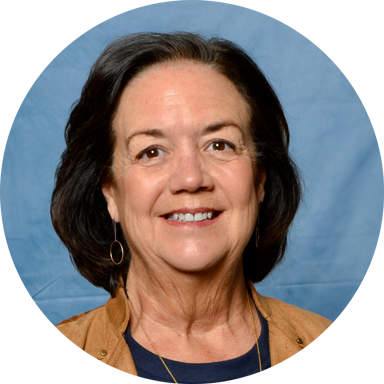
Sally K. Albrecht brings three decades of experience as a choral composer, conductor, and clinician to her work in music education. Recognized annually by ASCAP since 1987 for her contributions to music, she has amassed over 600 published choral works and 75 larger musicals and songbooks while serving as Director of School Choral, Vocal, and Elementary Publications for major educational music publishers. Her conducting has taken her to honor choir events nationwide, including prestigious venues such as Lincoln Center, Carnegie Hall, and The Kennedy Center.
Albrecht's particular expertise lies in choral movement and staging, a hallmark of her compositional voice. She earned her B.A. in Music and Theater from Rollins College, followed by an M.A. in Drama and an M.M. in Accompanying from the University of Miami. A recipient of the Distinguished Alumna Award from both institutions and the Omicron Delta Kappa "Pillar of Leadership" award, Albrecht continues to influence choral music education from her home in North Carolina, where she collaborates with composer and arranger Jay Althouse.
Why we love this
Albrecht and Althouse have crafted a piece that genuinely excites middle school choirs without oversimplifying the musical or cultural content. The blend of Swahili and English text, body percussion, and call-and-response patterns creates multiple entry points for singers at different skill levels while keeping the energy infectious. The choreography notation paired with layered African instrumentation on the accompaniment gives you an immediate blueprint for staging, which is rare at this level.
What to expect
From the opening call, this piece radiates joy and cultural authenticity. The rhythmic chanting and body percussion create a tactile, communal energy that draws singers into active participation rather than passive performance. African instruments weave throughout, lending warmth and textural richness that feels celebratory without being superficial.
Who it's for
This octavo works well for developing 2- and 3-part choirs in middle or early high school settings who are ready to engage with world music and movement without extensive choreographic training. It's equally at home in elementary programs where older students can lead and model the material for younger singers.
How to get the most out of it
- Establish the rhythmic foundation first by isolating the body percussion patterns in isolation before combining them with singing. This ensures the physical elements support rather than distract from the vocal line.
- Pronounce the Swahili text clearly and deliberately during early rehearsals. Work with a pronunciation guide to ensure authentic vowel sounds and consonant clarity before layering in the choreography.
- Use the recorded accompaniment as your rehearsal anchor, but encourage singers to listen for the African instruments so they understand which textures support each section and can adjust their dynamic accordingly.
- Balance the call and response exchanges so that the responding sections feel grounded and intentional, not rushed. The effectiveness of this structure depends on clear dialogue rather than speed.
How to use it
Program this as a concert opener or closing number where its infectious energy and movement will energize an audience and break the fourth wall. It pairs naturally with other world music selections or can anchor a multicultural concert theme. The accessible 2-part voicing also makes it suitable for all-choir moments in larger festivals or spring showcases.
Skills your students will build
- Pronunciation and phrasing in Swahili
- Call and response coordination and listening
- Integration of body percussion with vocal lines
- Rhythmic precision in syncopated patterns
- Dynamic control in layered textures
- Cultural awareness of African musical traditions